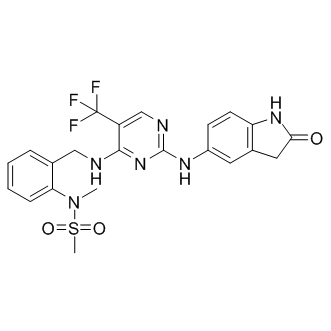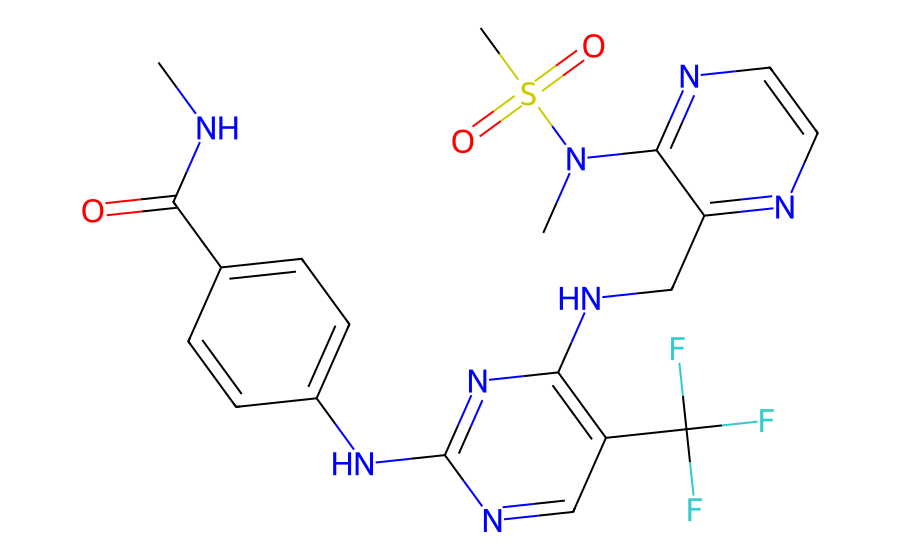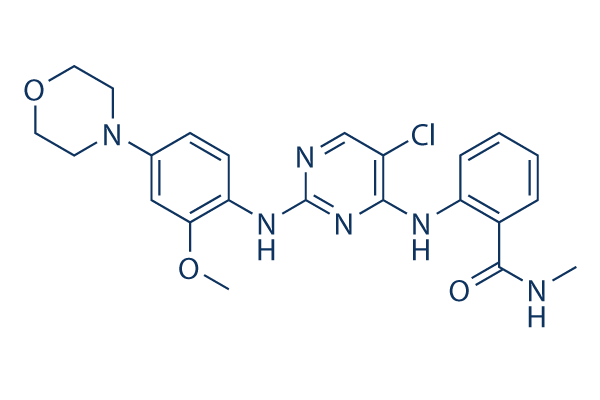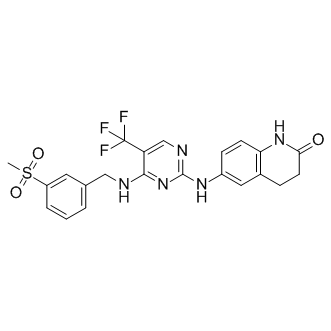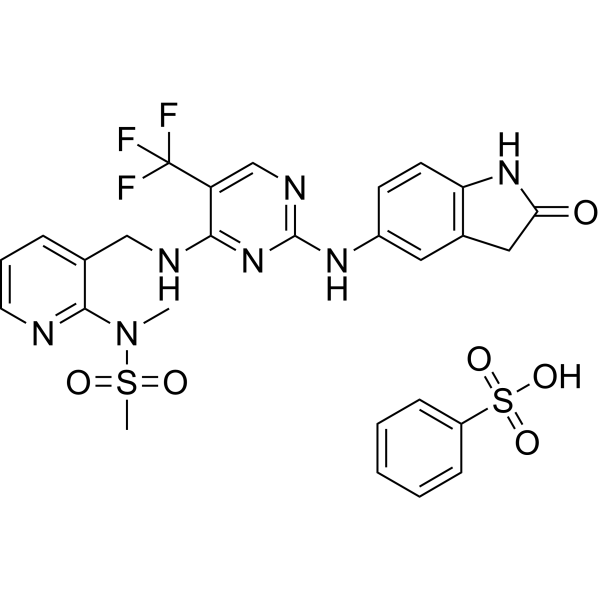
Biological Activity
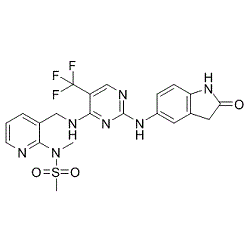
PND-1186 is a potent and reversible inhibitor of FAK with an IC50 of 1.5 nM in cell assay.
In Vitro
Using the recombinant FAK kinase domain as a glutathione-S-transferase (GST) fusion protein in an in vitro kinase assay, PND-1186 inhibits FAK activity with IC50 of 1.5 nM. PND-1186 has an IC50 of ~100 nM in breast carcinoma cells as determined by anti-phospho-specific immunoblotting to FAK Tyr-397. Whereas 1.0 µM PND-1186 (>5-fold above IC50) has limited effects on cell proliferation, under non-adherent conditions or when grown as spheroids or colonies in soft agar, 0.1 µM PND-1186 blocks FAK and p130Cas tyrosine phosphorylation, promotes caspase-3 activation, and triggers cell apoptosis. PND-1186 inhibits 4T1 breast carcinoma subcutaneous tumor growth correlated with elevated tumor cell apoptosis and caspase 3 activation[1].
In Vivo
100 mg/kg PND-1186 treatment significantly reduces final 4T1 tumor weight 2-fold (n=8, p<0.05) whereas 30 mg/kg PND-1186 slightly reduces final tumor weight but is not significantly different compare to control (n=8, p>0.05). Both 30 and 100 mg/kg administration of PND-1186 significantly increases tumor TUNEL staining compare to vehicle-treated controls. As elevated cleaved caspase-3 staining is also found in the tumors of PND-1186-treated mice[1]. PND-1186 displays a multi-exponential decay with a terminal half life (t1/2) of 1.72 hours after i.v. injection. Following i.p. and p.o. dosing, PND-1186 is rapidly absorbed with terminal half lives (t1/2) of 2.15 to 2.65 h, and bioavailability (%F) from 14.8 to 42.2%. PND-1186 bioavailability is greater upon intraperitoneal versus oral dosing[2].
References & source
Published experimental findings depend on the model and assay conditions. They do not guarantee equivalent performance in every application. For laboratory research use only.