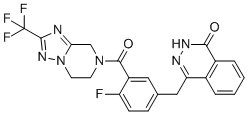
Biological Activity
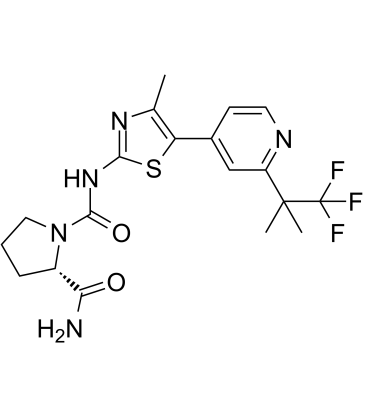
Alpelisib (BYL-719) is a potent and selective PI3Kα inhibitor with an IC50 of 5 nM.
In Vitro
Alpelisib (NVP-BYL719) potently inhibits the 2 most common PIK3CA somatic mutations (H1047R, E545K; IC50~4 nM). Alpelisib (NVP-BYL719) potently inhibits Akt phosphorylation in cells transformed with PI3Kα (IC50=74±15 nM) and shows significant reduced inhibitory activity in PI3Kβ or PI3Kδ isoforms transformed cells (≥15-fold compared with PI3Kα)[2]. Alpelisib (NVP-BYL719) decreases cell proliferation by blocking cell cycle in G0/G1 phase with no outstanding effects on apoptosis cell death in HOS and MOS-J tumor cells. BYL-719 inhibits cell migration and can thus be considered as a cytostatic drug for osteosarcoma. In murine preclinical models of osteosarcoma, Alpelisib (NVP-BYL719) significantly decreases tumor progression and tumor ectopic bone formation as shown by a decrease of Ki67+ cells and tumor vascularization. Alpelisib (NVP-BYL719) rapidly inhibits the levels of P-AKT and P-mTOR in all cell lines assessed, confirming the functional activity of Alpelisib (NVP-BYL719) on osteosarcoma cells. After 72 hr of treatment, Alpelisib (NVP-BYL719) significantly inhibits the cell growth of all osteosarcoma cell lines tested in a dose-dependent manner with an IC50 ranging from 6 to 15 µM and with the IC90 from 24 to 42 µM at 72 hr[3].
In Vivo
Alpelisib (BYL-719) displays excellent oral bioavailability in rats, mice and dogs and does not show any significant inhibition of the CYP450 enzymes[1]. Alpelisib (BYL-719) inhibits tumor growth in pre-clinical murine models of osteosarcoma. C57Bl/6J with MOS-J tumors (n=6 per group) are randomized as controls (vehicle) or Alpelisib (BYL-719) (12.5 mg/kg or 50 mg/kg per day)[3].
References & source
Published experimental findings depend on the model and assay conditions. They do not guarantee equivalent performance in every application. For laboratory research use only.