Biological Activity
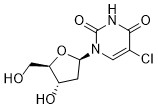
5-Chloro-2'-deoxyuridine, a thymine analog, is to study the potential of hypochlorous acid damage to DNA and DNA precursors.
In Vitro
When 5-Chloro-2’-deoxyuridine (ClDU) is placed into tissue culture medium, mammalian cells incorporate the analog into DNA. It is observed that 10 μM concentration of 5-Chloro-2’-deoxyuridine in the media does not alter cell division kinetics. Previously it has been shown that 5-Chloro-2’-deoxyuridine is metabolized and incorporated into DNA using antibodies that bind selectively to DNA containing halogenated bases. In the studies reported here, 5-Chloro-2’-deoxyuridine is more similar to BrdU in acting as a T analog. The toxicity of 5-Chloro-2’-deoxyuridine could in part be attributed to inhibition of thymidylate synthase[1].
In Vivo
No in vivo data are provided in the current product source. Contact us for further information.
Cell Assay
Human erythroleukemia K-562 cells are used throughout the study. Cells are initially seeded at 1.0×10⁵ cells/mL and treated with either 10 μM 5-Chloro-2’-deoxyuridine or 10 μM thymidine (negative control) for 63 h, or two cell doublings. Cells are counted by trypan blue exclusion, pelleted by centrifugation (500×g) and washed with 10 mL sterile PBS[1].
Animal Administration
Rats[2] Adult, male Wistar rats, weighing 200-250 g are used. Firstly, the animals are allowed to self-administer methamphetamine at a dose of 0.05 mg/kg/injection under a fixed-ratio 1 (FR1) schedule for baseline sessions. After that, the rats are divided into four groups. Two groups of rats (long-access; LgA-4 days (d), LgA-13 d; n=7 per group) are allowed to self-administer 0.05 mg/kg/injection of methamphetamine for 6 h per day, whereas the other groups (short-access; ShA-4 d, ShA-13 d; n=7 per group) are allowed to do so for 1 h per day. All procedures are performed during the dark cycle. On day 5, ShA-4 d and LgA-4 d rats receive one injection of 50 mg/kg 5-chloro-2’-deoxyuridine and survive for 30 min. On day 14, ShA-13 d and LgA-13 d receive one injection of 50 mg/kg 5-Iodo-2’-deoxyuridine followed by 50 mg/kg 5-chloro-2’-deoxyuridine 2 h later. These rats also survive for 30 min after the 5-Chloro-2'-deoxyuridine injection. A parallel group of drug-naive rats (n=6) receive one injection of 50 mg/kg IdU followed by 50 mg/kg 5-Chloro-2'-deoxyuridine 2 h later. These rats also survive for 30 min after the 5-Chloro-2'-deoxyuridine injection[2].
References & source
[1]. Kim CH, et al. Polymerase incorporation and miscoding properties of 5-chlorouracil. Chem Res Toxicol. 2010 Apr 19;23(4):740-8.
[2]. Yuan CJ, et al. Extended access methamphetamine decreases immature neurons in the hippocampus which results from loss and altered development of neural progenitors without altered dynamics of the S-phase of the cell cycle. Pharmacol Biochem Behav. 2011 Nov;100(1):98-108.
Published experimental findings depend on the model and assay conditions. They do not guarantee equivalent performance in every application. For laboratory research use only.