DMA4-H228
DC60856
Recommended because it shares a closely related research category or delivery context. Formulation and performance are product- and study-specific.
View product →
Ionizable lipid for LNP and nucleic-acid delivery research.
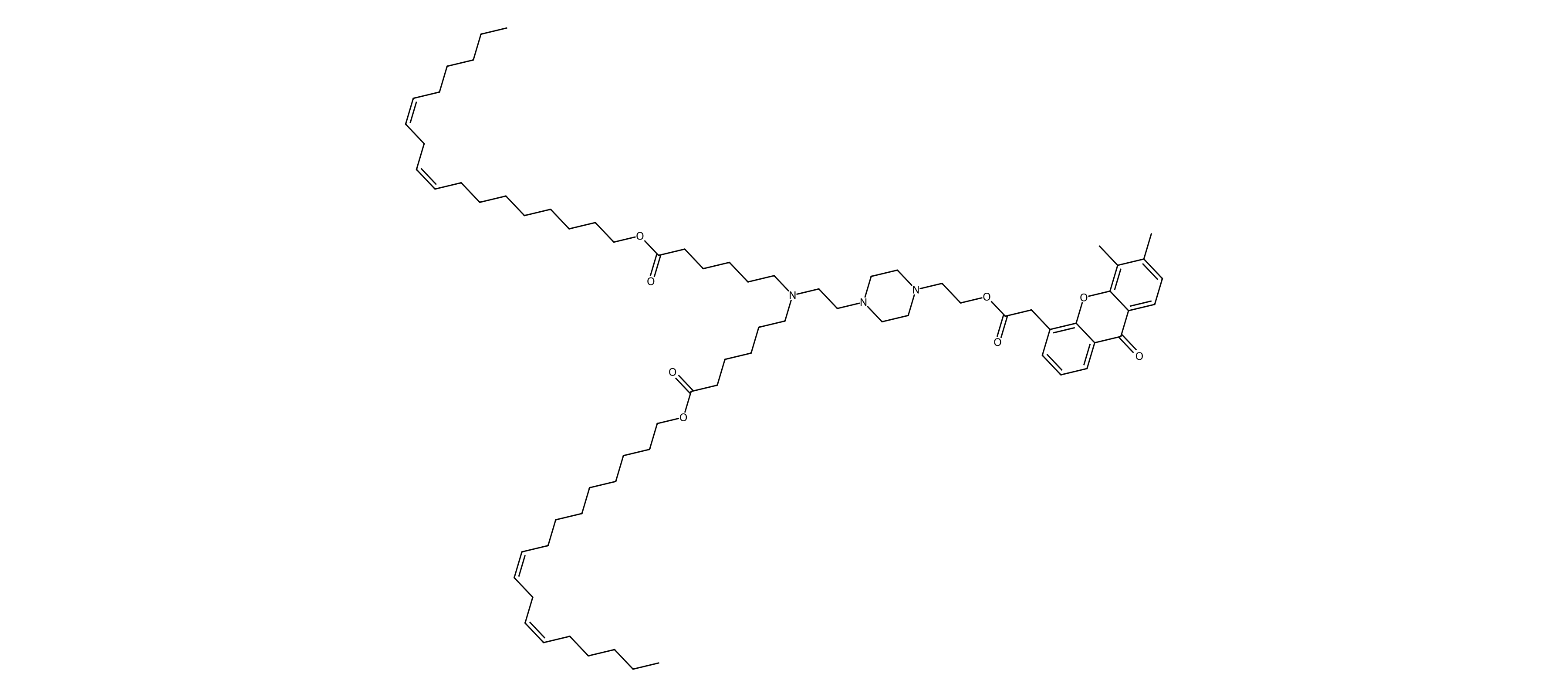
ST12 is a lipid-conjugated DMXAA prodrug designed for temporally controlled STING activation in mRNA vaccine formulations. Its structure integrates a mouse-specific STING agonist, a biodegradable ester linker, an RNA-interacting tertiary amine domain, and two hydrophobic tails. When incorporated as a partial replacement for SM-102, ST12 preserves early antigen mRNA translation and subsequently releases DMXAA to activate STING. This delayed activation supports localized type I interferon signaling, enhanced antigen-specific CD8-positive T-cell responses, and improved antitumor immunity. In preclinical OVA and HPV tumor models, ST12-based Syn-STING vaccines suppressed tumor growth and prolonged survival. ST12 remains a preclinical research lipid developed specifically around DMXAA-sensitive STING systems.
| CAS No. | Not available |
| Chemical Name | ST12 |
| Synonyms | Not available |
| SMILES | Not available |
| Formula | Not available |
| M.Wt | Not available |
| Purity | 98% |
| Storage | Pure form: −20 °C, 1 year; In solvent: −80 °C, 6 months; −20 °C, 1 month. Sealed and protected from light. |
| Shipping condition | Ships from Shanghai. Pure lipid is stable during ice-pack transport. |
| Publication | Qin P, Qin Q, Hao Y, et al. Enhanced antitumor immunity of mRNA vaccines by bioorthogonal-like delayed activation of exogeneous STING. Nature Biotechnology. 2026. |
The product molecular weight is prefilled when available and remains editable. Confirm solvent compatibility and solubility before preparation.
Solvent volumes update from the molecular weight above.
| Mass | 1 mM | 5 mM | 10 mM |
|---|---|---|---|
| 10 mg | Enter molecular weight | Enter molecular weight | Enter molecular weight |
| 25 mg | Enter molecular weight | Enter molecular weight | Enter molecular weight |
| 50 mg | Enter molecular weight | Enter molecular weight | Enter molecular weight |
| 100 mg | Enter molecular weight | Enter molecular weight | Enter molecular weight |
| 250 mg | Enter molecular weight | Enter molecular weight | Enter molecular weight |
Contact our team with the catalog number and requested quantity.