Research-use LNP lipids · Technical support from formulation through scale-up
Home  /  RNA Delivery  /  Lung-targeted lipids  /  TTP-3
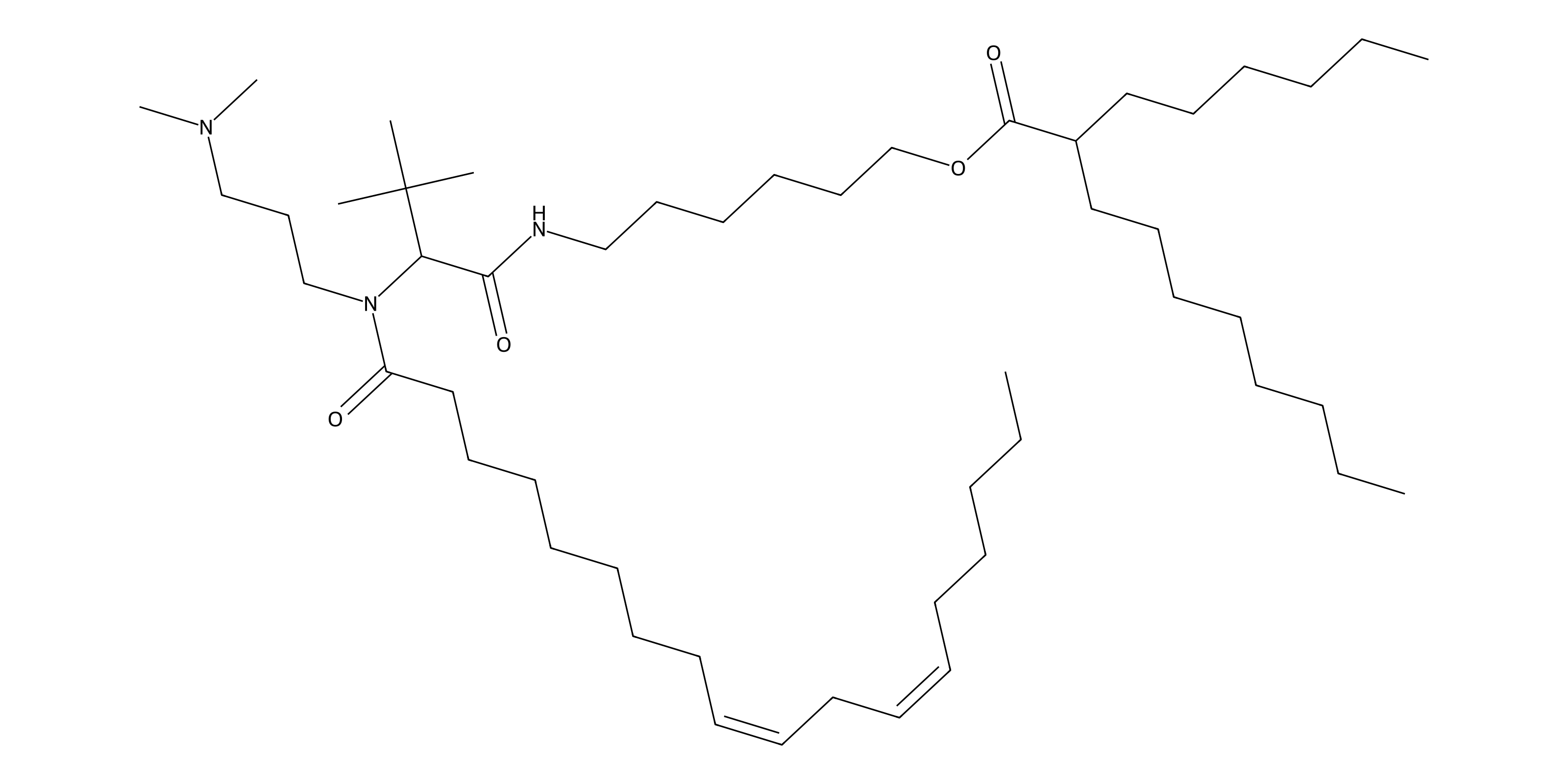
Literature-reconstructed chemical structure of TTP-3 View larger
2D structure reconstructed from the cited literatureFor research use only. We do not sell to patients.
CAT. NO. DC60964
Featured

TTP-3

Asymmetric Ugi-derived ionizable lipid selected for pulmonary delivery of structured suppressor tRNA cargo.

Research highlights
Pulmonary delivery researchSuppressor tRNA cargoIntratracheal administration studyAsymmetric Ugi-derived lipid
Literature-reported LNP dataNot a product specification or performance guarantee.View source

Available sizes & price

USD · research grade
SelectedPack size on request × 1
We match the best price and quality on market.
Ships from ShanghaiIce-pack transportPure lipid recommended
Description & Application

Cargo-tailored ionizable lipid for pulmonary sup-tRNA delivery

TTP-3 is an asymmetric Ugi-derived ionizable lipid identified from a 1,000-member library designed for pulmonary delivery of structured suppressor tRNA. In the cited study, TTP-3 was selected in a cystic-fibrosis-relevant air–liquid interface model containing artificial mucus, then evaluated in optimized LNP formulations for intratracheal delivery. All formulation and performance data below are literature-reported and remain specific to the stated cargo, preparation process, dose, model and administration route.

Library selectionSelected from 1,000 ionizable lipids
Formulation contextFour-component LNP optimized by DoE
Pulmonary researchIntratracheal administration studied
RNA cargoStructured suppressor tRNA
Product data

Technical details and supporting files

Specifications

PropertyValue
CAS No.Not assigned
Chemical NameTTP-3
SynonymsNot reported
SMILESCCCCC/C=C\C/C=C\CCCCCCCC(=O)N(CCCN(C)C)C(C(=O)NCCCCCCOC(=O)C(CCCCCC)CCCCCCCC)C(C)(C)C
Structure-derived from the alkene geometry drawn in the cited publication; absolute stereochemistry is not specified.
FormulaC51H97N3O4 (calculated from the literature-reported structure)
M.Wt816.35 g/mol (calculated)
Purity>98%
StoragePure form: −20 °C, 1 year. In solvent: −80 °C, 6 months; −20 °C, 1 month. Keep sealed and protected from light.
Shipping conditionPure lipid, shipped from Shanghai with ice packs.
PublicationChen J, Zhou M, Dong S, et al. Nonviral delivery of chemically modified tRNA rescues nonsense mutations in cystic fibrosis. Science. 2026;393:eaeb0054. DOI: 10.1126/science.aeb0054

Documentation

Literature-reported optimized formulation

Componentmol%Role
TTP-360.0Ionizable lipid
DOPE10.0Helper phospholipid
β-Sitosterol27.5Sterol lipid
C14-PEG20002.5PEG lipid
Total100.0

Formulation weight calculator

The literature-reported TTP-3 formulation and available component molecular weights are pre-filled. Edit any molecular weight or molar ratio for the exact materials used.

Literature ratio: 60 : 10 : 27.5 : 2.5. The four components total 100 mol%.
ComponentMolecular weight (g/mol)Literature molar ratio
TTP-3
DOPE
β-Sitosterol
C14-PEG2000
Calculated component requirements
ComponentNormalized mol%Amount (μmol)Required weight (mg)
Total100.000%

Calculation aid for research planning. C14-PEG2000 is treated using an approximate average molecular weight; confirm the exact supplier or batch value before use. The result covers lipid component weights only and does not include RNA, buffer, solvent, process loss or N/P ratio.

Not reported in the cited study
13.5:1
Suppressor tRNA
Intratracheal administration
LumA (FLuc R387X) mouse
1.25 mg/kg · day 3 readout
3 doses × 1 mg/kg
Reported preparation contextAqueous sup-tRNA in 10 mM citrate buffer (pH 4.0) was mixed with the ethanol lipid phase at a 3:1 aqueous-to-organic volume ratio using a T-junction device. The LNPs were then dialyzed against PBS overnight at 4 °C and concentrated using 100 kDa MWCO filters.

Literature-reported performance for the cited formulation

Fig. S1484.14 ± 2.52%sup-tRNA · mean ± SD
Fig. S14125.97 ± 13.38 nmhydrodynamic · mean ± SD
Fig. 3KSuperiorvs A10-LIN (P = 0.0010) and MC3 (P < 0.0001)
Fig. 4C–E~60%of tRNA_Aptamer-positive lung cells
Fig. 4E~32%tRNA_Aptamer-positive · MC3 ~13%
Fig. 4F22% · 19% · 32%ciliated · club · basal cells
Fig. S18~15%tRNA_Aptamer-positive
Fig. S1454.97 ± 2.60%EE; size 204.40 ± 3.01 nm
Literature Data DisclaimerAll formulation parameters and performance values shown in this section are derived from the cited publication and are provided for reference only. These results were obtained using the specific materials, formulation process, cargo, dose, analytical method, cell or animal model, and administration route described in that study. Unless otherwise stated, the data were not generated or independently verified by DC Chemicals. DC Chemicals supplies the lipid compound only and does not guarantee that customers will reproduce the reported LNP properties or biological performance.

The administration route shown above was used in the cited study and is not a clinical-use instruction or recommendation by DC Chemicals.
Cited literature for this formulation and performance datasetChen J, Zhou M, Dong S, et al. Nonviral delivery of chemically modified tRNA rescues nonsense mutations in cystic fibrosis. Science. 2026;393:eaeb0054. DOI: 10.1126/science.aeb0054

Formulation: main text and Methods; performance: Fig. 3K, Fig. 4C–F, and supplementary Figs. S13–S14 and S18.
Lab tools

Solution calculators

Molarity calculator

Mass (g) = Concentration (mol/L) × Volume (L) × Molecular Weight (g/mol)

Molecular weight is prefilled from the literature-derived structure and can be edited.

Dilution calculator

Concentration (start) × Volume (start) = Concentration (final) × Volume (final) · C₁V₁ = C₂V₂

Leave exactly one field blank. With the current values, V₁ will be calculated.
Preparing stock solutions

Quick preparation table

The molecular weight is prefilled above to generate solvent volumes and can be edited if required. Formula: volume (mL) = mass (mg) × 1000 ÷ [molecular weight (g/mol) × concentration (mM)].

Mass1 mM5 mM10 mM
Ethanol is a common starting solvent; confirm product-specific solubility before preparation.
Handling guidance

Shipping, storage and sampling

We generally ship the neat (undissolved) lipid compound rather than an ethanol solution. The neat lipid is stable during transport with ice packs, and shipments originate from Shanghai. Pure form: store at −20 °C for up to 1 year. In solvent: store at −80 °C for up to 6 months or at −20 °C for up to 1 month. Keep sealed and protected from light. Avoid repeated thaw cycles for best results.
Pure lipid is generally more stable during shipping and storage, so we usually recommend the pure form. A solution in ethanol or chloroform can be supplied when required by your workflow. Tell us the intended application, solvent and target concentration so the most suitable format can be confirmed.
Ionizable lipids are often oily liquids or viscous semisolids, so material can be lost during repeated weighing or transfer. For a small pack, dissolve the entire quantity and aliquot it volumetrically. For example, add 1 mL ethanol to 25 mg lipid to prepare a 25 mg/mL stock, then use a pipette to withdraw the required amount. For quantities above 100 mg, direct weighing with an analytical balance may be more practical. Always confirm solvent compatibility and solubility first.
Yes. Share the RNA cargo, target tissue, administration route, formulation method and assay plan. Our team can discuss starting molar ratios, N/P ratio and scale-up requirements for research workflows.

Request TTP-3

Tell us the required size, format and intended formulation. We will confirm price, availability and lead time.

Email order@dcchemicals.com