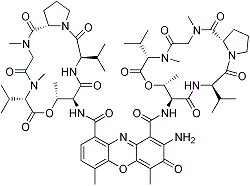
Actinomycin D chemical structure
Chemical structureResearch use only
CAT. NO. DC4197Featured

Actinomycin D

Pack Sizes & Prices

TotalUS$350
We match the best price and quality on market.
Product overview

Description & Application

Actinomycin D inhibits DNA repair with an IC50 of 0.42 μM.

ParameterValue
CAS No.50-76-0
FormulaC62H86N12O16
M.Wt1255.5
SMILESCC(C1=O)=C2C(C(C(N[C@@H]([C@@H](C)OC([C@H](C(C)C)N(C)C(CN3C)=O)=O)C(N[C@H](C(C)C)C(N4[C@H](C3=O)CCC4)=O)=O)=O)=C1N)=NC(C(C(N[C@@H]([C@@H](C)OC(C(C(C)C)N(C)C(CN5C)=O)=O)C(N[C@H](C(C)C)C(N6[C@H](C5=O)CCC6)=O)=O)=O)=CC=C7C)=C7O2
Purity99%
Storage2 years -20°C Powder, 2 weeks 4°C in DMSO, 6 months -80°C in DMSO

Biological Activity

Actinomycin D inhibits DNA repair with an IC50 of 0.42 μM.

In Vitro

Actinomycin D is an inhibitor of DNA transcription and replication[1]. Actinomycin D markedly reduces the vascular smooth muscle cells (SMC) proliferation via the inhibition of BrdU incorporation at 80 nM. This is further supported by the G1-phase arrest using a flowcytometric analysis. Actinomycin D is extremely potent with an inhibitory concentration IC50 at 0.4 nM, whereas the lethal dose LD50 is at 260 microM. The protein expression levels of proliferating cell nuclear antigen (PCNA), focal adhesion kinase (FAK), and Raf are all suppressed by Actinomycin D. Extracellular signal-regulated kinases (Erk) involved in cell-cycle arrest are found to increase by Actinomycin D[2].

In Vivo

The pluronic gel containing 80 nM and 80μM Actinomycin D is applied topically to surround the rat carotid adventitia, the thickness of neointima is substantially reduced (45 and 55%, respectively)[2]. Mice in the Actinomycin D and fludarabine group lives significantly longer than the control group with P values of <0.001 and 0.007, respectively. Interestingly, single treatment with Actinomycin D is superior to fludarabine regarding overall survival (P=0.026)[3].

References & source

DC Chemicals original product information

Published experimental findings depend on the model and assay conditions. They do not guarantee equivalent performance in every application. For laboratory research use only.
Product documentation

Refer to the certificate supplied with your lot for batch-specific release results.

Handling guide

2 years -20°C Powder, 2 weeks 4°C in DMSO, 6 months -80°C in DMSO

Solution calculator

Related research products

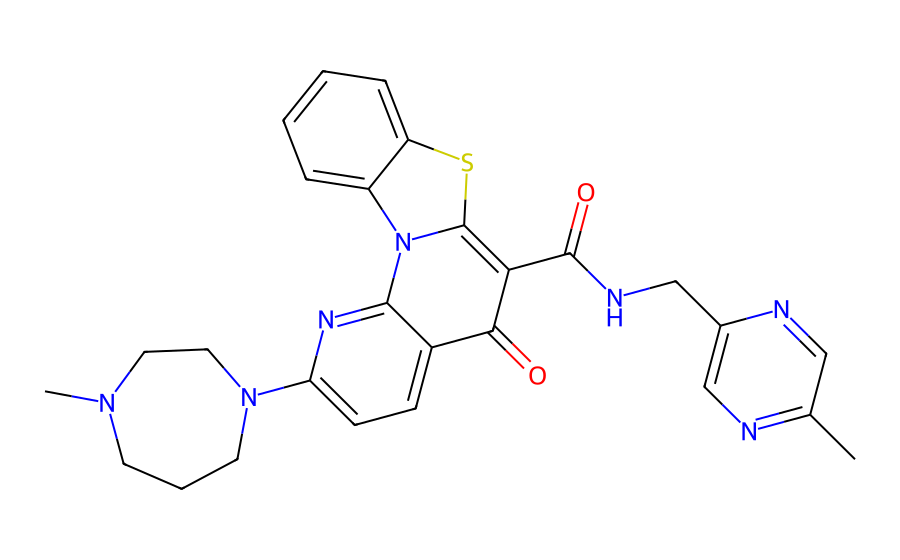
BMH-21 chemical structureDC7959

BMH-21

BMH-21 is a small molecule DNA intercalator that binds ribosomal DNA and inhibits RNA polymerase I (Pol I) transcription; does not cause phosphorylation of H2AX.

View activity & prices
CX-5461 chemical structureDC7810

CX-5461

CX-5461 is a potent and oral rRNA synthesis inhibitor. It inhibits RNA polymerase I-driven transcription of rRNA with IC50s of 142, 113, and 54 nM in HCT-116, A375, and MIA PaCa-2 cells, respectively.

View activity & prices
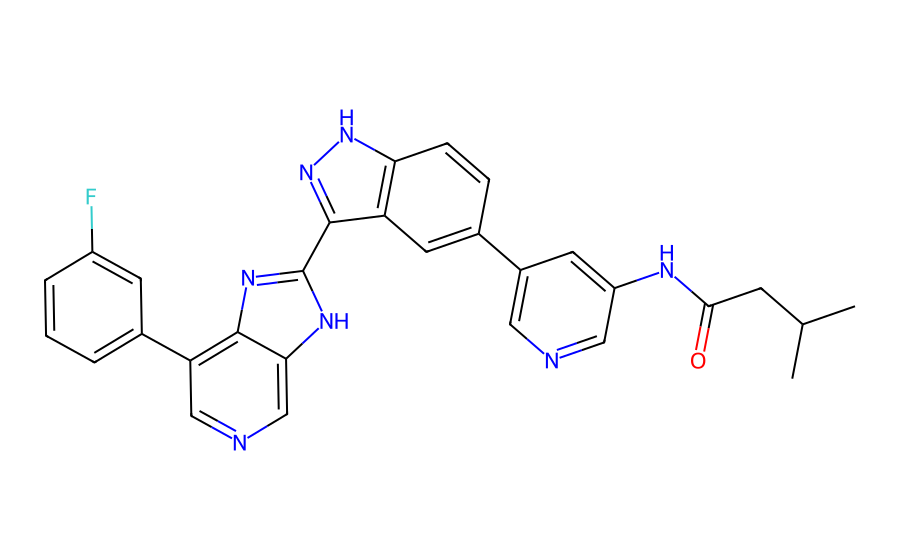
Adavivint chemical structureDC11886

Adavivint

Adavivint is a potent and selective inhibitor of canonical Wnt signaling, with an EC50 of 19.5 nM via a high-throughput TCF/LEF-reporter assay in SW480 colon cancer cells.

View activity & prices
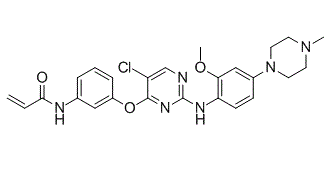
WZ4002 chemical structureDC5090

WZ4002

WZ4002 is a mutant selective EGFR inhibitor with IC50s of 2, 8, 3 and 2 nM for EGFRL858R, EGFRL858R/T790M, EGFRE746_A750 and EGFRE746_A750/T790M, respectively.

View activity & prices
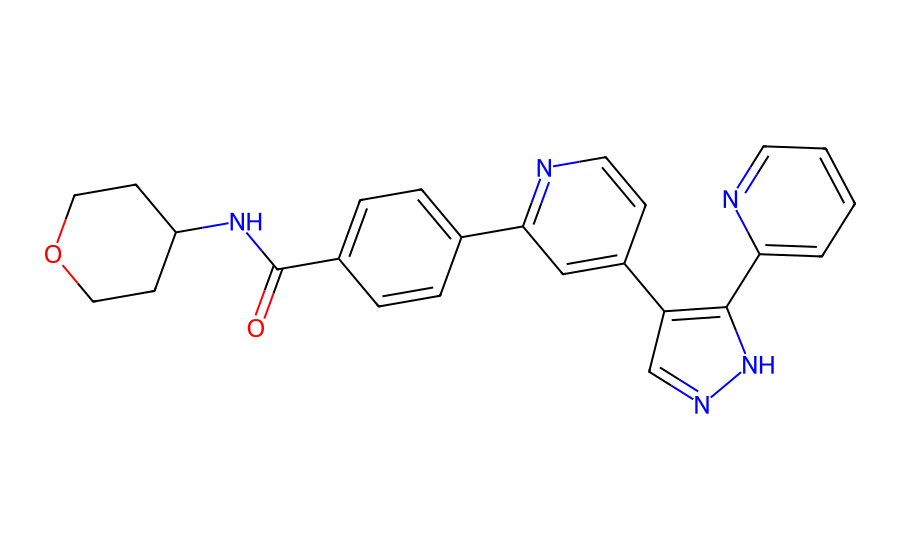
GW788388 chemical structureDC7146

GW788388

GW788388 is a potent and selective inhibitor of ALK5 with IC50 of 18 nM, and also inhibits TGF-β type II receptor and activin type II receptor activities, without inhibiting BMP type II receptor.

View activity & prices
AZD1152 chemical structureDC7060

AZD1152

AZD1152 is a pro-drug of Barasertib-hQPA, which is a highly selective Aurora B inhibitor with IC50 of 0.37 nM in a cell-free assay.

View activity & prices

Cart

Request quotation