Biological Activity
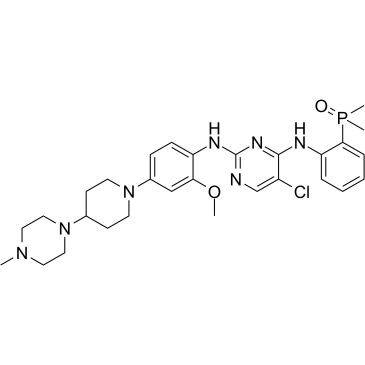
Brigatinib is a highly potent and selective ALK inhibitor, with an IC50 of 0.6 nM.
In Vitro
Brigatinib potently inhibits the in vitro kinase activity of ALK (IC50, 0.6 nM) and all five mutant variants tested, including G1202R (IC50, 0.6-6.6 nM). Brigatinib demonstrates a high degree of selectivity, only inhibiting 11 additional native or mutant kinases with IC50 <10 nM. These include ROS1, FLT3, and mutant variants of FLT3 (D835Y) and EGFR (L858R; IC50, 1.5-2.1 nM). Brigatinib exhibits more modest activity against EGFR with a T790M resistance mutation (L858R/T790M), native EGFR, IGF1R, and INSR (IC50, 29-160 nM) and does not inhibit MET (IC50 >1000 nM). In cellular assays, brigatinib inhibits ALK and ROS1 with IC50s of 14 and 18 nM, respectively. Brigatinib inhibits FLT3 and IGF-1R with about 11-fold lower potency (IC50, 148-158 nM) and inhibits mutant variants of FLT3 and EGFR with 15- to 35-fold lower potency (IC50, 211-489 nM). Brigatinib inhibits cell growth with GI50 values ranging from 503 to 2,387 nM in three ALK-negative ALCL and NSCLC cell lines[1]. Brigatinib inhibits ALK activity and abrogates proliferation of ALK addicted neuroblastoma cell lines, with IC50 of 75.27 ± 8.89 nM. Brigatinib inhibits both the ALK-I1171N and the ALK-G1269A mutant receptors at 10 and 4 nM levels, respectively[3].
In Vivo
Brigatinib (10, 25, or 50 mg/kg once daily, p.o.) leads to a dose-dependent inhibition of tumor growth in ALK+ Karpas-299 (ALCL) and H2228 (NSCLC) xenograft mouse models. Brigatinib markedly enhances survival of mice bearing ALK+ brain tumors compared with crizotinib[1]. Brigatinib (10, 25, 50 mg/kg, p.o.) results in dose-dependent antitumor activity, with tumor regressions in a mouse model of NSCLC[2].
References & source
Published experimental findings depend on the model and assay conditions. They do not guarantee equivalent performance in every application. For laboratory research use only.