Biological Activity
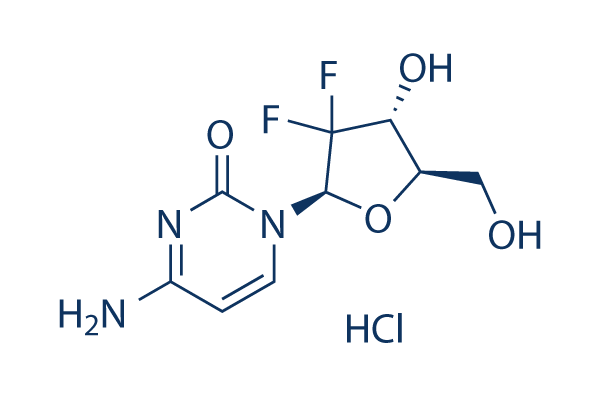
Gemcitabine hydrochloride is a DNA synthesis inhibitor with IC50s of 37.6, 42.9, 92.7, 89.3 and 131.4 nM in BxPC-3, Mia Paca-2, PANC-1, PL-45 and AsPC-1 cells, respectively.
In Vitro
MTS assay demonstrates that Gemcitabine at 15 nM, indole-3-carbinol (I3C) at 50 μM and the combination does not affect hTERT-HPNE cell viability. However, treatment with Gemcitabine at 15 nM, I3C at 50 μM and the combination results in 31%, 19% and 72% cell death of BxPC-3 cells, respectively[1].
In Vivo
The aim of study is to formulate PLGA nanoparticles (NPs) of Gemcitabine Hydrochloride (Gemcitabine HCl) for enhanced oral bioavailability via absorption through M cells of Peyer’s patches. Gemcitabine HCl is available as i.v. infusion due to its short half life (8-17 min), rapid metabolism and limited tumor uptake. Gemcitabine loaded PLGA NPs shows 21.47-fold increase in relative bioavailability in comparison to plain drug solution after oral delivery[2]. After i.v. injection of Gemcitabine at doses of 50, 100, and 120, and 300 mg/kg, the highest dose caused considerable body weight loss (p<0.05 at all the time points evaluated, starting from day 3 of first injection) compared with that of the untreated group and complete mortality, whereas 120 mg/kg is determined as the lethal dose 10% (LD10) and 100 mg/kg is considered as the maximal tolerated dose, which does not cause any mortality and a minimal body weight loss[3].
References & source
Published experimental findings depend on the model and assay conditions. They do not guarantee equivalent performance in every application. For laboratory research use only.