Biological Activity
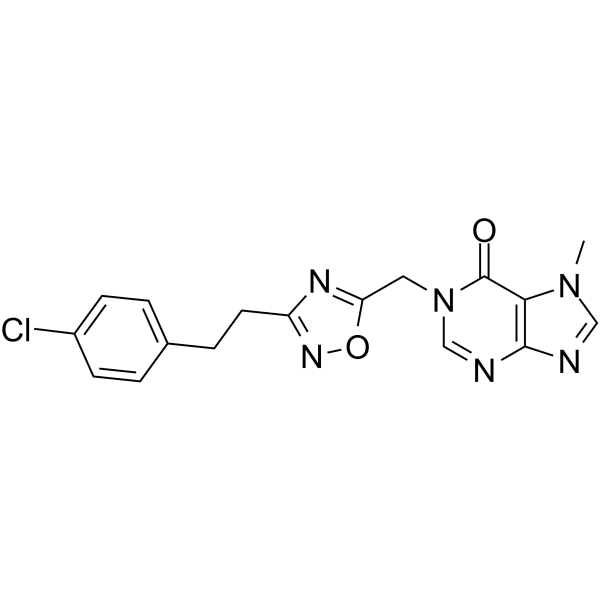
AM-0902 is a potent, selective transient receptor potential A1 (TRPA1) antagonist with IC50s of 71 and 131 nM for rTRPA1 and hTRPA1, respectively.
In Vitro
AM-0902 is a potent, selective antagonist of TRPA1 with IC50s of 71 and 131 nM for rTRPA1 and hTRPA1, respectively. AM-0902 is highly permeable (average Papp=44.5 μcm/s in MDCK cells), an unlikely substrate for P-gp (efflux ratio=1.3 in P-gp overexpressing MDCK cells), and demonstrates good solubility (PBS pH 7.4: 226 μM, SIF: 248 μM). AM-0902 shows good selectivity over other TRP channels, as no activity is observed against human TRPV1 or TRPV4, or rat TRPV1, TRPV3, or TRPM8, at concentrations up to 10 μM. AM-0902 inhibits 45Ca2+ flux upon activation of rat TRPA1 with methylglyoxal with an IC50 of 0.019 μM[1].
In Vivo
AM-0902 is a potent, selective antagonist of TRPA1 in vivo. AM-0902 has moderate terminal elimination half-life (t1/2=0.6 h and 2.8 h for rat (0.5 mg/kg, iv), rat (30 mg/kg, oral)). A dose-dependent reduction of allyl isothiocyanate (AITC)-induced flinching is observed for AM-0902, with a significant reduction in flinching observed postdosing of 10 and 30 mg/kg. The unbound plasma concentrations (Cu) at 1 h for the 1, 3, 10, and 30 mg/kg doses are 0.051±0.024 (n=8), 0.19±0.11 (n=8), 0.58±0.35 (n=8), and 2.2±0.40 (n=8) μM, covering the in vitro rat TRPA1 45Ca2+ IC50 at 0.72, 2.7, 8.2, and 30.3 fold, respectively. A good exposure-response relationship is observed in this target coverage model. An unbound in vivo IC50 of 0.35 μM, which is in good agreement with the in vitro rat TRPA1 45Ca2+ IC50, and unbound in vivo IC90 of 1.7 μM are determined. It is noteworthy that at a dose of 30 mg/kg, AM-0902 engages TRPA1 at concentrations that exceed the in vivo IC90, making it a useful tool for exploration of in vivo models of acute pain[1].
Cell Assay
MDCK cells are generated and maintained for the TRPA1 calcium flux assays. On the day of assay, culture media is removed and cells are incubated for 10 min at room temperature (RT) with 50 μL of AM-0902 (compound 27) in AM-0902 dilution buffer [HBSS containing 1 mM HEPES+0.1 mg/mL BSA] at final concentrations (2.0 nM to 40 μM, 1:3 ratio), followed by another 3 min incubation at RT. The reaction mixture is aspirated, and cells are washed three times with phosphate buffer saline (PBS) containing 0.1 mg/mL BSA. Radioactivity is measured using a TopCount microplate scintillation counter. The activation of TRPA1 is measured by the cellular uptake of radioactive calcium[1].
Animal Administration
Rats[1] Rats are dosed orally with either vehicle (2% HPMC/1% Tween-80) or AM-0902 at 1, 3, 10, or 30 mg/kg. After 1 h, one left ventral hind paw is injected with the TRPA1 agonist AITC (0.1%). AM-0902 is also given by an intravenous (IV) injection to rats (0.5 mg/kg)[1].
References & source
[1]. Schenkel LB, et al. Optimization of a Novel Quinazolinone-Based Series of Transient Receptor Potential A1 (TRPA1)Antagonists Demonstrating Potent in Vivo Activity. J Med Chem. 2016 Mar 24;59(6):2794-809.
Published experimental findings depend on the model and assay conditions. They do not guarantee equivalent performance in every application. For laboratory research use only.