Biological Activity
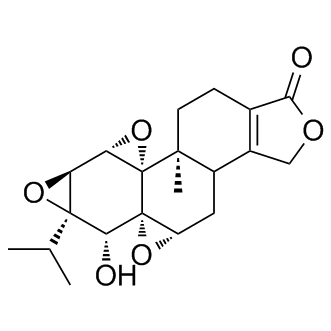
Triptolide is a diterpenoid triepoxide extracted from the root of Tripterygium wilfordii with immunosuppressive, anti-inflammatory and antiproliferative effects. Triptolide is a NF-κB activation inhibitor.
In Vitro
Triptolide induces apoptosis in cultured and primary Chronic Lymphocytic Leukemia (CLL) B-cells. Treatment of CD19+ B cells with Triptolide, induces a dose-dependent increase in apoptosis in cultured and primary CLL cells. Triptolide is selectively toxic to both high risk (n=5) and low risk CLL (n=12) B cells (10 to 50 nM range) while largely sparing normal B-cells (n=5). Consistent with the inhibition of heat-shock induced HSP transcription, treatment with Triptolide attenuates heat-shock induced expression of HSPs[1]. Triptolide is a natural product derived from the Chinese plant Tripterygium wilfordii, is reported to exhibit antitumor effects in a broad range of cancers. Triptolide inhibits MDM2 expression in a dose-dependent manner, even at low concentrations spanning 20-100 nM in acute lymphoblastic leukemia (ALL) cells. Triptolide exhibits strongly cytotoxic activity in all 8 cell lines having native MDM2 overexpression, with IC50 values range from 47 to 73 nM. Triptolide exhibits much less cytotoxic effect on EU-4 cells that express very low level of MDM2, while it effectively kill these cells when MDM2 is stably transfected (IC50 values: 725 nM vs. 88 nM)[2]. Differentiated PC12 cells are incubated with different concentrations of Triptolide (0.01, 0.1, and 1 nM) in the presence of 10 μM Aβ25-35 for 24 hours and MTT assay is used to detect the effect of Triptolide. The results show that Aβ25-35 can decrease the cell viability and when treated with Triptolide the viability of differentiated PC12 cells is significantly increased. The results indicate that Triptolide can alleviate cellular damage caused by Aβ25-35, which means that Triptolide has a neuroprotective effect[3].
In Vivo
The Triptolide (TP) plasma concentrations are declined rapidly in mice after receive an intravenous dose. After 2h of injection, the Triptolide concentrations are dropped below the lower limit of quantification for all three groups. A comparison of the parameters is made between the control and the treated groups to assess the effect of P-gp inhibition on the Triptolide exposure and elimination. Treatment with the mdr1a-siRNA can significantly enhance the Triptolide plasma exposure, with the Cmax increases from 413±74 to 510±94 ng/mL (P<0.05) and the AUC from 103.5±9.6 to 154.3±30.2 ng•h/mL (P<0.05). In the concomitant group with Tariquidar, the significantly increased AUC is also noted, from 103.5±9.6 of the control to 145.9±24.6 ng•h/mL of the Triptolide+Tariquidar group (P<0.05). Accordingly, the total body clearance of Triptolide in mice is remarkably decreased, from 9564±1024.2 mL/min/kg of the control to 6576.4±1438.5 (P<0.05) and 5755.4±1200.1 mL/min/kg (P<0.05) for Triptolide+Tariquidar and Triptolide+mdr1a-siRNA groups, respectively[4].
References & source
Published experimental findings depend on the model and assay conditions. They do not guarantee equivalent performance in every application. For laboratory research use only.