Biological Activity
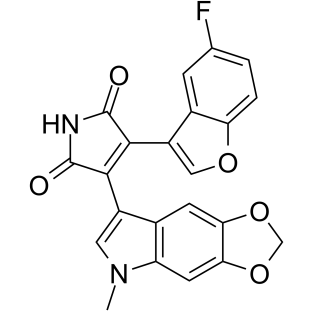
9-ING-41 (Elraglusib) is a cancer-research compound originally developed as a GSK-3β inhibitor. Published work documents model-dependent growth inhibition and additional mechanisms. Evaluated 9-ING-41 alone and with 5-fluorouracil and/or oxaliplatin.
In Vitro
| Endpoint | Model / conditions / source | Reported result |
|---|---|---|
| Colorectal model panel | HT-29, RKO and SW480 cells plus patient-derived colorectal cancer organoids. [1] | Evaluated 9-ING-41 alone and with 5-fluorouracil and/or oxaliplatin. |
| Patient-derived response | Organoids from patient 1. [1] | Growth decreased by 44–62% across the reported 9-ING-41-containing conditions. |
| Interpatient variation | Organoids from patient 3. [1] | 9-ING-41 monotherapy reduced growth by 32%; the additional reduction with the chemotherapy combination was not statistically significant (p=0.14). |
In Vivo
No compound-specific animal efficacy result is established by the sources summarized here.
Compound and Evidence Context
| Endpoint | Model / conditions / source | Reported result |
|---|---|---|
| Combination interpretation | Cell-line and patient-derived datasets. [1,2] | Combination benefit varied by model. Organoid response does not establish animal or clinical efficacy. |
Interpretation
The compound is not a universally selective proxy for GSK-3 loss, and combination benefit is model dependent.
Original studies
References
- Poloznikov A, et al. 9-ING-41, a Small Molecule Inhibitor of GSK-3β, Potentiates the Effects of Chemotherapy on Colorectal Cancer Cells. Frontiers in pharmacology (2021).
- Elraglusib (formerly 9-ING-41) possesses potent anti-lymphoma properties which cannot be attributed to GSK3 inhibition. Cell communication and signaling : CCS (2023).