Biological Activity
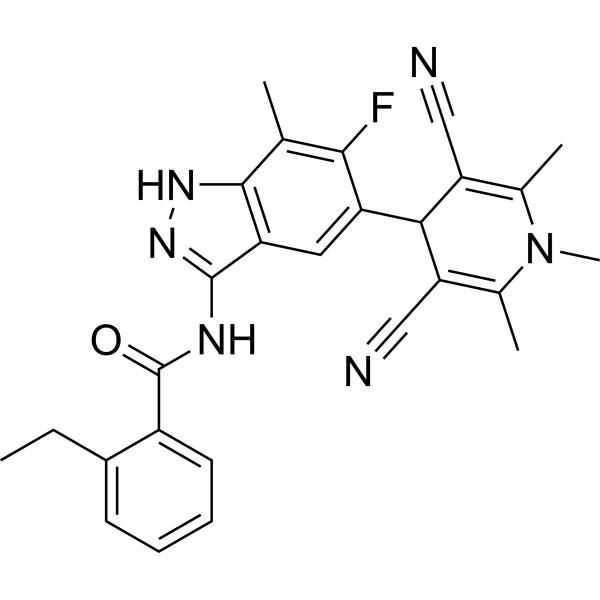
BAY-3827 is an AMPK inhibitor with additional RSK-family activity, used to study metabolic signaling and androgen-dependent prostate cancer. BAY-3827 inhibited AMPK and also RSK-family kinases; cellular activity is not exclusively attributable to AMPK.
In Vitro
| Endpoint | Model / conditions / source | Reported result |
|---|---|---|
| Target profile | Biochemical discovery study. [1] | BAY-3827 inhibited AMPK and also RSK-family kinases; cellular activity is not exclusively attributable to AMPK. |
| Responsive cancer models | Androgen-dependent prostate cancer cells. [1] | Proliferation was inhibited alongside reduced lipid flux and changes in LIPE, PRKAR2B, AKT3 and CPT1-family expression. |
| Androgen connection | Gene-expression and AR chromatin-binding analyses. [1] | Androgen-responsive models upregulated HMGCR, FASN and PFKFB2; AR binding was found at HMGCR and PFKFB2 loci. |
| Pharmacodynamic limitation | Independent AMPK inhibitor reassessment. [2] | Thr172 phosphorylation can rise despite catalytic inhibition. Substrate phosphorylation and functional endpoints are needed to interpret target response. |
In Vivo
No compound-specific animal efficacy result is established by the sources summarized here.
Interpretation
AMPK phosphorylation alone is not a sufficient activity readout, and cellular effects cannot automatically be attributed exclusively to AMPK.
Original studies
References
- Lemos C, et al. The potent AMPK inhibitor BAY-3827 shows strong efficacy in androgen-dependent prostate cancer models. Cellular oncology (Dordrecht, Netherlands) (2021).
- BAY-3827 and SBI-0206965: Potent AMPK Inhibitors That Paradoxically Increase Thr172 Phosphorylation. International journal of molecular sciences (2023).