Biological Activity
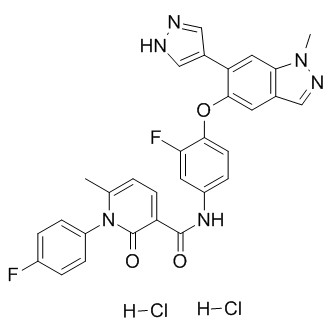
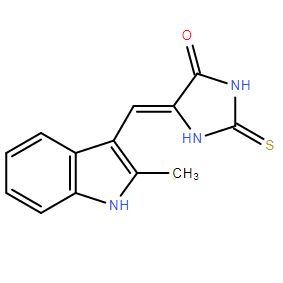
E260 is a Fer/FerT kinase inhibitor.
In Vitro
E260 is a Fer and FerT inhibitor, which selectively evokes metabolic stress in cancer cells by imposing mitochondrial dysfunction and deformation, and onset of energy-consuming autophagy which decreases the cellular ATP level. To demonstrate that E260 directly targets Fer and FerT, an in vitro kinase assay is performed using a purified kinase domain (KD)-containing fragment of these enzymes. This analysis demonstrates the direct inhibitory effect of E260 on this domain as reflected by the significantly decreased auto-phosphorylation level of the Fer/FerT KD when incubated with ATP and increasing concentrations of E260. Moreover, computational analysis of E260 docking in the modeled whole Fer protein reveals that the highest scored binding mode of E260 to Fer falls in the ATP-binding pocket of the enzyme’s KD. To measure the dissociation constant (Kd) of E260 from Fer/FerT KD, a microscale thermophoresis (MST) test is performed using ascending concentrations of E260. This analysis corroborates the direct binding of E260 to Fer/FerT KD and determines a Kd of 0.85 µM. To examine the effect of the E260 micellar formulation on Fer in malignant cells, the kinase is immunoprecipitated from untreated and from E260-treated SW620 CC cells. When applied to metastatic grade IV SW620 CC cells, which are serum starved for 16 h and treated with 3 mM H2O2 to activate Fer, E260 exhibits inhibitory effects on the Fer-kinase activity as is reflected by suppressed auto-phosphorylation activity of the enzyme. To characterize the effect of E260 on malignant cells, metastatic SW620 cells are treated with E260 followed by analysis of viability. Onset of death is observed in the E260-treated cells, with an EC50 value of 400 nM after 24 h of treatment and an EC50 of 300 nM after 48 h. E260 exhibits an EC50 of 3.2 µM after 72 h treatment of non-metastatic PANC-1 cells, which are derived from a primary pancreatic ductal carcinoma. Moreover, the maximum death level of these cells after 72 h of treatment with E260 is about 70% following treatment with 4 µM E260. In comparison, SU.86.86 which are metastatic ductal carcinoma cells, prove to be more susceptible to E260 with an EC50 of 1.1 µM after 72 h of treatment and 100% death level imposed by 2 µM E260[1].
In Vivo
E260 suppresses xenografts progression in vivo. The pharmacokinetic (PK) profile of E260 is determined in mice. E260 exhibits a T1/2 of 175 min in the blood, and a volume of distribution of 4244 mL/kg suggesting an efficient distribution of the compound in the animal tissues. To evaluate the efficacy of E260 on tumor growth, SW620 cells are subcutaneously introduced into immuno-compromised “Nude” mice. Administration of E260 leads to a significant attenuation of tumor progression throughout the experiment, and to a 10-fold decrease in average tumor volume after 22 days of treatment. To further demonstrate the anti-cancer activity of E260 in vivo, mice bearing SW48 cells derived xenografts are treated with E260 and the tumor progression profiles are determined. Mice treated with E260 demonstrate a 5-6-fold attenuation in tumors progression when compared to the control treated group[1].
References & source
Published experimental findings depend on the model and assay conditions. They do not guarantee equivalent performance in every application. For laboratory research use only.