Biological Activity
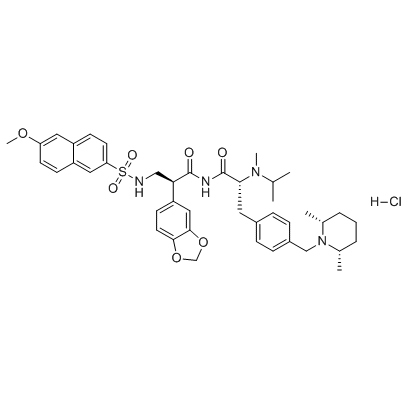
SSR240612 is a potent, and orally active specific non-peptide bradykinin B1 receptor antagonist, with Kis of 0.48 nM and 0.73 nM for B1 kinin receptors of human fibroblast MRC5 and HEK cells expressing human B1 receptors, 481 nM and 358 nM for B2 receptors of guinea pig ileum membranes and CHO cells expressing human B1 receptor, respectively.
In Vitro
SSR240612 is a potent bradykinin B1 receptor antagonist, with Kis of 0.48 nM and 0.73 nM for B2 kinin receptors of human fibroblast MRC5 and HEK cells expressing human B1 receptors, 481 nM and 358 nM for B1 receptors of guinea pig ileum membranes and CHO cells expressing human B1 receptor, respectively. SSR240612 inhibits inositol phosphate 1 formation with an IC50 of 1.9 nM, but shows no obvious effect on inositol phosphate-1 formation induced by BK (3 nM) activation of B2 receptor in human fibroblast MRC5[1].
In Vivo
SSR240612 (10 mg/kg p.o. or 0.3, 1 mg/kg i.p.) obviously blocks the des-Arg9-BK-induced paw edema in the mice. SSR240612 (10 and 30 mg/kg) reduces the duration of the late phase of paw licking in a dose dependent manner in the formalin model of inflammation in mice. SSR240612 (0.3, 3, and 30 mg/kg, p.o.) treatment before capsaicin potently and non-concentration-dependently reduces the ear edema. SSR240612 (0.3 mg/kg, i.v.) also suppresses the tissue destruction and neutrophil accumulation in the rat intestine, after splanchnic artery occlusion/reperfusion. Moreover, SSR240612 (1 and 3 mg/kg p.o.) dramacally increases the withdrawal latencies in the thermal hyperalgesia induced by UV irradiation in rats[1]. SSR240612 inhibits tactile and cold allodynia at 3 h in glucose-fed rats but had no effect in control rats with ID50s of 5.5 and 7.1 mg/kg, respectively. SSR240612 shows no effect on plasma glucose and insulin, insulin resistance (HOMA index) and aortic superoxide anion production in glucose-fed rats at 10 mg/kg[2].
Target
Ki: 0.48 nM (bradykinin B1 receptor, Human MRC5), 0.73 nM (bradykinin B1 receptor, Human HEK-B1), 481 nM (bradykinin B2 receptor, guinea pig ileum membranes), 358 nM (bradykinin B2 receptor, Human CHO-B2)[1]
Kinase Assay
[3H]Lys0-des-Arg9-BK binding to cell membranes is performed in binding buffer of the following composition: 137 mM NaCl, 5.4 mM KCl, 1.05 mM MgCl2, 1.8 mM CaCl2, 1.2 mM NaH2PO4, 15.5 mM NaHCO3, 10 mM HEPES, 1 g/L bovine serum albumin (BSA), 140 mg/L bacitracin, and 1 μM captopril, pH 7.4. Membranes are incubated for 30 min at 25°C in 500 μL of binding buffer containing 1 nM [3H]Lys0-des-Arg9-BK for competition curves or 0.1 to 10 nM for saturation isotherms. Filters are washed three times with 5 mL of binding buffer, and radioactivity is determined by liquid scintillation spectrometry. Nonspecific binding is determined by the addition of 1 μM of unlabeled Lys0-des-Arg9BK[1].
Animal Administration
Mice[1] Groups of eight male albino mice under isoflurane anesthesia receive a 20-μL intraplantar injection into the right hind paw of 5 μg of IL-1β in phosphate-buffered saline/0.1% BSA. Forty minutes later (T = 0), mice under anesthesia receive a 20-μL intraplantar injection in the same paw of des-Arg9-BK (10 μg/paw) in water. SSR240612 or vehicle [5% (v/v) ethanol and 5% (v/v) Tween 80 in water] is administered by oral route at the doses of 1, 3, and 10 mg/kg 1 h before des-Arg9-BK injection and by intraperitoneal route at the doses of 0.1, 0.3, and 1 mg/kg 40 min before des-Arg9-BK injection. Paw volume is measured with a plethysmometer at T = -2 h (initial measurement) and at several times after edema induction (T = 20, 40, 60, and 120 min). Paw edema volume is expressed in milliliters as the difference between the paw volume at each time after edema induction and the initial paw volume. Results for each group are expressed as mean ± S.E.M. of individual paw edema volumes. Statistical analysis is performed after verification of normality and homogeneity of variances using repeated ANOVA, then Duncan's test, treated groups versus des-Arg9-BK control group[1]. Rats[1] SSR240612 (suspended with 0.1% Tween 80 in saline) is administered by the oral route in a volume of 20 mL/kg, 2 h before the thermal hyperalgesia measurement. In the time course study, the compound is administered at 3 mg/kg p.o. 0.08, 0.25, 0.5, 1, 2, 4, 6, 8, and 24 h before measuring the withdrawal latencies in rats. Results are expressed in seconds as mean withdrawal latencies (s) ± S.E.M., and statistical analyses are performed using a two-way ANOVA followed by Dunnett's test[1].
References & source
[1]. Gougat J, et al. SSR240612 [(2R)-2-[((3R)-3-(1,3-benzodioxol-5-yl)-3-[[(6-methoxy-2-naphthyl)sulfonyl]amino]propanoyl)amino]-3-(4-[[2R,6S)-2,6-dimethylpiperidinyl]methyl]phenyl)-N-isopropyl-N-methylpropanamide hydrochloride], a new nonpeptide antagonist of the bradykinin B1 receptor: biochemical and pharmacological characterization. J Pharmacol Exp Ther. 2004 May;309(2):661-9.
[2]. Dias JP, et al. The kinin B1 receptor antagonist SSR240612 reverses tactile and cold allodynia in an experimental rat model of insulin resistance. Br J Pharmacol. 2007 Sep;152(2):280-7. Epub 2007 Jul 9.
Published experimental findings depend on the model and assay conditions. They do not guarantee equivalent performance in every application. For laboratory research use only.