Biological Activity
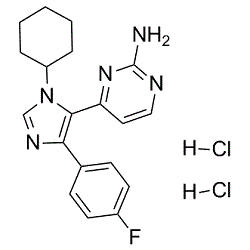
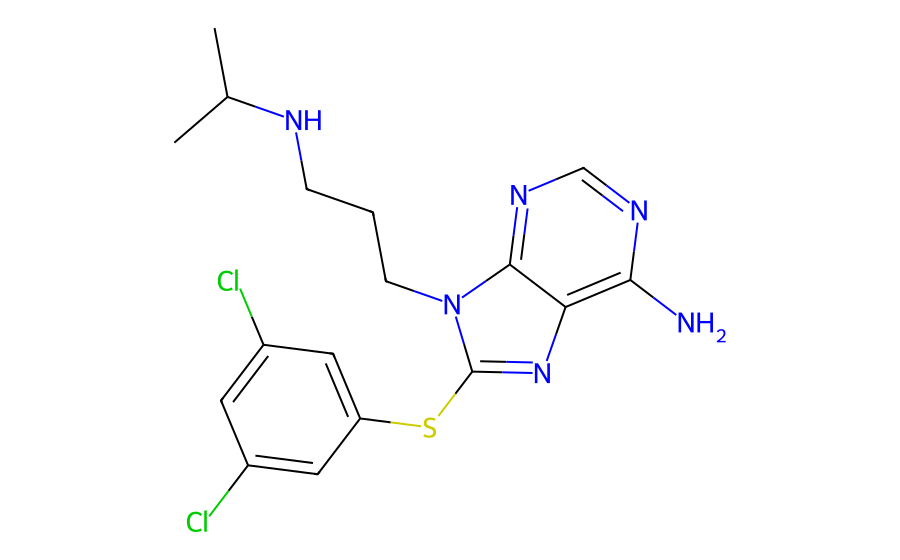
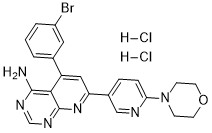
ABT-702 dihydrochloride is a potent adenosine kinase (AK) inhibitor (IC50=1.7 nM).
In Vitro
ABT-702 is an orally effective adenosine kinase inhibitor that has several orders of magnitude selectivity over other sites of adenosine (ADO) interaction (A1, A2A, A3 receptors, ADO transporter, and ADO deaminase). ABT-702 is equipotent (IC50=1.5±0.3 nM) in inhibiting native human AK (placenta), two human recombinant isoforms (AKlong and AKshort), and AK from monkey, dog, rat, and mouse brain. ABT-702 potently inhibits the activity of rat brain cytosolic AK in a concentration-dependent manner with an IC50 value of 1.7 nM. ABT-702 also potently inhibits AK activity in intact cultured IMR-32 human neuroblastoma cells (IC50=51 nM), indicating that ABT-702 can penetrate the cell membrane and potently inhibit AK at its intracellular site[1].
In Vivo
ABT-702 significantly reduces acute thermal nociception in a dose-dependent manner after both intraperitoneal (ED50=8 μmol/kg i.p.) and oral (ED50=65 μmol/kg p.o.) administration in the mouse hot-plate test. Consistent with its antinociceptive effects in the hot-plate assay, ABT-702 also produces dose-dependent antinociceptive effects (ED50=2 μmol/kg i.p.) in the abdominal constriction assay. Like Morphine (21 μmol/kg i.p.), ABT-702 exhibits full efficacy in this model of persistent chemical pain[1]. Rats are given an intraperitoneal injection of the adenosine A1 receptor antagonist DPCPX (3 mg/kg), ABT-702 (3 mg/kg), or vehicle 10 minutes prior to an intravenous injection of 2-18F-fluorodeoxy-D-glucose (FDG) (FDG, 15.4±0.7 MBq per rat). Rats are then subjected to a 15 minute static positron emission tomography (PET) scan. Reconstructed images are normalized to FDG PET template for rats and standard uptake values (SUVs) are calculated. To examine the regional effect of active treatment compared to vehicle, statistical parametric mapping analysis is performed. Whole-brain FDG uptake is not affected by drug treatment. Significant regional hypometabolism is detected, particularly in cerebellum, of DPCPX and ABT-702 treated rats, relative to vehicle-treated rats. Thus, endogenous adenosine can affect FDG accumulation although this effect is modest in quiescent rats. Body weight (316.8±28.4 g; mean±SD) and blood glucose (5.5±1.7 mM) are not significantly different among three groups. Whole-brain PET SUV values are 1.6±0.4, 1.6±0.6, and 1.8±0.6 for vehicle, ABT-702, and DPCPX-treated rats, respectively (F(2,9)=0.298, P=0.75). statistical parametric mapping (SPM) analysis reveals significant regional hypometabolism in the cerebellum, mesencephalic region, and medulla in the ABT-702-treated rats compared to the vehicle-treated rats[2].
References & source
Published experimental findings depend on the model and assay conditions. They do not guarantee equivalent performance in every application. For laboratory research use only.