1,2-DSPC
DC57005
View product-specific chemistry and research information.
View product →
Select a pack size below, or contact our team for custom quantities and availability.
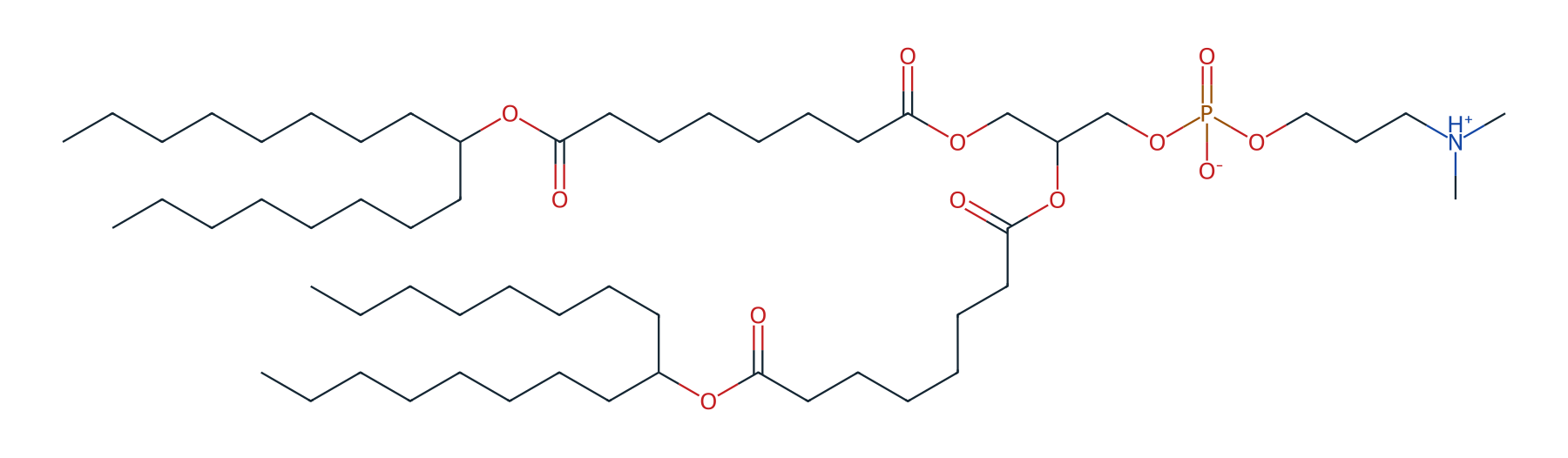
PEA-DMA-12 is a two-tailed helper phospholipid reported by the Sanofi mRNA Center of Excellence. Its dimethylaminopropyl headgroup has a three-carbon spacer, and its glycerol backbone carries two branched, ester-linked hydrophobic groups.
| CAS No. | Not reported in this source |
| Chemical Name | O'1,O1-(3-(((3-(Dimethylamino)propoxy)(hydroxy)phosphoryl)oxy)propane-1,2-diyl) 8-di(heptadecan-9-yl) di(octanedioate) |
| Synonyms | PEA DMA 12; PEADMA12 |
| SMILES | CCCCCCCCC(CCCCCCCC)OC(=O)CCCCCCC(=O)OCC(COP(=O)([O-])OCCC[NH+](C)C)OC(=O)CCCCCCC(=O)OC(CCCCCCCC)CCCCCCCC |
| Formula | C58H112NO12P |
| Average molar mass | 1046.50 g/mol |
| Chemical form / stereochemistry | Zwitterionic form depicted in the supplement. Glycerol C-2 configuration is unspecified. |
| InChIKey | QAJSTWVGKNHFSL-UHFFFAOYSA-N |
| Monoisotopic mass | 1045.792215 Da |
| HRMS [M+H]⁺, calculated / found (m/z) | 1046.8000 / 1046.8039 |
| Selected ¹H NMR signals | 400 MHz, CDCl₃, δ 2.78 (s, 6H) ppm |
| Appearance of the literature sample | Pale-yellow wax |
| Role | Helper lipid |
| Purity | >95% by ELSD-HPLC; issued batch certificate on request |
| Storage | Follow the product label and batch documentation; protect from light and moisture. |
| Availability | Price, stock status and lead time on request |
| Reference | Karve et al., Advanced Materials (2026), e75746 · Supporting Information · Fig. S1 |
Supplementary Table S2 reports serum hEPO in mice relative to the DOPE formulation for each route. Values are mean ± SD, with four animals per group.
| Intramuscular | 1.12 ± 0.40 |
|---|---|
| Intravenous | 10.67 ± 2.24 |
Figure S3a,b plots apparent pKa of assembled LNPs by tail class. The individual points have no compound labels.
Average molar mass · 1046.50 g/mol
Volumes use the average molar mass of the structure shown.
| Mass | 1 mM | 5 mM | 10 mM |
|---|---|---|---|
| 10 mg | 9.5557 mL | 1.9111 mL | 955.57 μL |
| 25 mg | 23.8892 mL | 4.7778 mL | 2.3889 mL |
| 50 mg | 47.7783 mL | 9.5557 mL | 4.7778 mL |
| 100 mg | 95.5566 mL | 19.1113 mL | 9.5557 mL |
| 250 mg | 238.8915 mL | 47.7783 mL | 23.8892 mL |
Contact our team with the catalog number and requested quantity.