PEA-DMA-12 · DCL0053

Formulation & Performance

DCL0053 · HELPER LIPID

PEA-DMA-12: mRNA-LNP study information

DOI: 10.1002/adma.75746

Results refer to assembled mRNA-LNPs with the identified helper lipid. Screening and optimized recipes are kept separate. Ionizable Lipid A identity is undisclosed; this product's detailed chemical fields are pending verification.

Formulation parameters

ParameterSource-backed record
RoleHelper lipid in a four-component mRNA-LNP. Ionizable Lipid A is the separate primary carrier; its chemical identity is undisclosed.
Screening compositionIonizable Lipid A / helper / cholesterol / DMG-PEG2000 = 40 / 30 / 28.5 / 1.5 mol% (Figs. 1–2).
Optimized composition38.5 / 15 / 45 / 1.5 mol%, in the same component order (Fig. 3b). Used for subsequent studies; do not substitute the screening recipe.
N/PExact N/P for the Ionizable Lipid A recipes is not given in the supplied main paper. Referenced supporting information is unavailable; no value or nitrogen-count convention is inferred.
Total lipid:RNA mass ratioApproximately 19–24 mg/mg across study formulations (Methods §4.2). No exact value is assigned to an individual helper recipe, and this mass range is not N/P.
Cargo preparationMain Materials: Cap 1 and approximately 200-nucleotide poly(A) tail; no RNA modification chemistry is specified. General Materials lists California HA, whereas vaccine/HAI Methods identify Tasmania H3N2; assay-specific identities are retained.
RNA and lipid inputRNA 0.0833 mg/mL in 1 mM sodium citrate + 150 mM NaCl, pH 4.5. Lipids in ethanol; individual/combined organic-phase concentrations unspecified.
Mixing and processingAqueous:ethanolic phase 4:1; nylon T-mixer and gear pumps, total 250 mL/min. Dialysis, UF/DF, sterile filtration and concentration adjustment; final buffer and filter pore size unspecified.
StorageAssembled LNPs stored at −80°C; duration not stated. This is separate from supplied-lipid handling guidance.
Particle characterizationIndividual size/PDI/EE and zeta results are in unavailable SI Fig. S2. Main text reports +1.8 to +3.3 mV for representative formulations in 0.1× PBS; this is not an assigned value for this product.
Source limitationsSupporting files 0001 and 0002 are unavailable. Figure/Methods discrepancies in hDC dose, reporter-mouse strain, prime/boost interval and PTE timing are preserved in the assay records.

Main Results pp. 2–6; Methods §4.2–4.4, p. 14

Formulation components and molecular-weight conversion

Initial hEPO screening

Ionizable Lipid A / PEA-DMA-12 / Cholesterol / DMG-PEG2000 = 40 / 30 / 28.5 / 1.5 mol%. Fig. 1f, PDF p. 3; Figs. 1c / 2c

ComponentDC Chemicals productMW (g/mol)mol%Mass at 1 µmol total lipid (mg)
Ionizable Lipid AIdentity undisclosedUndisclosed40Unavailable: MW not verified
PEA-DMA-12DCL0053Pending chemical verification30Unavailable: MW not verified
CholesterolDCD-041386.6528.50.110195
DMG-PEG2000DC40169≈25071.50.037605

Only known component masses are calculated. DMG-PEG2000 uses the approximate whole-conjugate average MW 2507. The complete mass allocation is unavailable until both missing MW values are verified.

Component mass calculator

Research scenario only. Missing MW inputs are deliberately blank. Entering values does not establish the study lipid identity, a validated formulation or an RNA dose.

ComponentMW (g/mol)mol%Mass (mg)Mass %
Ionizable Lipid A——
PEA-DMA-12——
Cholesterol——
DMG-PEG2000——

Optimized lead formulation

Ionizable Lipid A / PEA-DMA-12 / Cholesterol / DMG-PEG2000 = 38.5 / 15 / 45 / 1.5 mol%. Fig. 3b, PDF p. 6; Results p. 5

ComponentDC Chemicals productMW (g/mol)mol%Mass at 1 µmol total lipid (mg)
Ionizable Lipid AIdentity undisclosedUndisclosed38.5Unavailable: MW not verified
PEA-DMA-12DCL0053Pending chemical verification15Unavailable: MW not verified
CholesterolDCD-041386.65450.173993
DMG-PEG2000DC40169≈25071.50.037605

Only known component masses are calculated. DMG-PEG2000 uses the approximate whole-conjugate average MW 2507. The complete mass allocation is unavailable until both missing MW values are verified.

Component mass calculator

Research scenario only. Missing MW inputs are deliberately blank. Entering values does not establish the study lipid identity, a validated formulation or an RNA dose.

ComponentMW (g/mol)mol%Mass (mg)Mass %
Ionizable Lipid A——
PEA-DMA-12——
Cholesterol——
DMG-PEG2000——

pKa

The main article reports assembled-LNP apparent pKa values across a 6.1–6.5 range. The individual value for this helper formulation is in unavailable SI Fig. S3a,b, so no individual number is assigned. This range is not the intrinsic pKa of the isolated helper lipid.

TNS assay: pH 3–9, excitation 320 nm / emission 430 nm; Methods §4.4. Assay concentration and temperature are not fully specified. Results p. 5 and Methods §4.4, p. 14

Cell performance and cytokines

Main-article measurements are retained. Exact graph values and dose/timing inconsistencies are not silently resolved.

Human MIMIC PTE cytokine response

Lower IL-1β than the DOPE-containing formulation.

Human PBMC/endothelial collagen-matrix PTE. Cargo: Influenza HA mRNA. Dose: Treatment RNA concentration not reported in the supplied main paper. Time: 24 h in Results/legend; PTE exposure 22 h in Methods. Comparator: DOPE helper-lipid LNP. N=10 human donors (5 female / 5 male) for cytokine panel; no numeric cytokine values reconstructed.

Results p. 11; Fig. 5h and caption pp. 10–12; Methods §4.19, pp. 17–18

hDC mRNA uptake

Uptake measured by smFISH; no per-helper numerical fold is stated in the main text.

Primary human dendritic cells. Cargo: Influenza H3 HA mRNA. Dose: 1 µg RNA / 10^6 cells. Time: 4 h. Comparator: DOPE, DSPC and lead helper-lipid LNPs. Fig. 5c: n=3 technical replicates for protein-expression means; uptake replicate count not separately stated.

Fig. 5a,c, p. 10; Methods §4.13, p. 16

hDC HA protein expression

HA protein expression evaluated by immunofluorescence; no per-helper fold stated in main text.

Primary human dendritic cells. Cargo: Influenza H3 HA mRNA. Dose: Conflict: Fig. 5a caption 1 µg / 10^6 cells; Methods §4.14 10 µg / 10^6 cells. Time: 24 h. Comparator: DOPE, DSPC and lead helper-lipid LNPs. n=3 technical replicates for means in Fig. 5c.

Results p. 9; Fig. 5a,c, p. 10; Methods §4.14, p. 16

Human MIMIC LTE anti-HA response

Matched or trended above the DOPE benchmark; no numerical fold reconstructed.

Primary human B/T/APC lymphatic-tissue-equivalent culture. Cargo: A/Tasmania influenza HA mRNA. Dose: Treatment concentration not reported in supplied main paper. Time: 14-day APC/B-cell/autologous CD4+ T-cell co-culture after antigen priming. Comparator: DOPE helper-lipid LNP. N=18 human donors; geometric mean and geometric SD in original figure.

Results p. 9; Fig. 5e and caption p. 10; Methods §4.19.6–4.19.7, p. 18

Flu HA-positive classical monocytes

8.9%.

MIMIC PTE classical monocytes, CD14+ CD16−. Cargo: Influenza HA mRNA. Dose: Treatment concentration not reported in supplied main paper. Time: PTE endpoint; Results 24 h / Methods treatment 22 h. Comparator: Near-baseline DOPE; other helper-lipid groups shown in original Fig. 5g. Donor-level fraction; exact panel-g sample count not independently stated in text.

Results p. 11; Fig. 5f,g and caption pp. 10–12; Methods §4.19, pp. 17–18

Animal performance

Route-matched screening controls and optimized experiments are separate records. Reporter-mouse strain and vaccine timing differ between captions and Methods.

Serum hEPO expression

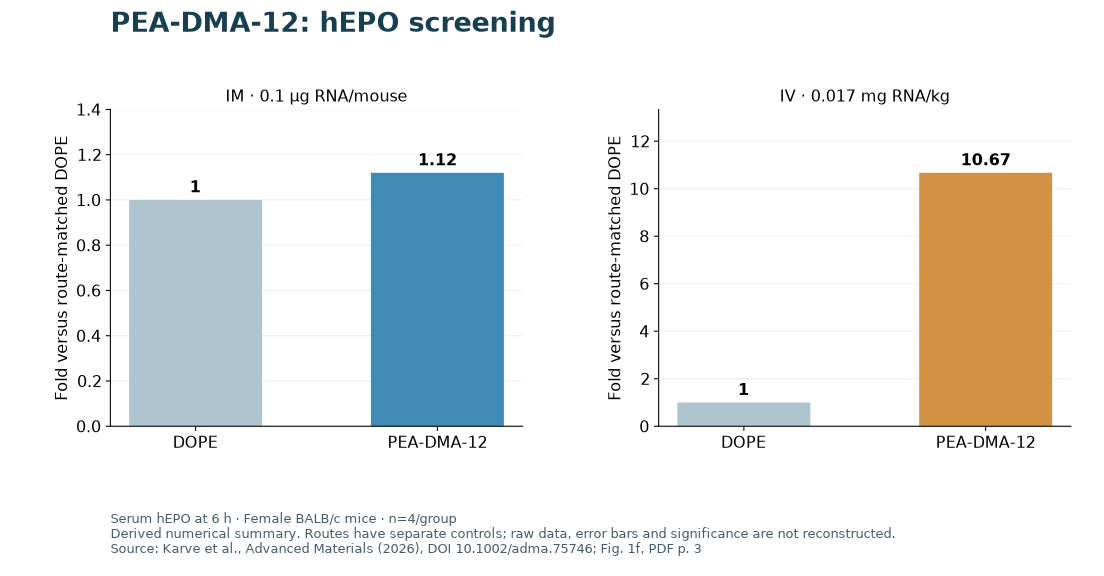
1.12-fold DOPE.

Female BALB/c mice, 6–8 weeks. Cargo: hEPO mRNA. Dose: 0.1 µg RNA/mouse. Route: IM, right gastrocnemius. Time: 6 h. Comparator: DOPE-containing LNP in the same route. n=4 mice; mean fold change; no error bars reconstructed.

Fig. 1f, PDF p. 3; legends and Methods §4.16, pp. 16–17

Serum hEPO expression

10.67-fold DOPE.

Female BALB/c mice, 6–8 weeks. Cargo: hEPO mRNA. Dose: 0.017 mg RNA/kg. Route: IV. Time: 6 h. Comparator: DOPE-containing LNP in the same route. n=4 mice; mean fold change; no error bars reconstructed.

Fig. 1f, PDF p. 3; legends and Methods §4.16, pp. 16–17

Liver luciferase expression

1.8-fold DOPE.

Male mice, 6–8 weeks; Fig. 4 legend: BALB/c; Methods §4.16: CD1 (source conflict). Cargo: FFluc mRNA. Dose: 0.017 mg RNA/kg. Route: IV. Time: 24 h. Comparator: DOPE helper-lipid LNP. n=4 mice; original plots mean ± SD.

Results p. 7; Fig. 4b,c, p. 8; Methods §4.16, p. 17

Influenza hemagglutination inhibition (HAI)

Higher HAI response than DOPE (p = 0.0004); no numerical GMT reconstructed.

Female BALB/c mice. Cargo: A/Tasmania/503/2020 (H3N2) HA mRNA. Dose: 0.4 µg RNA/dose, two doses. Route: IM, quadriceps; Methods 0.05 mL/dose. Time: Schedule conflict: caption 3 weeks apart; Methods days 0 and 28. Blood-sampling day not specified here.. Comparator: DOPE helper-lipid LNP. n=8 mice/group; ordinary one-way ANOVA with Dunnett test.

Results p. 9; Fig. 5b and caption p. 10; Methods §4.17, p. 17

Source-linked performance figures

The following newly drawn figure summarizes verified reported numerical comparisons. Original experimental figures and statistics remain available at the publisher; no original artwork, raw points or error bars are reconstructed.

PEA-DMA-12 hEPO screening results versus route-matched DOPE
Derived numerical summary. New numerical summary of the reported IM and IV comparisons at 6 h; 40 / 30 / 28.5 / 1.5 mol% screening recipe, not the optimized recipe. Mean folds, n=4 mice/group. Each route uses its own DOPE control; no raw error bars reconstructed. Fig. 1f, PDF p. 3

Cell experiment protocols

Source-specific procedures with missing operational details and source conflicts retained.

Human DC mRNA uptake · Optimized lead formulation

Primary hDCs in RPMI + 10% heat-inactivated FBS + 1% penicillin/streptomycin. Cargo: Influenza H3 HA mRNA. Dose: 1 µg RNA / 10^6 cells. Controls: Lead-helper, DOPE and DSPC LNPs.

Exact smFISH replicate count not separately stated.

  1. Rest hDCs for 3–4 h at 37°C; use 10^6 viable cells/mL and 50,000 cells/well in PhenoPlates.
  2. Treat with the optimized LNP at 1 µg RNA per million cells for 4 h.
  3. Wash with PBS containing 2 mM VRC; fix with pre-chilled −20°C 100% methanol for 15 min at room temperature.
  4. Hybridize with 100 nM Quasar 670 HA-H3 probes overnight at 37°C; wash as described in the source.
  5. Acquire 63× images using five z-stacks and eight fields/well; quantify intracellular mRNA spots rather than protein expression.
Lipid stock / organic phase

Lipids were dissolved in ethanol; individual and combined lipid-stock concentrations were not stated.

Ionizable Lipid A, PEA-DMA-12, cholesterol and DMG-PEG2000; Ethanol; Organic input before T-mixing; concentrations unspecified

RNA aqueous input

RNA input concentration and buffer are reported in Methods §4.2.

Influenza H3 HA mRNA; 1 mM sodium citrate + 150 mM NaCl, pH 4.5; 0.0833; mg/mL; Input RNA concentration, not final administered concentration; Aqueous input before T-mixing

Mixing and processing

Aqueous:organic = 4:1 by volume; nylon T-mixer, gear pumps, 250 mL/min total. Lipid concentrations, mixing temperature and exact per-formulation N/P are unspecified.

RNA aqueous and ethanolic lipid phases; Aqueous:ethanol 4:1; total 250 mL/min. Source Methods §4.2.

Final treatment / dose

The reported dose and endpoint are retained. Final LNP buffer, concentration and delivered volume are not all specified.

Influenza H3 HA mRNA; 1 µg RNA / 10^6 cells; 4 h exposure; overnight hybridization

Preparation, storage and use

After dialysis and UF/DF, LNPs were sterile-filtered, concentration-adjusted and stored at −80°C. Final buffer, filter pore size and storage duration were not specified.

Dialysis → UF/DF → sterile filtration → target-concentration adjustment → −80°C storage. These are assembled-LNP conditions, not the supplied pure-lipid shelf life.

Main Methods §4.12–4.13, p. 16; Fig. 5a

Human DC protein expression · Optimized lead formulation

Primary hDCs; same cell-culture conditions as uptake. Cargo: Influenza H3 HA mRNA. Dose: Methods: 10 µg RNA / 10^6 cells; Fig. 5a caption: 1 µg / 10^6 cells (unresolved source conflict). Controls: Lead-helper, DOPE and DSPC LNPs.

n=3 technical replicates for protein means in Fig. 5c.

  1. Seed 50,000 rested hDCs per well in the stated culture medium.
  2. Use the source-specific dose with the documented 1 versus 10 µg/million discrepancy unresolved; do not substitute a single reconciled dose.
  3. At 24 h, fix in 4% PFA for 10 min and block in 2% BSA for 1 h.
  4. Stain with anti-H3 AF647 antibody (1:250) and DAPI for 1 h.
  5. Acquire 20× Opera Phenix images, four fields/well, and quantify HA protein expression.
Lipid stock / organic phase

Lipids were dissolved in ethanol; individual and combined lipid-stock concentrations were not stated.

Ionizable Lipid A, PEA-DMA-12, cholesterol and DMG-PEG2000; Ethanol; Organic input before T-mixing; concentrations unspecified

RNA aqueous input

RNA input concentration and buffer are reported in Methods §4.2.

Influenza H3 HA mRNA; 1 mM sodium citrate + 150 mM NaCl, pH 4.5; 0.0833; mg/mL; Input RNA concentration, not final administered concentration; Aqueous input before T-mixing

Mixing and processing

Aqueous:organic = 4:1 by volume; nylon T-mixer, gear pumps, 250 mL/min total. Lipid concentrations, mixing temperature and exact per-formulation N/P are unspecified.

RNA aqueous and ethanolic lipid phases; Aqueous:ethanol 4:1; total 250 mL/min. Source Methods §4.2.

Final treatment / dose

The reported dose and endpoint are retained. Final LNP buffer, concentration and delivered volume are not all specified.

Influenza H3 HA mRNA; Methods: 10 µg RNA / 10^6 cells; Fig. 5a caption: 1 µg / 10^6 cells (unresolved source conflict); 24 h

Preparation, storage and use

After dialysis and UF/DF, LNPs were sterile-filtered, concentration-adjusted and stored at −80°C. Final buffer, filter pore size and storage duration were not specified.

Dialysis → UF/DF → sterile filtration → target-concentration adjustment → −80°C storage. These are assembled-LNP conditions, not the supplied pure-lipid shelf life.

Main Methods §4.14, p. 16; Fig. 5a,c caption, p. 10
Human MIMIC PTE transfection and cytokines · Optimized lead formulation

EA.hy926 endothelial layer on collagen matrix; cryopreserved PBMCs from 5 female / 5 male donors aged 18–60. Cargo: Influenza HA mRNA. Dose: RNA treatment concentration not reported. Controls: Source DOPE/helper LNP groups; original paper also includes vaccine benchmarks.

N=10 donors for cytokines; triplicate PTE wells in Methods.

  1. Establish the reported collagen/endothelial tissue-equivalent culture with EA.hy926 cells and primary human PBMCs.
  2. Apply the optimized HA mRNA-LNP. The source main article does not give its treatment concentration.
  3. Keep the 22 h Methods versus 24 h Results endpoint difference visible.
  4. Harvest cells for multiparameter flow cytometry, including CD14/CD16-defined classical monocytes and HA expression.
  5. Collect supernatants for Luminex cytokine measurement; distinguish transfection percentage from cytokine production.
Lipid stock / organic phase

Lipids were dissolved in ethanol; individual and combined lipid-stock concentrations were not stated.

Ionizable Lipid A, PEA-DMA-12, cholesterol and DMG-PEG2000; Ethanol; Organic input before T-mixing; concentrations unspecified

RNA aqueous input

RNA input concentration and buffer are reported in Methods §4.2.

Influenza HA mRNA; 1 mM sodium citrate + 150 mM NaCl, pH 4.5; 0.0833; mg/mL; Input RNA concentration, not final administered concentration; Aqueous input before T-mixing

Mixing and processing

Aqueous:organic = 4:1 by volume; nylon T-mixer, gear pumps, 250 mL/min total. Lipid concentrations, mixing temperature and exact per-formulation N/P are unspecified.

RNA aqueous and ethanolic lipid phases; Aqueous:ethanol 4:1; total 250 mL/min. Source Methods §4.2.

Final treatment / dose

The reported dose and endpoint are retained. Final LNP buffer, concentration and delivered volume are not all specified.

Influenza HA mRNA; RNA treatment concentration not reported; Methods 22 h treatment; Results/legend 24 h cytokine collection

Preparation, storage and use

After dialysis and UF/DF, LNPs were sterile-filtered, concentration-adjusted and stored at −80°C. Final buffer, filter pore size and storage duration were not specified.

Dialysis → UF/DF → sterile filtration → target-concentration adjustment → −80°C storage. These are assembled-LNP conditions, not the supplied pure-lipid shelf life.

Main Methods §4.19, pp. 17–18; Fig. 5f–h

Human MIMIC LTE antibody response · Optimized lead formulation

Primary human lymphatic-tissue-equivalent B/T/APC culture. Cargo: A/Tasmania influenza HA mRNA. Dose: LNP treatment concentration not stated in supplied main article. Controls: DOPE and helper-lipid LNP comparators.

N=18 donors.

  1. Use the source human LTE co-culture of B cells, T cells and antigen-presenting cells.
  2. Prime differentiated APCs and isolated B cells with HA mRNA-LNP; no treatment concentration is inferred.
  3. Co-culture primed APCs and B cells with autologous CD4+ T cells for 14 days.
  4. Collect supernatants and measure HA-specific IgG using recombinant A/Tasmania/503/2020 HA-coated magnetic beads and the Bioplex-100 system. Retain donor-level data; Fig. 5e plots log10 MFI with geometric mean and geometric SD.
Lipid stock / organic phase

Lipids were dissolved in ethanol; individual and combined lipid-stock concentrations were not stated.

Ionizable Lipid A, PEA-DMA-12, cholesterol and DMG-PEG2000; Ethanol; Organic input before T-mixing; concentrations unspecified

RNA aqueous input

RNA input concentration and buffer are reported in Methods §4.2.

A/Tasmania influenza HA mRNA; 1 mM sodium citrate + 150 mM NaCl, pH 4.5; 0.0833; mg/mL; Input RNA concentration, not final administered concentration; Aqueous input before T-mixing

Mixing and processing

Aqueous:organic = 4:1 by volume; nylon T-mixer, gear pumps, 250 mL/min total. Lipid concentrations, mixing temperature and exact per-formulation N/P are unspecified.

RNA aqueous and ethanolic lipid phases; Aqueous:ethanol 4:1; total 250 mL/min. Source Methods §4.2.

Final treatment / dose

The reported dose and endpoint are retained. Final LNP buffer, concentration and delivered volume are not all specified.

A/Tasmania influenza HA mRNA; LNP treatment concentration not stated in supplied main article; 14-day co-culture after antigen priming

Preparation, storage and use

After dialysis and UF/DF, LNPs were sterile-filtered, concentration-adjusted and stored at −80°C. Final buffer, filter pore size and storage duration were not specified.

Dialysis → UF/DF → sterile filtration → target-concentration adjustment → −80°C storage. These are assembled-LNP conditions, not the supplied pure-lipid shelf life.

Fig. 5e caption, p. 10; Methods §4.19.6–4.19.7, p. 18

Animal experiment protocols

Study-specific routes, cargo doses and endpoint details; no unreported stock or administered concentration is invented.

hEPO screening · IM · Initial hEPO screening

Female BALB/c mice, 6–8 weeks. Cargo: hEPO mRNA. Dose: 0.1 µg RNA/mouse. Controls: Route-matched DOPE helper-lipid LNP.

n=4 mice/group.

  1. Prepare the screening recipe with Ionizable Lipid A / helper / cholesterol / DMG-PEG2000 = 40 / 30 / 28.5 / 1.5 mol%.
  2. Use the stated ethanolic lipid and citrate-buffered RNA inputs at aqueous:ethanol 4:1, 250 mL/min total; dialyze and UF/DF, sterile-filter and concentration-adjust as reported.
  3. Administer 0.1 µg RNA/mouse by IM into the right gastrocnemius.
  4. Collect blood at 6 h and quantify serum hEPO with the R&D Systems ELISA; normalize to the DOPE control from the same route.
Lipid stock / organic phase

Lipids were dissolved in ethanol; individual and combined lipid-stock concentrations were not stated.

Ionizable Lipid A, PEA-DMA-12, cholesterol and DMG-PEG2000; Ethanol; Organic input before T-mixing; concentrations unspecified

RNA aqueous input

RNA input concentration and buffer are reported in Methods §4.2.

hEPO mRNA; 1 mM sodium citrate + 150 mM NaCl, pH 4.5; 0.0833; mg/mL; Input RNA concentration, not final administered concentration; Aqueous input before T-mixing

Mixing and processing

Aqueous:organic = 4:1 by volume; nylon T-mixer, gear pumps, 250 mL/min total. Lipid concentrations, mixing temperature and exact per-formulation N/P are unspecified.

RNA aqueous and ethanolic lipid phases; Aqueous:ethanol 4:1; total 250 mL/min. Source Methods §4.2.

Final treatment / dose

The reported dose and endpoint are retained. Final LNP buffer, concentration and delivered volume are not all specified.

hEPO mRNA; 0.1 µg RNA/mouse; 6 h

Preparation, storage and use

After dialysis and UF/DF, LNPs were sterile-filtered, concentration-adjusted and stored at −80°C. Final buffer, filter pore size and storage duration were not specified.

Dialysis → UF/DF → sterile filtration → target-concentration adjustment → −80°C storage. These are assembled-LNP conditions, not the supplied pure-lipid shelf life.

Fig. 1f, PDF p. 3; Methods §4.2 and §4.16, pp. 14,16–17

hEPO screening · IV · Initial hEPO screening

Female BALB/c mice, 6–8 weeks. Cargo: hEPO mRNA. Dose: 0.017 mg RNA/kg. Controls: Route-matched DOPE helper-lipid LNP.

n=4 mice/group.

  1. Prepare the screening recipe with Ionizable Lipid A / helper / cholesterol / DMG-PEG2000 = 40 / 30 / 28.5 / 1.5 mol%.
  2. Use the stated ethanolic lipid and citrate-buffered RNA inputs at aqueous:ethanol 4:1, 250 mL/min total; dialyze and UF/DF, sterile-filter and concentration-adjust as reported.
  3. Administer 0.017 mg RNA/kg by IV.
  4. Collect blood at 6 h and quantify serum hEPO with the R&D Systems ELISA; normalize to the DOPE control from the same route.
Lipid stock / organic phase

Lipids were dissolved in ethanol; individual and combined lipid-stock concentrations were not stated.

Ionizable Lipid A, PEA-DMA-12, cholesterol and DMG-PEG2000; Ethanol; Organic input before T-mixing; concentrations unspecified

RNA aqueous input

RNA input concentration and buffer are reported in Methods §4.2.

hEPO mRNA; 1 mM sodium citrate + 150 mM NaCl, pH 4.5; 0.0833; mg/mL; Input RNA concentration, not final administered concentration; Aqueous input before T-mixing

Mixing and processing

Aqueous:organic = 4:1 by volume; nylon T-mixer, gear pumps, 250 mL/min total. Lipid concentrations, mixing temperature and exact per-formulation N/P are unspecified.

RNA aqueous and ethanolic lipid phases; Aqueous:ethanol 4:1; total 250 mL/min. Source Methods §4.2.

Final treatment / dose

The reported dose and endpoint are retained. Final LNP buffer, concentration and delivered volume are not all specified.

hEPO mRNA; 0.017 mg RNA/kg; 6 h

Preparation, storage and use

After dialysis and UF/DF, LNPs were sterile-filtered, concentration-adjusted and stored at −80°C. Final buffer, filter pore size and storage duration were not specified.

Dialysis → UF/DF → sterile filtration → target-concentration adjustment → −80°C storage. These are assembled-LNP conditions, not the supplied pure-lipid shelf life.

Fig. 1f, PDF p. 3; Methods §4.2 and §4.16, pp. 14,16–17

IV liver reporter biodistribution · Optimized lead formulation

Male mice 6–8 weeks; BALB/c in Fig. 4 caption versus CD1 in Methods. Cargo: FFluc mRNA. Dose: 0.017 mg RNA/kg. Controls: DOPE/DSPC and lead-helper LNPs.

n=4 mice/group.

  1. Prepare the optimized lead composition from Fig. 3b.
  2. Administer FFluc mRNA-LNP intravenously at 0.017 mg RNA/kg. Retain the unresolved mouse-strain discrepancy.
  3. At day 2 inject 0.2 mL D-luciferin (15 mg/mL) subcutaneously; image 10–15 min later.
  4. Acquire whole-animal and ex vivo heart, lung, liver, kidney and spleen signals; compare with the DOPE formulation.
Lipid stock / organic phase

Lipids were dissolved in ethanol; individual and combined lipid-stock concentrations were not stated.

Ionizable Lipid A, PEA-DMA-12, cholesterol and DMG-PEG2000; Ethanol; Organic input before T-mixing; concentrations unspecified

RNA aqueous input

RNA input concentration and buffer are reported in Methods §4.2.

FFluc mRNA; 1 mM sodium citrate + 150 mM NaCl, pH 4.5; 0.0833; mg/mL; Input RNA concentration, not final administered concentration; Aqueous input before T-mixing

Mixing and processing

Aqueous:organic = 4:1 by volume; nylon T-mixer, gear pumps, 250 mL/min total. Lipid concentrations, mixing temperature and exact per-formulation N/P are unspecified.

RNA aqueous and ethanolic lipid phases; Aqueous:ethanol 4:1; total 250 mL/min. Source Methods §4.2.

Final treatment / dose

The reported dose and endpoint are retained. Final LNP buffer, concentration and delivered volume are not all specified.

FFluc mRNA; 0.017 mg RNA/kg; 24 h; Methods day 2

Preparation, storage and use

After dialysis and UF/DF, LNPs were sterile-filtered, concentration-adjusted and stored at −80°C. Final buffer, filter pore size and storage duration were not specified.

Dialysis → UF/DF → sterile filtration → target-concentration adjustment → −80°C storage. These are assembled-LNP conditions, not the supplied pure-lipid shelf life.

Fig. 4a–c, p. 8; Main Methods §4.16, p. 17

Influenza mRNA vaccine HAI · Optimized lead formulation

Female BALB/c mice. Cargo: A/Tasmania/503/2020 (H3N2) HA mRNA. Dose: 0.4 µg RNA/dose; two doses. Controls: DOPE helper LNP; clinical-lipid DSPC benchmarks as shown in Fig. 5b.

n=8 mice/group; one-way ANOVA / Dunnett.

  1. Use the optimized helper-lipid formulation and HA mRNA.
  2. Administer 0.4 µg RNA per mouse intramuscularly; Methods specify 0.05 mL into quadriceps.
  3. The source describes two schedules (3-week interval in caption; days 0 and 28 in Methods). Keep both source versions rather than invent a corrected schedule.
  4. Test serum against homologous A/Tasmania/503/2020 H3N2 using the source HAI procedure. Do not substitute the California HA name from the general Materials paragraph.
Lipid stock / organic phase

Lipids were dissolved in ethanol; individual and combined lipid-stock concentrations were not stated.

Ionizable Lipid A, PEA-DMA-12, cholesterol and DMG-PEG2000; Ethanol; Organic input before T-mixing; concentrations unspecified

RNA aqueous input

RNA input concentration and buffer are reported in Methods §4.2.

A/Tasmania/503/2020 (H3N2) HA mRNA; 1 mM sodium citrate + 150 mM NaCl, pH 4.5; 0.0833; mg/mL; Input RNA concentration, not final administered concentration; Aqueous input before T-mixing

Mixing and processing

Aqueous:organic = 4:1 by volume; nylon T-mixer, gear pumps, 250 mL/min total. Lipid concentrations, mixing temperature and exact per-formulation N/P are unspecified.

RNA aqueous and ethanolic lipid phases; Aqueous:ethanol 4:1; total 250 mL/min. Source Methods §4.2.

Final treatment / dose

The reported dose and endpoint are retained. Final LNP buffer, concentration and delivered volume are not all specified.

A/Tasmania/503/2020 (H3N2) HA mRNA; 0.4 µg RNA/dose; two doses; Caption: 3 weeks apart; Methods: days 0 and 28

Preparation, storage and use

After dialysis and UF/DF, LNPs were sterile-filtered, concentration-adjusted and stored at −80°C. Final buffer, filter pore size and storage duration were not specified.

Dialysis → UF/DF → sterile filtration → target-concentration adjustment → −80°C storage. These are assembled-LNP conditions, not the supplied pure-lipid shelf life.

Fig. 5b and caption p. 10; Methods §4.17–4.18, p. 17

Reference and scope

Karve S, Kaushal N, Zhang H, et al. Engineering Tunable Helper Lipid Architecture to Improve Messenger RNA Lipid Nanoparticle Performance. Advanced Materials (2026), e75746. DOI: 10.1002/adma.75746

Values shown are literature-reported results for the cited formulation and study conditions. They do not guarantee performance of the supplied product in other formulations or experiments. DC Chemicals supplies the helper lipid only; RNA and prepared LNPs are not included.