Biological Activity
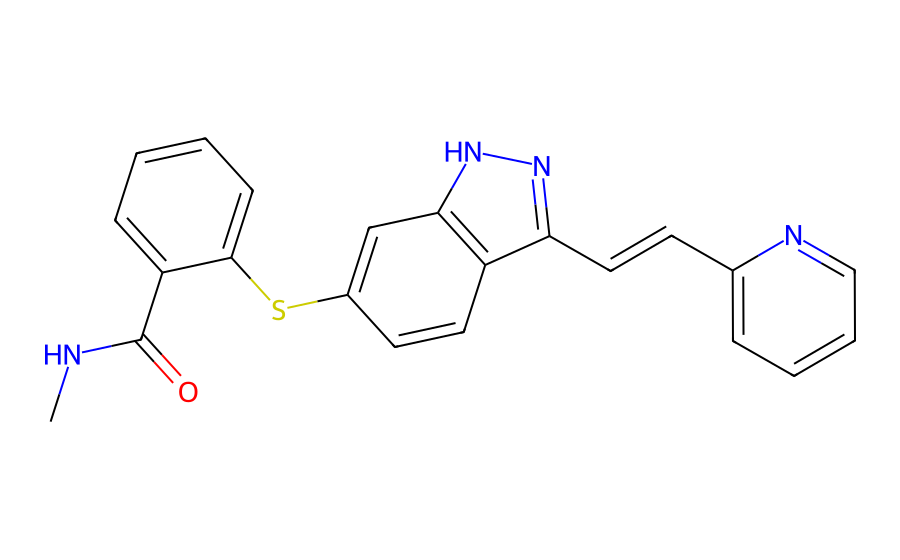
Axitinib is a multi-targeted tyrosine kinase inhibitor with IC50s of 0.1, 0.2, 0.1-0.3, 1.6 nM for VEGFR1, VEGFR2, VEGFR3 and PDGFRβ, respectively.
In Vitro
Axitinib (AG-013736) is a potent and selective inhibitor of VEGFR 1 to 3. In transfected or endogenous RTK-expressing cells, Axitinib potently blocks growth factor-stimulated phosphorylation of VEGFR-2 and VEGFR-3 with average IC50 values of 0.2 and 0.1 to 0.3 nM, respectively. Cellular activity against VEGFR-1 is 1.2 nM (measured in the presence of 2.3% bovine serum albumin), equivalent to an absolute IC50 of ~0.1 nM, based on protein binding of Axitinib. The potency against murine VEGFR-2 (Flk-1) in Flk-1-transfected NIH-3T3 cells is 0.18 nM, similar to that of its human homologue. Axitinib shows ~8- to 25-fold higher IC50 against the closely related type III and V family RTKs, including PDGFR-β (1.6 nM), KIT (1.7 nM), and PDGFR-α (5 nM); nanomolar concentrations of Axitinib blocks PDGF BB-mediated human glioma U87MG cell (PDGFR-β-positive) migration but not proliferation[2].
In Vivo
A single oral dose of Axitinib (100 mg/kg) markedly suppresses murine VEGFR-2 phosphorylation for up to 7 h compared with control tumors. Axitinib rapidly inhibits VEGF-induced vascular permeability in the skin of mice; the inhibition is dose-dependent and directly correlated with drug concentration in mice. Pharmacokinetic/pharmacodynamic analysis indicate an unbound EC50 of 0.46 nM. Similar inhibitory effects are also shown in the skin of MV522 tumor-bearing mice without exogenous VEGF-A stimulation. Axitinib inhibits the growth of human xenograft tumors in mice. Axitinib produces dose-dependent growth delay regardless of initial tumor size, model type, or implant site[2].
References & source
Published experimental findings depend on the model and assay conditions. They do not guarantee equivalent performance in every application. For laboratory research use only.