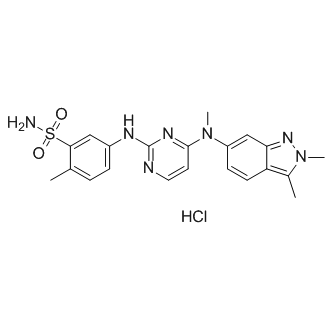
Pazopanib Hydrochloride chemical structure
Chemical structureResearch use only
CAT. NO. DC9776Featured

Pazopanib Hydrochloride

Pack Sizes & Prices

TotalUS$200
We match the best price and quality on market.
Product overview

Description & Application

Pazopanib Hydrochloride is a novel multi-target inhibitor of VEGFR1, VEGFR2, VEGFR3, PDGFRβ, c-Kit, FGFR1, and c-Fms with an IC50 of 10, 30, 47, 84, 74, 140 and 146 nM, respectively.

ParameterValue
Chemical NameGW-786034,GW786034,GW 786034
CAS No.635702-64-6
SynonymsGW-786034,GW786034,GW 786034
FormulaC21H24ClN7O2S
M.Wt473.98
SMILESCC1=CC=C(C=C1S(N)(=O)=O)NC2=NC=CC(N(C3=CC4=NN(C(C)=C4C=C3)C)C)=N2.Cl
Purity>98%
Storage2 years -20°C Powder, 2 weeks 4°C in DMSO, 6 months -80°C in DMSO

Biological Activity

Pazopanib Hydrochloride is a novel multi-target inhibitor of VEGFR1, VEGFR2, VEGFR3, PDGFRβ, c-Kit, FGFR1, and c-Fms with an IC50 of 10, 30, 47, 84, 74, 140 and 146 nM, respectively.

In Vitro

Pazopanib shows good potency against all the human VEGFR receptors with an IC50 of 10, 30, and 47 nM for VEGFR-1, -2, and -3, respectively. Significant activity is also seen against the closely related tyrosine receptor kinases PDGFRβ, c-Kit, FGF-R1, and c-fms with IC50s of 84, 74, 140, and 146 nM, respectively. In cellular assays, in addition to inhibiting the VEGF-induced proliferation of HUVECs, Pazopanib potently inhibits VEGF-induced phosphorylation of VEGFR-2 in HUVEC cells with an IC50 of ~8 nM. Pazopanib possesses good pharmacokinetics in rat, dog, and monkey with low clearances (1.4-1.7 mL/min/kg) and good oral bioavailabilities (72, 47, 65%) dosed at 10, 1, and 5 mg/kg, respectively. The cytochrome P450 profile is also improved with inhibition >10 μM against the isozymes tested, with the exception of 2C9 (7.9 μM)[1].

In Vivo

Treatment of mice with 100 mg/kg of Pazopanib twice daily for five days results in significant inhibition in the degree of vascularization. The antiangiogenic activity of Pazopanib is examined in mice bearing established human xenografts (200−250 mm3) using HT29 (colon carcinoma), A375P (melanoma), and HN5 (head and neck carcinoma) tumors following a standard three-week course of therapy. The HN5 and HT29 xenografts responded better at all doses compared to the A375P model, which is historically more resistant to VEGFR-2 inhibitors. As support that the observed inhibition of xenograft growth is working through an antiangiogenic rather than antitumor mechanism, no antiproliferative activity is observed below 10 μM for Pazopanib against these human tumor lines (HT29, HN5, A375P) growing in serum-containing media. No significant effect on the body weight of mice is observed, and the animals appeared healthy and active throughout the study duration[1]. The quantity of adherent leukocytes in the Pazopanib eye drops group is less than untreated diabetic animals and more than the healthy animals. Average leukocytes adhered to the retinal vasculature in healthy animals is 37.2±7.8, whereas diabetic animals have an average value of 102±15.6, approximately 3-fold higher than healthy animals. Animals treated with 0.5 % w/v Pazopanib suspension demonstrate 69.5±9.5 leukocytes adhered in their retinal vasculature, which is found to be significantly lower than diabetic animals[2].

References & source

DC Chemicals original product information

Published experimental findings depend on the model and assay conditions. They do not guarantee equivalent performance in every application. For laboratory research use only.
Product documentation

Refer to the certificate supplied with your lot for batch-specific release results.

Handling guide

2 years -20°C Powder, 2 weeks 4°C in DMSO, 6 months -80°C in DMSO

Solution calculator

Related research products

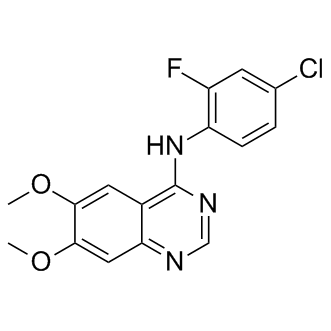
ZM306416 chemical structureDC1082

ZM306416

ZM-306416 (CB 676475) is a potent inhibitor of VEGFR with IC50s of 0.1 and 2 μM for KDR and Flt, respectively. ZM-306416 is also a EGFR inhibitor with an IC50 of <10 nM.

View activity & prices
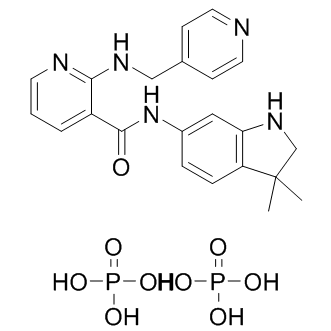
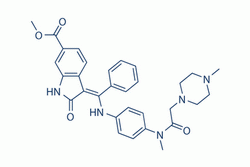
Nintedanib (BIBF 1120) chemical structureDC7084

Nintedanib (BIBF 1120)

BIBF 1120 is a potent triple angiokinase inhibitor for VEGFR1/2/3, FGFR1/2/3 and PDGFRα/β with IC50s of 34 nM/13 nM/13 nM, 69 nM/37 nM/108 nM and 59 nM/65 nM, respectively.

View activity & prices
Motesanib Diphosphate (AMG-706) chemical structureDC7200

Motesanib Diphosphate (AMG-706)

Motesanib Diphosphate is a potent ATP-competitive inhibitor of VEGFR1/2/3 with IC50s of 2 nM/3 nM/6 nM, respectively, and has similar activity against Kit, and is approximately 10-fold more selective for VEGFR than…

View activity & prices
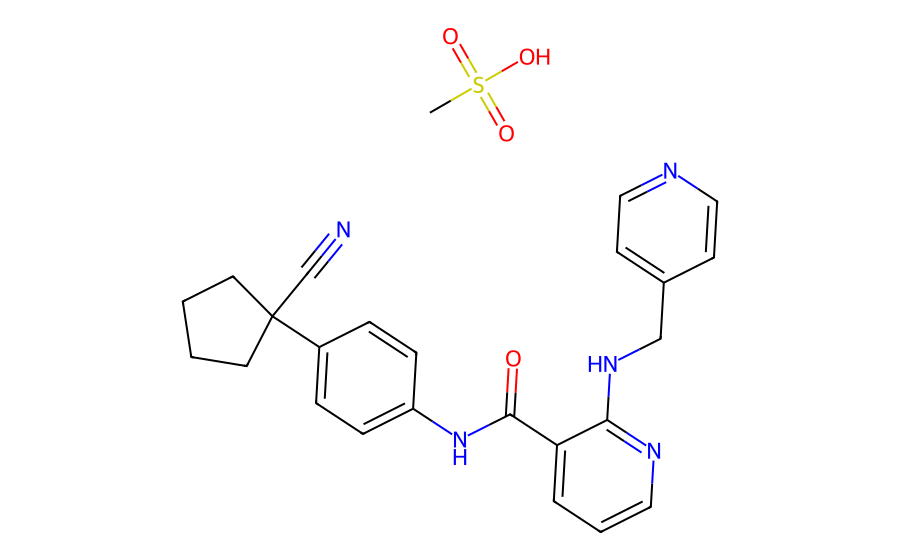
Apatinib Mesylate chemical structureDC4101

Apatinib Mesylate

Apatinib is a highly selective VEGFR2 inhibitor with an IC50 of 1 nM. Apatinib also potently suppresses the activities of Ret, c-Kit and c-Src with IC50s of 13, 429 and 530 nM, respectively.

View activity & prices
Cediranib chemical structureDC3170

Cediranib

Cediranib maleate (AZD-2171 maleate) is a highly potent, orally available VEGFR tyrosine kinase inhibitor with IC50s of <1, <3, 5, 5, 36, 2 nM for Flt1, KDR, Flt4, PDGFRα, PDGFRβ, c-Kit, respectively.

View activity & prices
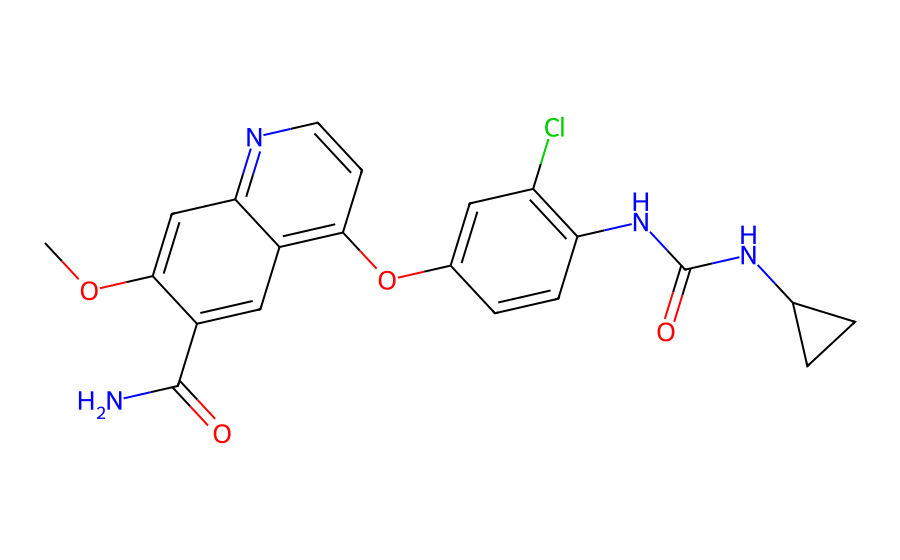
E7080 (Lenvatinib) chemical structureDC7116

E7080 (Lenvatinib)

Lenvatinib is an oral, multi-targeted tyrosine kinase inhibitor with IC50s of 4 and 5.2 nM for VEGFR2(KDR) and VEGFR3(Flt-4), respectively. Lenvatinib is less potent against VEGFR1/Flt-1 and shows approximately 10-fold…

View activity & prices
Cabozantinib S-malate chemical structureDC9266

Cabozantinib S-malate

Cabozantinib (S-malate) is a potent multiple receptor tyrosine kinases inhibitor that inhibits VEGFR2, c-Met, Kit, Axl and Flt3 with IC50s of 0.035, 1.3, 4.6, 7 and 11.3 nM, respectively.

View activity & prices
SKLB610 chemical structureDC7502

SKLB610

SKLB610, a novel multi-targeted inhibitor, inhibits angiogenesis-related tyrosine kinase VEGFR2, FGFR2 and PDGFR at rate of 97%, 65% and 55%, respectively, at concentration of 10 μM in biochemical kinase assays.

View activity & prices

Cart

Request quotation