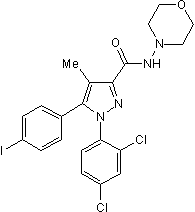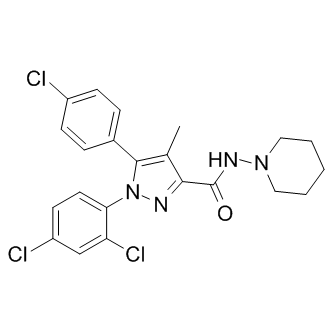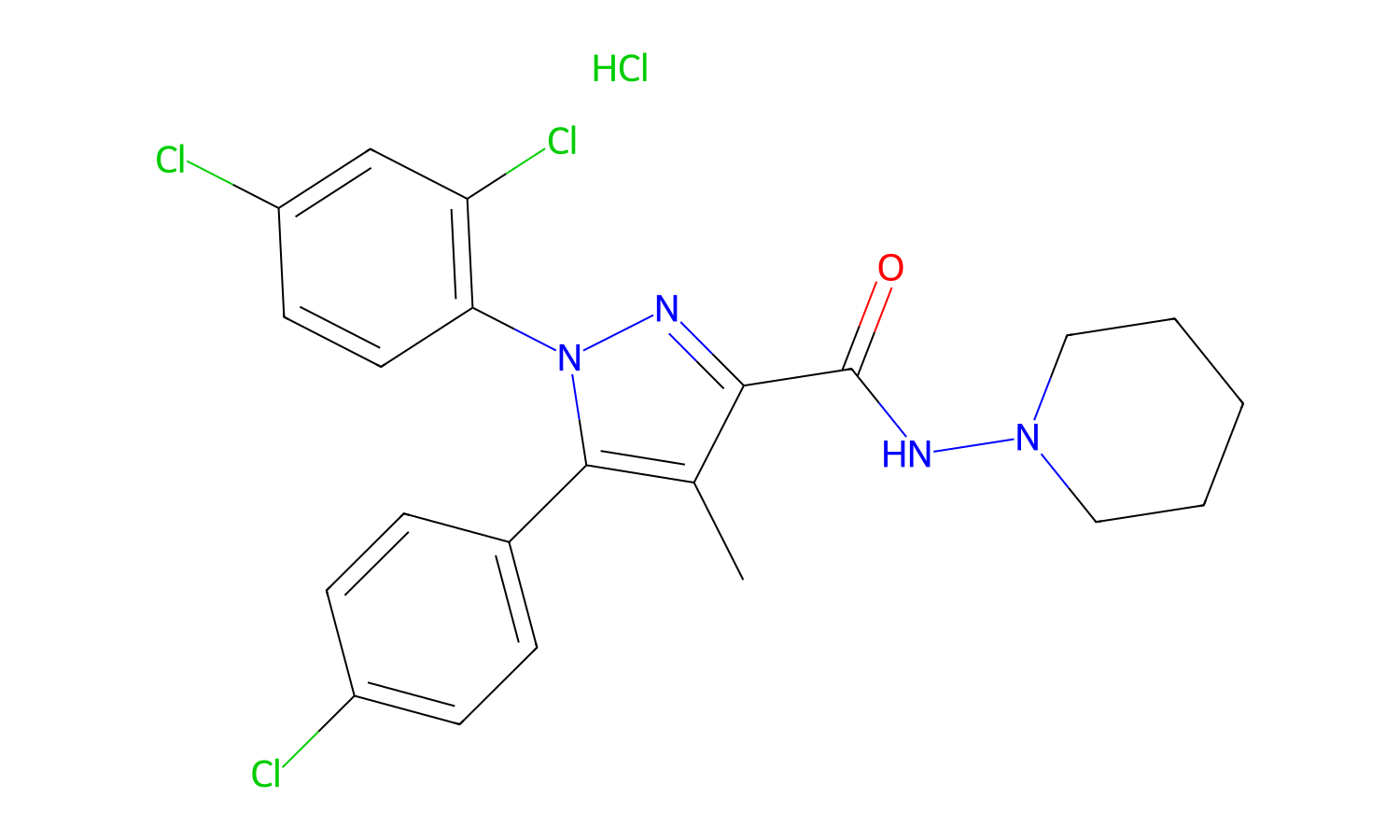
Rimonabant hydrochloride chemical structure
Chemical structureResearch use onlyView full-size structure
CAT. NO. DC9383Featured

Rimonabant hydrochloride

Pack Sizes & Prices

TotalUS$150
We match the best price and quality on market.
Product overview

Description & Application

Rimonabant hydrochloride is a cannabinoid receptor (CB) antagonist which binds selectively to CB1 with a Ki of 2 nM.

ParameterValue
Chemical NameRimonabant hydrochloride
CAS No.158681-13-1
SynonymsRimonabant (Hydrochloride)
FormulaC22H22Cl4N4O
M.Wt500.26
SMILESCc1c(C(=O)NN2CCCCC2)nn(-c2ccc(Cl)cc2Cl)c1-c1ccc(Cl)cc1.Cl
Purity>98%
Storage2 years -20°C Powder, 2 weeks 4°C in DMSO, 6 months -80°C in DMSO

Chemical identity references

Biological Activity

Rimonabant hydrochloride is a cannabinoid receptor (CB) antagonist which binds selectively to CB1 with a Ki of 2 nM.

In Vitro

Rimonabant hydrochloride (SR 141716A) binds selectively to central cannabinoid receptors (CB1) with high affinity (Ki=2 nM), and blocks the inhibitory effects of cannabinoid receptor agonists in the mouse vas deferens, dopamine-stimulated adenylyl cyclase and WIN 55212-stimulated GTPγS binding[1]. Rimonabant dose-dependently inhibited CO synthesis in Raw 264.7 macrophages, with 1 µM producing a significant (~40%) decrease compared to untreated controls and concentrations ≥ 5 µM producing near complete inhibition. A small, but significant, reduction of TG and DG synthesis is also observed with Rimonabant at concentrations ≥ 10 µM. Inhibition of CO synthesis in Raw 264.7 macrophages by Rimonabant (IC50 value 2.9±0.38 µM) is very similar to that of AM251 and SR144528 (IC50 value 2.6±0.26 µM and 2.5±0.32 µM, respectively), two related compounds previously demonstrated to be potent ACAT inhibitors. Mouse peritoneal macrophages also displayed significantly reduced CO synthesis in response to Rimonabant treatment. Rimonabant at concentrations ≥ 1 µM significantly inhibits CO synthesis in CHO-ACAT1 and CHO-ACAT2 cells in a concentration-dependent manner with similar efficiency (IC50s of 1.5±1.2 µM and 2.2±1.1 µM, respectively)[2].

In Vivo

Pretreatment with Rimonabant hydrochloride (SR 141716A) blocks the antinociceptive, discriminative stimulus, memory impairing and hypolocomotor effects produced by Δ-9-THC. SR 141716A also precipitates a withdrawal syndrome in rats treated chronically with Δ-9-THC[1]. Pretreatment of mice with 0.1 mg/kg of WIN 55212-2 is effective in increasing the CPP induced by MDMA , while 1 mg/kg of Rimonabant specifically blocks CB1 receptors and does not act as an inverse agonist[3].

References & source

DC Chemicals original product information

Published experimental findings depend on the model and assay conditions. They do not guarantee equivalent performance in every application. For laboratory research use only.
Product documentation

Refer to the certificate supplied with your lot for batch-specific release results.

Handling guide

2 years -20°C Powder, 2 weeks 4°C in DMSO, 6 months -80°C in DMSO

Solution calculator

Related research products

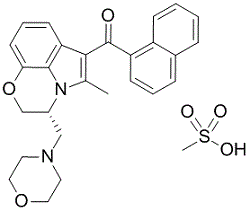
WIN-55212-2 mesylate chemical structureDC2050

WIN-55212-2 mesylate

WIN 55,212-2 Mesylate is a potent aminoalkylindole cannabinoid (CB) receptor agonist with Kis of 62.3 and 3.3 nM for human recombinant CB1 and CB2 receptors, respectively.

View activity & prices
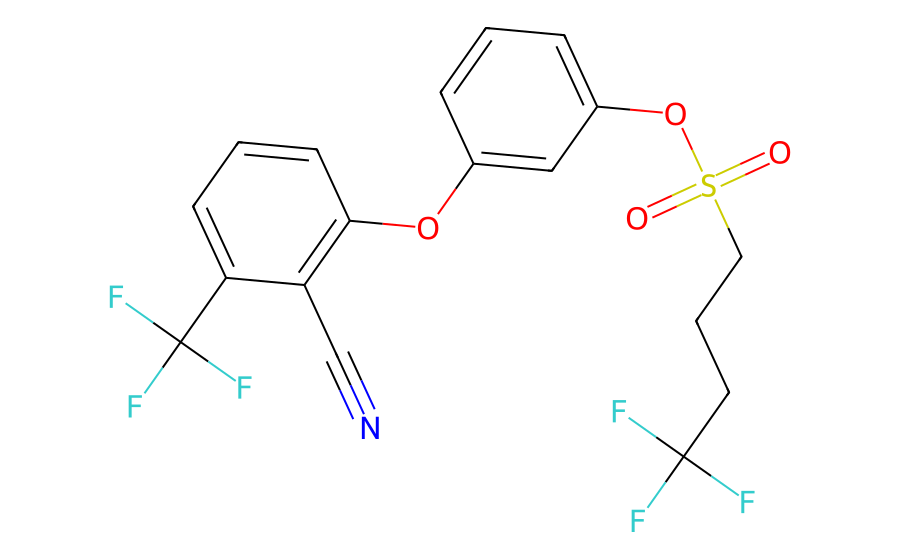
Bay 59-3074 chemical structureDC9783

Bay 59-3074

Bay 59-3074 is a novel, selective CB1/CB2 receptor partial agonist with Ki values of 48.3 and 45.5 nM at human CB1 and CB2 receptors respectively . Orally active CB1 agonist in vivo.

View activity & prices
AM 281 chemical structureDC7251

AM 281

AM281 is a selective CB1 receptor antagonist with an IC50 of 9.91 nM. AM281 inhibits CB2 receptor with an IC50 of 13000 nM[1].

View activity & prices
K145 (hydrochloride) chemical structureDC9625

K145 (hydrochloride)

K145 is a selective SphK2 inhibitor with an IC50 of 4.30±0.06 μM , while no inhibition of SphK1 at concentrations up to 10 μM.IC50 value: 4.3 uM [1]Target: SphK2in vitro: K145 inhibited the activity of SphK2 in a…

View activity & prices
Reversine chemical structureDC7260

Reversine

Reversine is a novel class of ATP-competitive Aurora kinase inhibitor with IC50s of 400, 500 and 400 nM for Aurora A, Aurora B and Aurora C, respectively.

View activity & prices
ND-646 chemical structureDC9810

ND-646

ND-646 is an orally bioavailable and steric inhibitor of acetyl-CoA carboxylase (ACC) with IC50s of 3.5 nM and 4.1 nM for recombinant hACC1 and hACC2, respectively.

View activity & prices

Cart

Request quotation