Biological Activity
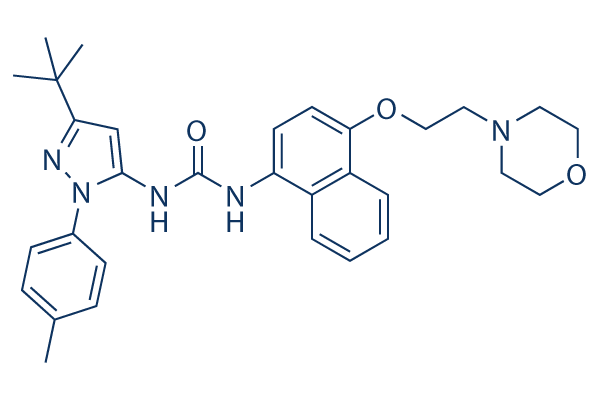
Doramapimod (BIRB 796) is a highly potent p38 MAPK inhibitor with an IC50 of 4 nM. It also inhibits B-Raf with an IC50 of 83 nM.
In Vitro
Doramapimod (BIRB 796) is a highly potent inhibitor of p38α, a serine/threonine mitogen activated protein kinase (MAPK) that is usually associated with inflammation because of its role in T-cell proliferation and cytokine production[1]. Doramapimod (BIRB 796) is a picomolar inhibitor of human p38 MAP kinase[2]. HEK293 cells are incubated with different concentrations of Doramapimod (BIRB 796) for 30 min or 2 h prior to stimulation with sorbitol (an osmotic shock) and examined the activation of MAPKAP-K2 by measuring its activity. MAPKAP-K2 activation is inhibited in these cells in a time-dependent manner with an apparent IC50 of 30 nM after 30 min or 8 nM after 2 h of preincubation with Doramapimod[3].
In Vivo
The mean xenograft weigh of Doramapimod (BIRB 796) plus Paclitaxel group (1.14±0.48 g) is lighter than control, Doramapimod or Paclitaxel group (1.84±0.61, 1.80±0.62 and 1.65±0.29 g) (P<0.05) in Athymic nude mice (BALB/c-nu/nu). The inhibition rate of Doramapimod, Paclitaxel and Doramapimod plus Paclitaxel is 1.93%, 9.93% and 38%. Importantly, the combination of Doramapimod and Paclitaxel produces a significant inhibition of tumor growth, compare with control, Paclitaxel or Doramapimod alone[4]. The Doramapimod (BIRB 796) treatment slightly reduces blood pressure (166±7 mm Hg at week 7; P<0.05), whereas SD rats are normotensive (123±3 mm Hg). Despite the reduction in blood pressure, untreated and Doramapimod-treated dTGRs have similar heart weight and cardiac hypertrophy indices (heart-to-tibia ratio), which are significantly higher compare with nontransgenic SD rats (310±6 versus 307±6 versus 206±5 mg/cm, respectively; P<0.05)[5].
References & source
Published experimental findings depend on the model and assay conditions. They do not guarantee equivalent performance in every application. For laboratory research use only.