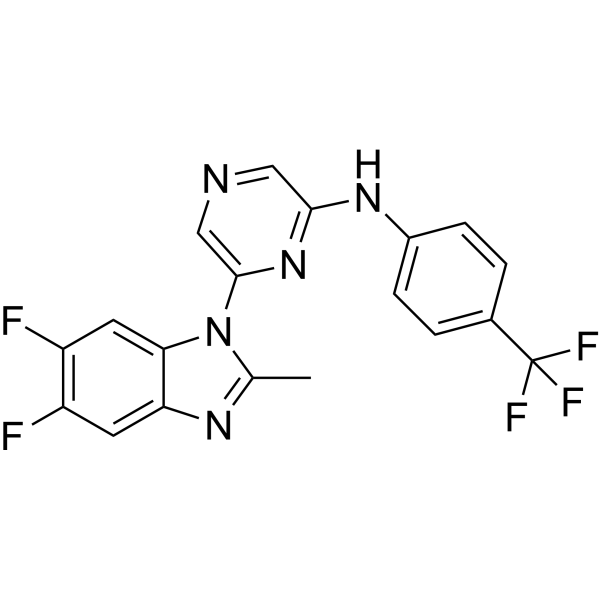
PTC-028 chemical structure
Chemical structureResearch use only
CAT. NO. DC7552Featured

PTC-028

Pack Sizes & Prices

TotalUS$500
We match the best price and quality on market.
Product overview

Description & Application

PTC-028 is an orally bioavailable inhibitor of stem cell factor BMI-1 in ovarian cancer. PTC-028 selectively inhibits cancer cells whereas normal cells remain unaffected. Depletion of BMI-1 by PTC-028 induces caspase-mediated apoptosis[1].

ParameterValue
Chemical NamePTC-028
CAS No.1782970-28-8
Synonyms2-Pyrazinamine, 6-(5,6-difluoro-2-methyl-1H-benzimidazol-1-yl)-N-[4-(trifluoromethyl)phenyl]-;6-(5,6-difluoro-2-methyl-1H-benzo[d]imidazol-1-yl)-N-(4-(trifluoromethyl)phenyl)pyrazin-2-amine;PTC 028;PTC028;BCP20909;s8662;ZB1588;AK00798850;A16812;6-(5,6-difluoro-2-methylbenzimidazol-1-yl)-N-[4-(trifluoromethyl)phenyl]pyrazin-2-amine;PTC-028;HY-103696;PTC-028?;AC-36334;CCG-268705;BP168106;D80525;AKOS037648938;1782970-28-8;6-(5,6-difluoro-2-methyl-1,3-benzodiazol-1-yl)-N-[4-(trifluoromethyl)phenyl]pyrazin-2-amine;PTC 028;EX-A1647;DA-57208;SCHEMBL16747858;BS-16072;CS-0032942;JEZGPBWIZWPDHP-UHFFFAOYSA-N
FormulaC19H12F5N5
M.Wt405.3241
SMILESFC1=C(C=C2C(=C1)N(C1C=NC=C(NC3C=CC(C(F)(F)F)=CC=3)N=1)C(C)=N2)F
Purity>98%
Storage2 years -20°C Powder, 2 weeks 4°C in DMSO, 6 months -80°C in DMSO

Biological Activity

PTC-028 is an orally bioavailable inhibitor of stem cell factor BMI-1 in ovarian cancer. PTC-028 selectively inhibits cancer cells whereas normal cells remain unaffected. Depletion of BMI-1 by PTC-028 induces caspase-mediated apoptosis[1].

In Vitro

PTC-028 (25-500 nM; 48 hours) significantly decreases CP20, OVCAR4 and OV90 epithelial ovarian cancer cells viability. However, in normal ovarian surface epithelial cells (OSE) and fallopian tube epithelial cells (FTE) cells, up to 500 nM treatment with PTC-028 for 48 hours has minimal effect (~18-30% decrease) [1]. PTC-028 (100 nM; 2-12 hours) increases in the phosphorylated BMI-1 species in a time-dependent manner. PTC-028 subsequently reduces BMI-1 in the biochemical functional readout [1]. uH2A is observed up to 12 h with PTC-028 (100 nM) in both CP20 and OV90 cells while total H2A levels remained unchanged [1]. PTC-028 (100 nM; 48 hours) significantly decreases BMI-1. However, PTC-028 decreases the expression of XIAP and RIPK1 while LC3B levels remains unchanged compared to that of the control [1]. Significant cleavage of Caspase 7, Caspase 9 and poly ADP-ribose polymerase (PARP) is observed in PTC-028 (100 nM; 48 hours)[1]. Cell Viability Assay[1] Cell Line: OVCAR4, OV90 and CP20 cells Concentration: 0, 25, 50, 100, 200, 500 nM Incubation Time: 48 hours Result: OVCAR4, OV90 and CP20 cells demonstrated significant dose dependent decrease in cell viability with an IC50 of ~100 nM and ~95% decrease at 500 nM. Western Blot Analysis[1] Cell Line: OV90 and CP20 cells Concentration: 100 nM Incubation Time: 2, 4, 6, 12 hours Result: A time-dependent increase in the phosphorylated BMI-1 species and subsequent reduction in the biochemical functional readout. uH2A was observed up to 12 h while total H2A levels remained unchanged.

In Vivo

PTC-028 (15 mg/kg; administered orally twice weekly) caused ~94% (0.169 g) reduction in tumor weight compared to the control (average tumor weight, ~3g) [1]. No obvious toxicity is noted in the animals during therapy experiments as assessed by mean body weight[1]. PTC-028 (10 mg/kg or 20mg/kg; single oral doses) is administrated to the CD-1 mice. The Cmax is reached at both dose levels 1h post dose after which plasma concentrations slowly reduce[1]. Animal Model: Female athymic nude mice with implanted OV90 cells[1] Dosage: 15 mg/kg Administration: Orally administered; twice weekly Result: Caused ~94% (0.169 g) reduction in tumor weight. Animal Model: Female CD-1 mice[1] Dosage: 10 mg/kg or 20mg/kg Administration: Oral administered; single dose Result: Total plasma AUC0-24h were 10.9 and 26.1 μg•h/mL at doses of 10 and 20 mg/kg. The Cmax for PTC-028 at 10 and 20 mg/kg was 0.79 and 1.49 ug/mL, respectively.

References & source

DC Chemicals original product information

Published experimental findings depend on the model and assay conditions. They do not guarantee equivalent performance in every application. For laboratory research use only.
Product documentation

Refer to the certificate supplied with your lot for batch-specific release results.

Handling guide

2 years -20°C Powder, 2 weeks 4°C in DMSO, 6 months -80°C in DMSO

Solution calculator

Related research products

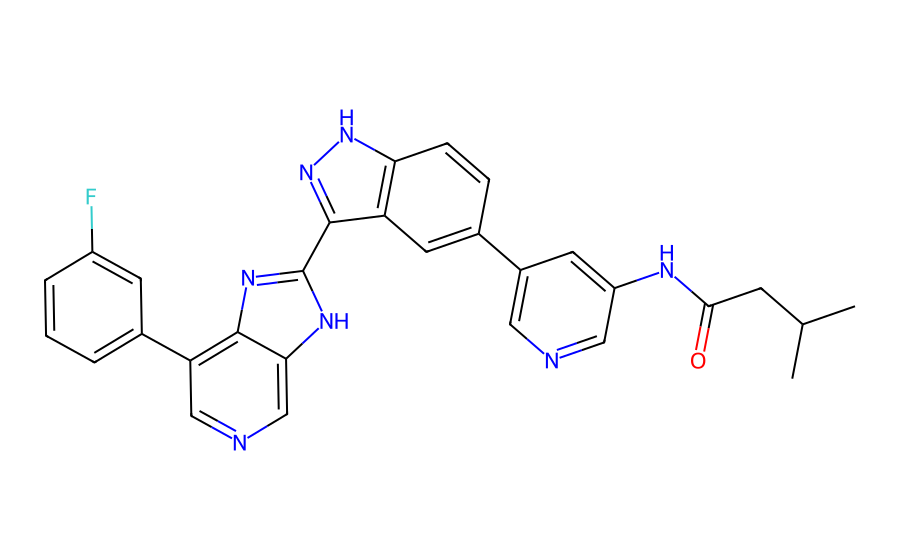
Adavivint chemical structureDC11886

Adavivint

Adavivint is a potent and selective inhibitor of canonical Wnt signaling, with an EC50 of 19.5 nM via a high-throughput TCF/LEF-reporter assay in SW480 colon cancer cells.

View activity & prices
WZ4002 chemical structureDC5090

WZ4002

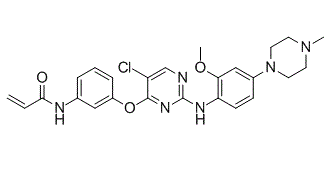
WZ4002 is a mutant selective EGFR inhibitor with IC50s of 2, 8, 3 and 2 nM for EGFRL858R, EGFRL858R/T790M, EGFRE746_A750 and EGFRE746_A750/T790M, respectively.

View activity & prices
GW788388 chemical structureDC7146

GW788388

GW788388 is a potent and selective inhibitor of ALK5 with IC50 of 18 nM, and also inhibits TGF-β type II receptor and activin type II receptor activities, without inhibiting BMP type II receptor.

View activity & prices
AZD1152 chemical structureDC7060

AZD1152

AZD1152 is a pro-drug of Barasertib-hQPA, which is a highly selective Aurora B inhibitor with IC50 of 0.37 nM in a cell-free assay.

View activity & prices
Fluzoparib chemical structureDC22228

Fluzoparib

Fluzoparib (SHR-3162) is a novel, potent and orally available inhibitor of PARP; potently inhibited PARP1 enzyme activity and induced DNA double-strand breaks, G2/M arrest and apoptosis in homologous recombination…

View activity & prices
GNF-2 chemical structureDC1062

GNF-2

GNF-2 is a highly selective non-ATP competitive inhibitor of oncogenic Bcr-Abl activity (IC50 = 0.14 μM).IC50 value: 0.14 uM [1]Target: Bcr-Ablin vitro: Ba/F3 cells harboring native or T315I mutated Bcr-Abl constructs…

View activity & prices

Cart

Request quotation