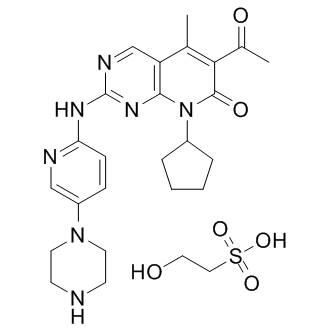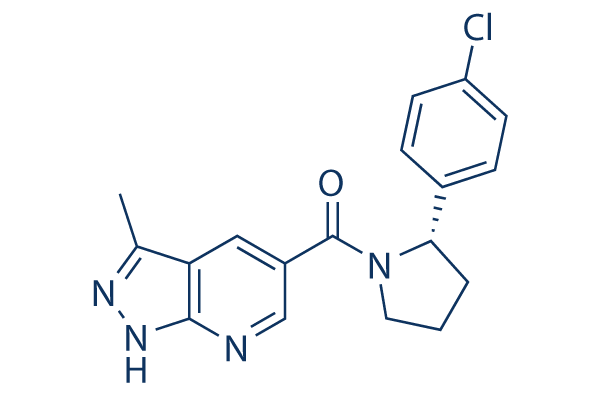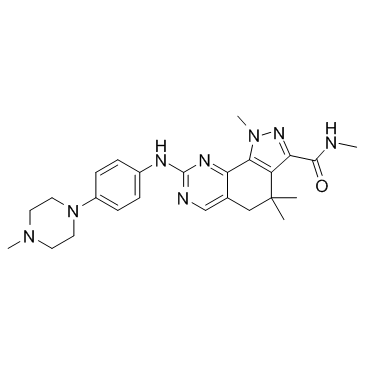
Biological Activity
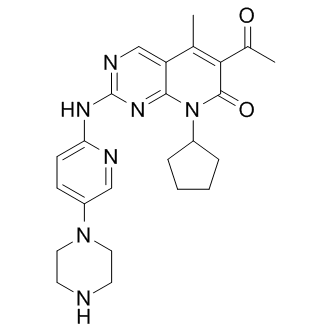
Milciclib (PHA-848125) is a potent, dual inhibitor of CDK and Tropomyosin receptor kinase (TRK), with IC50s of 45, 150, 160, 363, 398 nM and 53 nM for cyclin A/CDK2, cyclin H/CDK7, cyclin D1/CDK4, cyclin E/CDK2, cyclin B/CDK1 and TRKA, respectively.
In Vitro
Milciclib (PHA-848125; 0.156 or 0.625 μM) up-regulates the expression of PDCD4, DDIT4, SESN2/sestrin 2 and DEPDC6/DEPTOR in GL-Mel cells[1]. Milciclib (PHA-848125) potently inhibits the kinase activity of CDK2/cyclin A complex and of TRKA in a biochemical assay, with IC50s of 45 and 53 nM, respectively. Milciclib induces a clear accumulation of cells in G1 phase. Milciclib strongly inhibits NGF-induced phosphorylation of TRKA in a dose-dependent manner[2].
In Vivo
Milciclib (PHA-848125; 5, 10, and 15 mg/kg, p.o.) inhibits the growth of tumor in 7,12-dimethylbenz(a) anthracene (DMBA)-induced rat mammary carcinoma model. Milciclib has significant antitumor activity in various human xenografts and carcinogen-induced tumors as well as in disseminated primary leukemia models, with plasma concentrations in rodents in the same range as those found active in inhibiting cancer cell proliferation[2]. Milciclib (PHA-848125; 40 mg/kg) induces a significant tumor growth inhibition in K-RasG12DLA2 mice, and this is accompanied by a reduction in the cell membrane turnover[3].
References & source
Published experimental findings depend on the model and assay conditions. They do not guarantee equivalent performance in every application. For laboratory research use only.