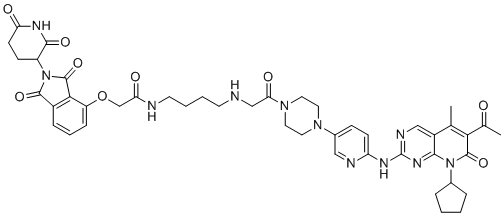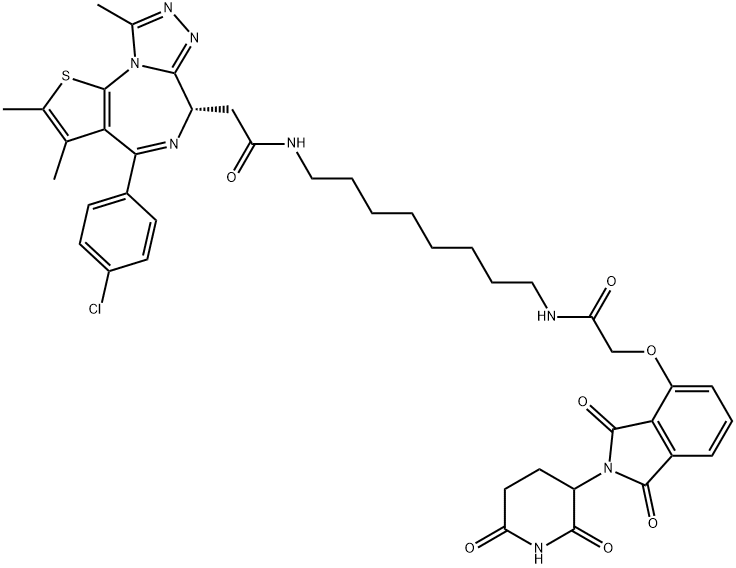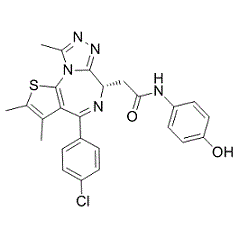
Biological Activity
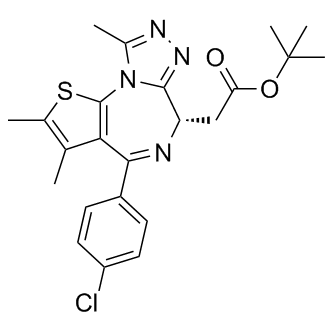
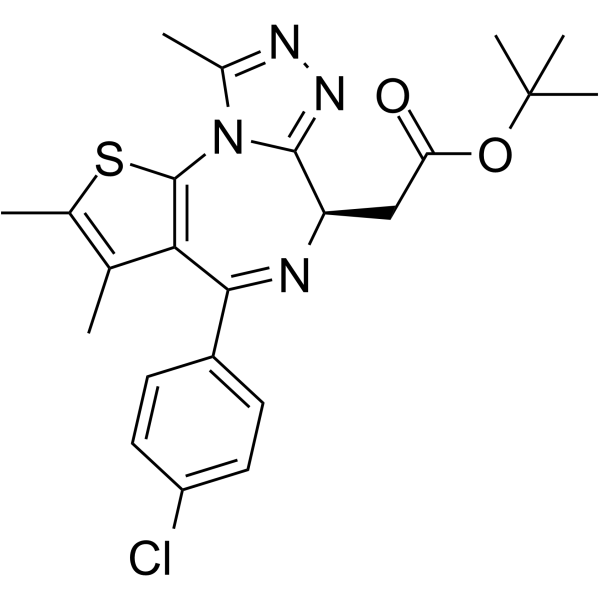
Birabresib (OTX-015) is a potent bromodomain (BRD2/3/4) inhibitor with IC50s ranging from 92 to 112 nM.
In Vitro
Birabresib (OTX-015) (500 nM) exposure induces a strong decrease of BRD2, BRD4 and c-MYC and increase of HEXIM1 proteins, while BRD3 expression is unchanged. c-MYC, BRD2, BRD3, BRD4 and HEXIM1 mRNA levels do correlate however with viability following exposure to Birabresib (OTX-015). Sequential combinations of Birabresib (OTX-015) with other epigenetic modifying drugs, panobinostat and azacitidine have a synergic effect on growth of the KASUMI cell line[2]. Birabresib (OTX-015) (0.1, 1, 5 μM) treatment induces HIV-1 full-length transcripts and viral outgrowth in resting CD4+ T cells from infected individuals receiving suppressive antiretroviral therapy (ART), while exerting minimal toxicity and effects on T cell activation. Birabresib-mediated activation of HIV-1 involves an increase in CDK9 occupancy and RNAP II C-terminal domain (CTD) phosphorylation[3].
In Vivo
In MDA-MB-231 murine xenografts, tumor mass is significantly (p < 0.05) reduced by Birabresib (OTX-015) (50 mg/kg) with respect to vehicle-treated animals. Birabresib (OTX-015) in combination with 2 mg/kg everolimus shows more effective activity than Birabresib alone[4].
References & source
Published experimental findings depend on the model and assay conditions. They do not guarantee equivalent performance in every application. For laboratory research use only.