Biological Activity
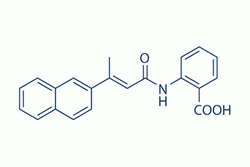
BIBR 1532 is a potent, selective and non-competitive telomerase inhibitor with IC50 of 100 nM in a cell-free assay.
In Vitro
BIBR 1532 non-competitively inhibits telomerase activity[1]. BIBR 1532 inhibits the proliferation of JVM13 leukemia cells with an IC50 of 52 μM, and similar effect also occurs in other leukemia cell lines such as Nalm-1, HL-60, and Jurkat. BIBR 1532 exerts antiproliferative effect on acute myeloid leukemia (AML) with IC50 of 56 μM with no effect on the proliferative capacity of normal hematopoietic progenitor cells[2]. BIBR 1532 (2.5 μM) reduces colony-forming ability, induces telomere length shortening and causes chemotherapeutic sensitization via inhibiting telomerase activity in MCF-7/WT and melphalan-resistant MCF-7/MlnR cell lines[3]. BIBR 1532 is cytotoxic in a dose-dependent manner in T-cell prolymphocytic leukemia (T-PLL)[4]. BIBR 1532 in combination with carboplatin (a chemotherapeutic agent) eliminates ovarian cancer spheroid-forming cells in ES2, SKOV3, and TOV112D cell lines[5].
In Vivo
No in vivo data are provided in the current product source. Contact us for further information.
Target
IC50: 100 nM (telomerase)
Kinase Assay
For the direct telomerase assay with the endogenous telomerase, 10 μL of telomerase-enriched extract is mixed with different concentrations of BIBR1532 in a final volume of 20 μL. After 15-minute preincubation on ice, 20 μL of the reaction mixture is added, and the reaction is initiated by transferring the tubes to 37°C. The final concentrations in the reaction mixture are 25 mM Tris-Cl (pH 8.3), 1 mM MgCl2, 1 mM EGTA, 1 mM dATP, 1 mM dTTP, 6.3 μM cold dGTP, 15 μCi [α-32P]dGTP (3000 Ci/mmol; NEN), 1.25 mM spermidine, 10 units of RNasin, 5 mM 2-mercaptoethanol, and 2.5 μM TS-primer (5'-AATCCGTCGAGCAGAGTT). For the recombinant enzyme, 1-7 μL of affinity-purified telomerase (containing less than 0.025 μM hTERT) are assayed in a final volume of 40 μL containing 50 mM Tris acetate (pH 8.5), 50 mM KCl, 1 mM MgCl2, 1 mM spermidine, 5 mM 2-mercaptoethanol, 1 mM dATP, 1 mM dTTP, 2.5 μM dGTP, 15 μCi of [α-32P]dGTP (3000 Ci/mmol) and 2.5 μM (TTAGGG)3. The reaction is initiated by incubation at 37°C for 2 hours and stopped by addition of 50 μL of RNase mix (0.1 mg/mL RNaseA-100 u/mL RNaseT1 in 10 mM Tris-Cl (pH 8.3) and 20 mm EDTA) and incubation for 20 min at 37°C. Samples are deproteinated by adding 50 μL of 0.3 mg/m proteinase K in 10 mM Tris-Cl (pH 8.3) and 0.5% w/v SDS, for a 30-minute incubation at 37°C. DNA is recovered by phenol extraction and ethanol precipitation, and the extension products are analyzed on an 8% (endogenous telomerase) or 12% (recombinant telomerase) polyacrylamide-urea gel. Dried gels are exposed to a Kodak phosphorimager screen, and the results are analyzed.
Cell Assay
Cells are plated as triplicates in complete RPMI 1640 medium with various concentrations of BIBR1532. After 24 to 72 hours, water-soluble tetrazolium (WST-1) is added, which is transformed into formazan by mitochondrial reductase systems. The increase in the number of viable cells results in an increase of activity of mitochondrial dehydrogenases, leading to an increase of formazan dye formed, which is quantified by ELISA reader after 2, 3, and 4 hours of incubation.
References & source
[1]. Pascolo E, et al. Mechanism of human telomerase inhibition by BIBR1532, a synthetic, non-nucleosidic drug candidate. J Biol Chem. 2002 May 3;277(18):15566-72.
[2]. El-Daly H, et al. Selective cytotoxicity and telomere damage in leukemia cells using the telomerase inhibitor BIBR1532. Blood. 2005 Feb 15;105(4):1742-9.
[3]. Ward RJ, et al. Pharmacological telomerase inhibition can sensitize drug-resistant and drug-sensitive cells to chemotherapeutic treatment. Mol Pharmacol. 2005 Sep;68(3):779-86.
[4]. R?th A, et al. Short telomeres and high telomerase activity in T-cell prolymphocytic leukemia. Leukemia. 2007 Dec;21(12):2456-62.
[5]. Meng E, et al. Targeted inhibition of telomerase activity combined with chemotherapy demonstrates synergy in eliminating ovarian cancer spheroid-forming cells. Gynecol Oncol. 2012 Mar;124(3):598-605.
Published experimental findings depend on the model and assay conditions. They do not guarantee equivalent performance in every application. For laboratory research use only.