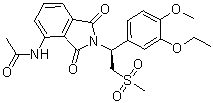
Apremilast chemical structure
Chemical structureResearch use only
CAT. NO. DC7063Featured

Apremilast

Pack Sizes & Prices

TotalUS$200
We match the best price and quality on market.
Product overview

Description & Application

Apremilast is an orally available inhibitor of type-4 cyclic nucleotide phosphodiesterase (PDE-4) with an IC50 of 74 nM.

ParameterValue
Chemical NameApremilast
CAS No.608141-41-9
SynonymsApreMilast;(S)-N-(2-(1-(3-Ethoxy-4-methoxyphenyl)-2-(methylsulfonyl)ethyl)-1,3-dioxoisoindolin-4-yl)acetamide;ApreMilast,CC-10004;AcetaMide, N-[2-[(1S)-1-(3-ethoxy-4-Methoxyphenyl)-2-(Methylsulfonyl)ethyl]-2,3-dihydro-1,3-dioxo-1H-isoindol-4-yl]-;Appleton West;(S)-N-(2-(1-(3-Ethoxy-4-methoxyphenyl)-2-(methylsulfonyl)ethyl)-1,3-dioxoisoindolin-4-yl)acetamide Apremilast (CC-10004;(S)-N-(2-(1-(3-Ethoxy-4-methoxyphenyl)-2-(methylsulfonyl)ethyl)-1,3-dioxoisoindolin-4-yl);N-[2-[(1S)-1-(3ethoxy-4-methoxyphenyl)-2-(methylsulfonyl)ethyl]-2,3-dihydro-1,3-dioxo-1H-isoindol-4-yl]acetamide;Apremilast QCR-202 CC10004;1,3-Dioxo-2-isoindolineaceticacid;Apremilast (CC-10004);ApreMilast, (S)-2-[1-(3-Ethoxy-4-Methoxyphenyl)-2-Methylsulfonylethyl]-4-acetylaMinoisoindoline-1,3-dione;LCZ696;N-[2-[(1S)-1-(3-ethoxy-4-methoxyphenyl)-2-methylsulfonylethyl]-1,3-dioxoisoindol-4-yl]acetamide;(S)-2-[1-(3-Ethoxy-4-methoxyphenyl)-2-methylsulfonylethyl]-4-acetylaminoisoindoline-1,3-dione;CC10004;CC-10004;N-{2-[(1S)-1-(3-Ethoxy-4-methoxyphenyl)-2-(methylsulfonyl)ethyl]-1,3-dioxo-2,3-dihydro-1H-isoindol-4-yl}acetamide;Unii-up7qbp99pn;Apremilast(CC-10004);OTEZLA;CC 10004;apremilastum;UP7QBP99PN;C22H24N2O7S;Apremilast [USAN:INN];Otezla (TN);Apremilast (JAN/USAN);Apremilast/CC 10004/;GTPL7372;QC
FormulaC22H24N2O7S
M.Wt460.5002
SMILESCC(NC1=CC=CC(C(N2[C@@H](C3=CC=C(OC)C(OCC)=C3)CS(=O)(C)=O)=O)=C1C2=O)=O
Purity>98%
Storage2 years -20°C Powder, 2 weeks 4°C in DMSO, 6 months -80°C in DMSO

Biological Activity

Apremilast is an orally available inhibitor of type-4 cyclic nucleotide phosphodiesterase (PDE-4) with an IC50 of 74 nM.

In Vitro

Apremilast inhibits TNF-α release by lipopolysaccharide (LPS) with an IC50 of 104 nM (pIC50=6.98±0.2), which almost exactly replicates previous reported TNF-α inhibition by Apremilast on peripheral blood mononuclear cells (PBMCs) (IC50=110 nM) and which is similar to the potency of Apremilast for PDE4 enzymatic inhibition (IC50=74 nM). These results are clearly consistent with the hypothesis that Apremilast inhibits TNF-α by increasing intracellular cAMP levels. PKA, Epac1 and Epac2 knockdowns prevented TNF-α inhibition and IL-10 stimulation by Apremilast[1].

In Vivo

Apremilast, orally administered (5 mg/kg), significantly inhibits TNF-α production in the air pouch by 39 % (61±6 % of vehicle, P <0.001) and diminishes (by 28 %) the number of leukocytes present (72±12 % of vehicle, P<0.05). In agreement, immunohistologic analysis shows that neutrophil accumulation in the air pouch membrane is dramatically reduced by Apremilast. In the murine air pouch model, both Apremilast and methotrexate (MTX) significantly inhibit leukocyte infiltration, while Apremilast, but not MTX, significantly inhibits TNF-α release. The addition of MTX (1 mg/kg) to Apremilast (5 mg/kg) yields no more inhibition of leukocyte infiltration or TNF-α release than with Apremilast alone[1]. Apremilast is a novel, oral PDE4 inhibitor that has been shown to regulate inflammatory mediators. After oral administration of Apremilast, a mean maximum plasma concentration (Cmax) is found to be 67.00±14.87 ng/mL. The plasma concentration of Apremilast decreases rapidly and is eliminated from plasma with a terminal half-life of 0.92±0.46 h[2]

References & source

DC Chemicals original product information

Published experimental findings depend on the model and assay conditions. They do not guarantee equivalent performance in every application. For laboratory research use only.
Product documentation

Refer to the certificate supplied with your lot for batch-specific release results.

Handling guide

2 years -20°C Powder, 2 weeks 4°C in DMSO, 6 months -80°C in DMSO

Solution calculator

Related research products

PF-2545920(MP-10) chemical structureDC7201

PF-2545920(MP-10)

PF-2545920 is a potent and selective PDE10A inhibitor with IC50 of 0.37 nM, with >1000-fold selectivity over the PDE.PDE10A subcutaneously administrated at dose of 1 mg/kg elevates striatal cGMP about 3 fold in male…

View activity & prices
PF-04447943 chemical structureDC11367

PF-04447943

PF-04447943 is a potent inhibitor of human recombinant PDE9A (IC50=12 nM) with >78-fold selectivity, respectively, over other PDE family members (IC50>1000 nM).

View activity & prices
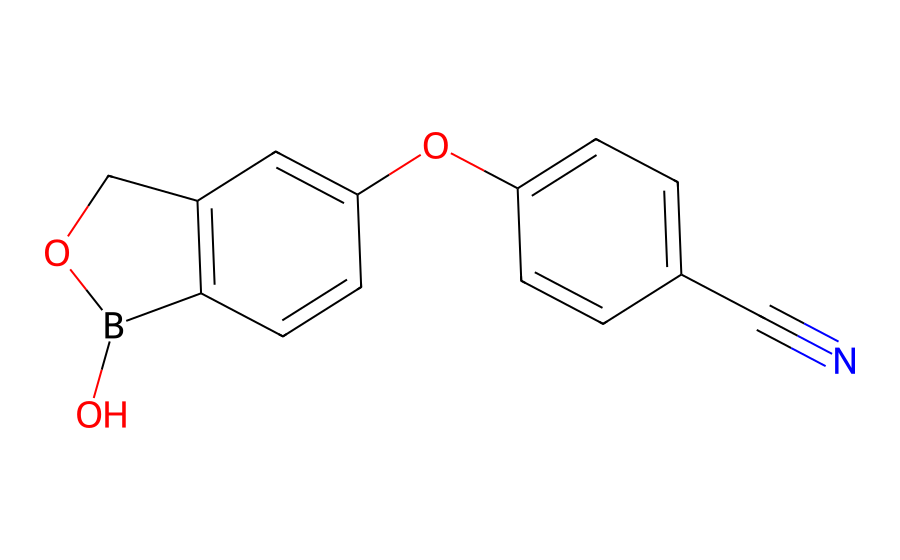
Crisaborole(AN-2728) chemical structureDC7815

Crisaborole(AN-2728)

AN-2728 is a topically administered, boron-containing, anti-inflammatory compound that inhibits PDE4 activity and thereby suppresses the release of TNFalpha, IL-12, IL-23 and other cytokines. AN-2728 appears to have…

View activity & prices
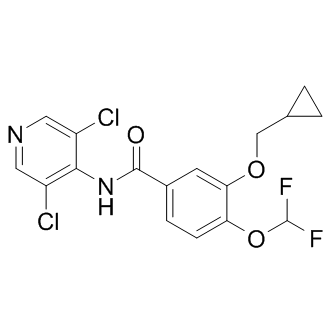
Roflumilast chemical structureDC4146

Roflumilast

Roflumilast is a selective PDE4 inhibitor with IC50s of 0.7, 0.9, 0.7, and 0.2 nM for PDE4A1, PDEA4, PDEB1, and PDEB2, respectively, without affecting PDE1, PDE2, PDE3 or PDE5 isoenzymes from various cells.

View activity & prices
Vesnarinone(OPC8212) chemical structureDC9847

Vesnarinone(OPC8212)

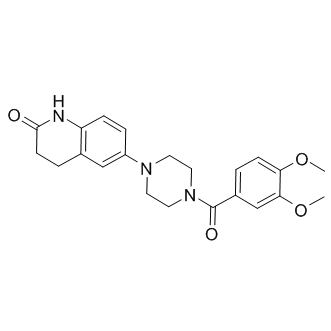
Vesnarinone is a quinolinone derivative, and its pharmacodynamic effects include inhibition of phosphodiesterase III (PDE3) activity, increases in calcium flux and decreases in potassium flux.

View activity & prices
Olprinone (Hydrochloride) chemical structureDC9577

Olprinone (Hydrochloride)

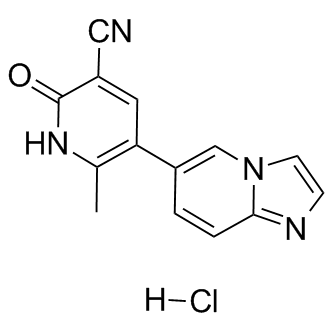
Olprinone Hcl(Loprinone Hcl) is a selective phosphodiesterase 3 (PDE3) inhibitor. Olprinone is used as cardiotonic agent with positive inotropic and vasodilating effects. Olprinone has been reported to improve…

View activity & prices
GSK2981278 chemical structureDC9713

GSK2981278

GSK2981278 is a retinoid-related orphan receptor gamma (RORy) modulator, extracted from patent WO/2015061515 A1, example 124.

View activity & prices
Solcitinib(GLPG0778) chemical structureDC8169

Solcitinib(GLPG0778)

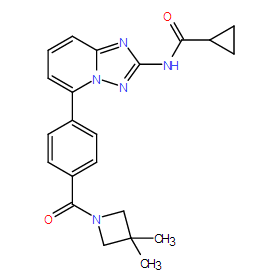
Solcitinib is an orally active, competitive, potent, selective JAK1 inhibitor, with an IC50 of 9.8 nM, and 11-, 55- and 23-fold selectivity over JAK2, JAK3 and TYK2, respectively; Solcitinib is used in the research of…

View activity & prices

Cart

Request quotation