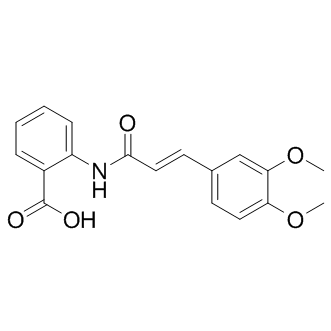
Tranilast (SB 252218) chemical structure
Chemical structureResearch use only
CAT. NO. DC6400Featured

Tranilast (SB 252218)

Pack Sizes & Prices

TotalUS$250
We match the best price and quality on market.
Product overview

Description & Application

Tranilast is an antiallergic agent.Tranilast has been approved in Japan and South Korea, since 1982, for the treatment of bronchial asthma, with indications for keloids and hypertrophic scar added in 1993. Tranilast is also used to treat asthma, autoimmune diseases, atopic and fibrotic pathologies, and can also inhibit angiogenesis. The antiproliferative properties of tranilast were found that tranilast elicited an inhibitory effect on fibroblast proliferation in vitro and also suppressed collagen production both in vitro and in vivo . Tranilast also reduced the release of chemical mediators from mast cells and suppressed hypersensitivity reactions. [1]Three-week-old C57Bl/10 and mdx mice received tranilast (~300 mg/kg) in their food for 9 weeks, after which fibrosis was assessed through histological analyses, and functional properties of tibialis anterior muscles were assessed in situ and diaphragm muscle strips in vitro. Tranilast administration did not significantly alter the mass of any muscles in control or mdx mice, but it decreased fibrosis in the severely affected diaphragm muscle by 31% compared with untreated mdx mice (P< 0.05) [2].

ParameterValue
Chemical Name(E)-2-(3-(3,4-dimethoxyphenyl)acrylamido)benzoic acid
CAS No.53902-12-8
SynonymsRizaben, MK 341, Tranpro
FormulaC18H17NO5
M.Wt327.33
SMILESO=C(O)C1=CC=CC=C1NC(/C=C/C2=CC=C(OC)C(OC)=C2)=O
Purity>99%
Storage2 years -20°C Powder, 2 weeks 4°C in DMSO, 6 months -80°C in DMSO

Biological Activity

Tranilast is an antiallergic agent.Tranilast has been approved in Japan and South Korea, since 1982, for the treatment of bronchial asthma, with indications for keloids and hypertrophic scar added in 1993. Tranilast is also used to treat asthma, autoimmune diseases, atopic and fibrotic pathologies, and can also inhibit angiogenesis. The antiproliferative properties of tranilast were found that tranilast elicited an inhibitory effect on fibroblast proliferation in vitro and also suppressed collagen production both in vitro and in vivo . Tranilast also reduced the release of chemical mediators from mast cells and suppressed hypersensitivity reactions. [1]Three-week-old C57Bl/10 and mdx mice received tranilast (~300 mg/kg) in their food for 9 weeks, after which fibrosis was assessed through histological analyses, and functional properties of tibialis anterior muscles were assessed in situ and diaphragm muscle strips in vitro. Tranilast administration did not significantly alter the mass of any muscles in control or mdx mice, but it decreased fibrosis in the severely affected diaphragm muscle by 31% compared with untreated mdx mice (P< 0.05) [2].

In Vitro

No in vitro data are provided in the current product source. Contact us for further information.

In Vivo

No in vivo data are provided in the current product source. Contact us for further information.

References & source

DC Chemicals original product information

Published experimental findings depend on the model and assay conditions. They do not guarantee equivalent performance in every application. For laboratory research use only.
Product documentation

Refer to the certificate supplied with your lot for batch-specific release results.

Handling guide

2 years -20°C Powder, 2 weeks 4°C in DMSO, 6 months -80°C in DMSO

Solution calculator

Related research products

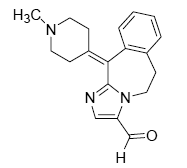
Alcaftadine chemical structureDCAPI1467

Alcaftadine

For the detailed information of Alcaftadine, the solubility of Alcaftadine in water, the solubility of Alcaftadine in DMSO, the solubility of Alcaftadine in PBS buffer, the animal experiment(test) (test) of…

View activity & prices
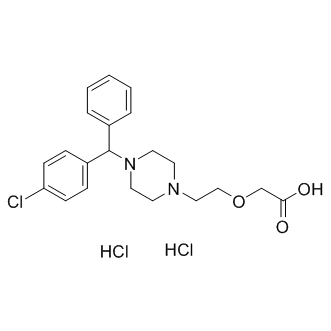
Cetirizine 2HCl chemical structureDC9154

Cetirizine 2HCl

Cetirizine 2Hcl, a second-generation antihistamine, is a major metabolite of hydroxyzine, and a racemic selective H1 receptor inverse agonist used in the treatment of allergies, hay fever, angioedema, and…

View activity & prices
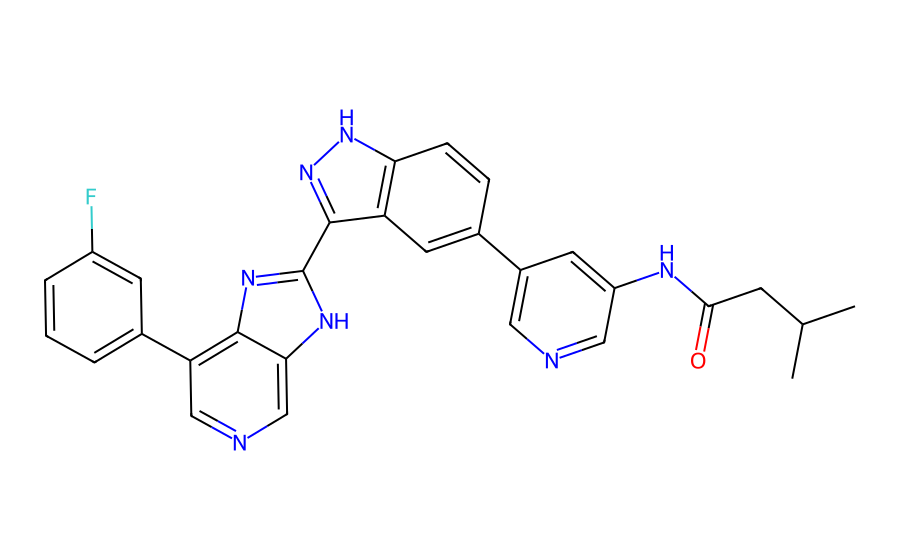
Adavivint chemical structureDC11886

Adavivint

Adavivint is a potent and selective inhibitor of canonical Wnt signaling, with an EC50 of 19.5 nM via a high-throughput TCF/LEF-reporter assay in SW480 colon cancer cells.

View activity & prices
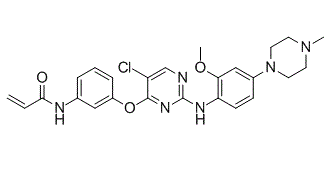
WZ4002 chemical structureDC5090

WZ4002

WZ4002 is a mutant selective EGFR inhibitor with IC50s of 2, 8, 3 and 2 nM for EGFRL858R, EGFRL858R/T790M, EGFRE746_A750 and EGFRE746_A750/T790M, respectively.

View activity & prices
GW788388 chemical structureDC7146

GW788388

GW788388 is a potent and selective inhibitor of ALK5 with IC50 of 18 nM, and also inhibits TGF-β type II receptor and activin type II receptor activities, without inhibiting BMP type II receptor.

View activity & prices
AZD1152 chemical structureDC7060

AZD1152

AZD1152 is a pro-drug of Barasertib-hQPA, which is a highly selective Aurora B inhibitor with IC50 of 0.37 nM in a cell-free assay.

View activity & prices

Cart

Request quotation