Specifications Biological Activity Documentation
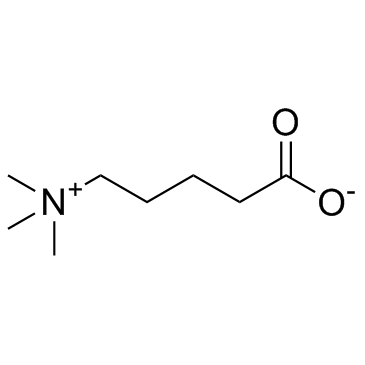
Parameter Value Chemical Name delta-Valerobetaine CAS No. 6778-33-2 Synonyms delta-Valerobetaine; 5-(trimethylazaniumyl)pentanoate; 725A8L267W; delta-Valerobetaine-; 5-Aminovaleric acid betaine; 5-(Trimethylammonio)pentanoate; delta-Aminovaleric acid betaine; 5-(N-Trimethylamino)pentanoate; BDBM50008014; Q27896958; (4-Carboxybutyl)trimethylammonium hydroxide, inner salt; 1-Butanaminium, 4-carboxy-N,N,N-trimethyl-, inner salt; Ammonium, (4-carboxybutyl)trimethyl-, hydroxide, inner salt Formula C8H17NO2 M.Wt 159.2261 SMILES C[N+](C)(C)CCCCC([O-])=O Purity On request Storage 2 years -20°C Powder, 2 weeks 4°C in DMSO, 6 months -80°C in DMSO
Microbiome / carnitine metabolism · Literature evidence Biological Activity Delta-valerobetaine is a microbiome-derived metabolite used to investigate mitochondrial fatty-acid oxidation and diet-dependent obesity. δ-Valerobetaine lowered carnitine availability and mitochondrial long-chain acyl-CoA transport, reducing fatty-acid oxidation.
In Vitro In Vivo References In Vitro Endpoint Model / conditions / source Reported result Metabolic mechanism Cellular and biochemical metabolite studies. [1] δ-Valerobetaine lowered carnitine availability and mitochondrial long-chain acyl-CoA transport, reducing fatty-acid oxidation.
In Vivo Endpoint Model / conditions / source Reported result Germ-free model Male C57BL/6 mice; 25 mg/kg intraperitoneally on weekdays for 6 weeks; chow or Western diet, n=5/group. [1], Methods The study tested interaction between the microbial metabolite and dietary context. Conventional-mouse experiment 50 mg/kg intraperitoneally on weekdays during an 8-week dietary study. [1] Western-diet conditions revealed increased visceral adiposity and hepatic steatosis; the effect was not reproduced uniformly on control chow.
Clinical / Human Evidence Endpoint Model / conditions / source Reported result Human association Human metabolomic observations. [1] Valerobetaine correlated with visceral adiposity. This association is not a randomized treatment effect.
Interpretation Human correlation does not establish causation, and animal effects depended on diet.
Original studies References Liu KH, et al. Microbial metabolite delta-valerobetaine is a diet-dependent obesogen. Nature metabolism (2021). Product documentation Refer to the certificate supplied with your lot for batch-specific release results.