Biological Activity
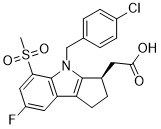
Laropiprant is a DP1 receptor antagonist for prostanoid signaling and platelet-function research. Its effects on platelet activation vary with agonist and concentration. Reversed the inhibition of aggregation produced by DP1 agonists. Laropiprant at 1 µM alone did not alter ADP-induced aggregation.
In Vitro
| Endpoint | Model / conditions / source | Reported result |
|---|---|---|
| Platelet DP1 antagonism | Human platelet-rich plasma; laropiprant 1 µM, PGD2 30 nM or BW245c 3 nM; ADP challenge. [1], Fig. 1 | Reversed the inhibition of aggregation produced by DP1 agonists. Laropiprant at 1 µM alone did not alter ADP-induced aggregation. |
| Activation markers | Human platelet assays; laropiprant 1 µM. [1], activation experiments | Counteracted DP-dependent inhibition of calcium responses, P-selectin expression and GPIIb/IIIa activation. |
| Thrombus formation | Human whole blood on collagen under flow; laropiprant 1 µM. [1], Fig. 2 | Reversed the reduction in thrombus formation caused by PGD2. This experiment used blood outside the body. |
| Concentration and receptor dependence | Platelet/thrombus assays with additional prostanoid agonists. [1] | At higher concentrations, laropiprant reduced TP- and EP3-related activation. EP4- and IP-mediated inhibitory responses were not affected. |
In Vivo
No compound-specific animal efficacy result is established by the sources summarized here.
Interpretation
These are in vitro platelet and thrombus-formation findings, not animal efficacy data.