Biological Activity
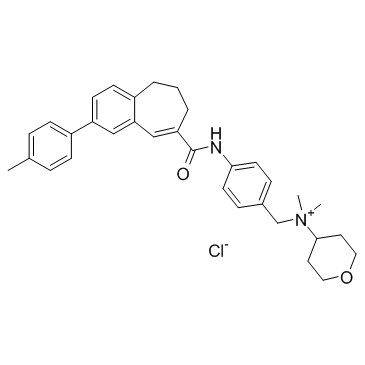
TAK-779 is a potent and selective nonpeptide antagonist of CCR5 and CXCR3, with a Ki of 1.1 nM for CCR5, and effectively and selectively inhibits R5 HIV-1, with EC50 and EC90 of 1.2 nM and 5.7 nM, respectively, in MAGI-CCR5 cells.
In Vitro
TAK-779 is a potent and selective nonpeptide antagonist of CCR5, with a Ki of 1.1 nM, and effectively and selectively inhibits R5 HIV-1, with EC50 and EC90 of 1.2 nM and 5.7 nM, respectively, in MAGI-CCR5 cells. TAK-779 less potently blocks the binding of [125I]-monocyte chemotactic protein 1 to CCR2b in CHO/CCR2b cells, with an IC50 for CCR2b of 27 nM. TAK-779 also completely inhibits the binding of [125I]-RANTES to CHO/CCR5 cells with an IC50 of 1.4 nM. TAK-779 (20 nM) selectively inhibits CCR5-mediated Ca2+-signaling. In addition, TAK-779 shows no inhibition on X4 HIV-1 strains[1]. TAK-779 is an antagonist of CXCR3, and inhibits the migration of T cells but not T cell proliferation[2].
In Vivo
TAK-779 (10 mg/kg per day, s.c.) significantly prolongs the allograft survival of the rat intestinal transplantation model. TAK-779 also decreases the number of CD4+ as well as CD8+ T cells in spleen, blood and recipient mesenteric lymph nodes (MLN)[2]. TAK-779 (150 µg per mouse, s.c.) supppresses the development of experimental autoimmune encephalomyelitis (EAE) in myelin oligodendrocyte glycoprotein (MOG)-immunized C57BL/6 mice. TAK-779 decreases the infiltration of CXCR3 and CCR5 bearing leukocytes into the spinal cord. TAK-779 does not alter myelin oligodendrocyte glycoprotein (MOG)-specific immune responses or affect the potential of MOG-specific T cells to transfer experimental autoimmune encephalomyelitis (EAE)[3].
References & source
Published experimental findings depend on the model and assay conditions. They do not guarantee equivalent performance in every application. For laboratory research use only.