1,2-DSPC
DC57005
View product-specific chemistry and research information.
View product →
Select a pack size below, or contact our team for custom quantities and availability.
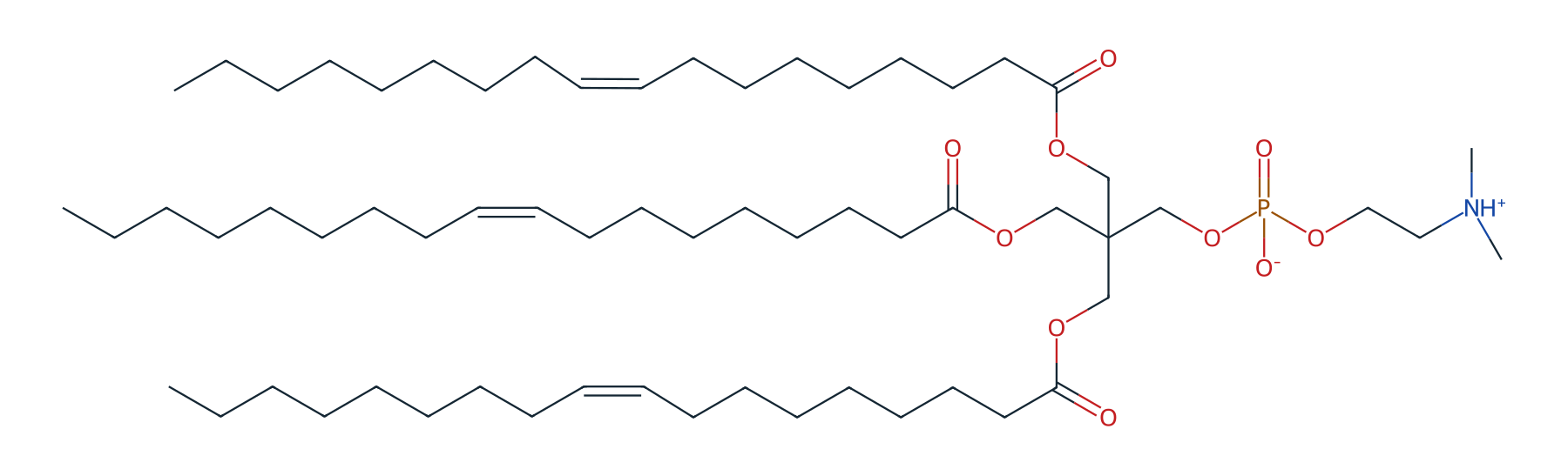
PEA-DMA-PE-02 is a three-tailed helper phospholipid reported by the Sanofi mRNA Center of Excellence. Its pentaerythritol core carries three oleoyl esters, each with a cis double bond, and a dimethylaminoethyl phosphate headgroup.
| CAS No. | Not reported in this source |
| Chemical Name | 2-((((2-(dimethylamino)ethoxy)(hydroxy)phosphoryl)oxy)methyl)-2-((oleoyloxy)methyl)propane-1,3-diyl dioleate |
| Synonyms | PEA DMA PE 02; PEADMAPE02 |
| SMILES | CCCCCCCC/C=C\CCCCCCCC(=O)OCC(COC(=O)CCCCCCC/C=C\CCCCCCCC)(COC(=O)CCCCCCC/C=C\CCCCCCCC)COP(=O)([O-])OCC[NH+](C)C |
| Formula | C63H118NO10P |
| Average molar mass | 1080.61 g/mol |
| Chemical form / stereochemistry | Zwitterionic form depicted in the supplement. All three oleoyl double bonds are 9Z. |
| InChIKey | CKZNOILQRNJXEJ-PGEUSFDPSA-N |
| Monoisotopic mass | 1079.849336 Da |
| HRMS [M+H]⁺, calculated / found (m/z) | 1080.8571 / 1080.8614 |
| Selected ¹H NMR signals | 300 MHz, CDCl₃, δ 2.85 (s, 6H), 5.44–5.25 (m, 6H) ppm |
| Appearance of the literature sample | Colorless gum |
| Role | Helper lipid |
| Purity | >95% by ELSD-HPLC; issued batch certificate on request |
| Storage | Follow the product label and batch documentation; protect from light and moisture. |
| Availability | Price, stock status and lead time on request |
| Reference | Karve et al., Advanced Materials (2026), e75746 · Supporting Information · Fig. S1 |
Supplementary Table S2 reports serum hEPO in mice relative to the DOPE formulation for each route. Values are mean ± SD, with four animals per group.
| Intramuscular | 1.18 ± 0.35 |
|---|---|
| Intravenous | 12.01 ± 4.44 |
Figure S3a,b plots apparent pKa of assembled LNPs by tail class. The individual points have no compound labels.
Average molar mass · 1080.61 g/mol
Volumes use the average molar mass of the structure shown.
| Mass | 1 mM | 5 mM | 10 mM |
|---|---|---|---|
| 10 mg | 9.2540 mL | 1.8508 mL | 925.40 μL |
| 25 mg | 23.1351 mL | 4.6270 mL | 2.3135 mL |
| 50 mg | 46.2702 mL | 9.2540 mL | 4.6270 mL |
| 100 mg | 92.5403 mL | 18.5081 mL | 9.2540 mL |
| 250 mg | 231.3508 mL | 46.2702 mL | 23.1351 mL |
Contact our team with the catalog number and requested quantity.