1,2-DSPC
DC57005
View product-specific chemistry and research information.
View product →
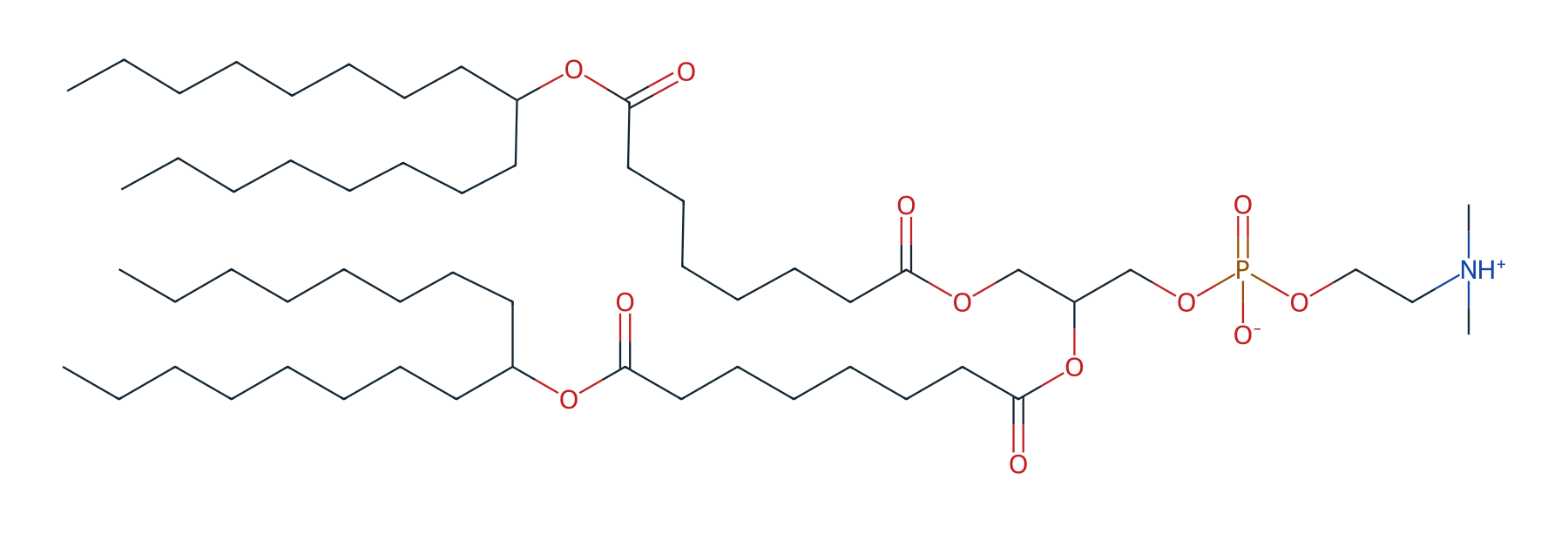
Select a pack size below, or contact our team for custom quantities and availability.
PEA-DMA-06 is a two-tailed helper phospholipid reported by the Sanofi mRNA Center of Excellence. A two-carbon spacer connects the dimethylamino group to the phosphate oxygen. The glycerol backbone carries two ester-linked groups terminating in branched heptadecan-9-yl groups.
| CAS No. | Not reported in this source |
| Chemical Name | O'1,O1-(3-(((2-(Dimethylamino)ethoxy)(hydroxy)phosphoryl)oxy)propane-1,2-diyl) 8-di(heptadecan-9-yl) di(octanedioate) |
| Synonyms | PEA DMA 06; PEADMA06 |
| SMILES | CCCCCCCCC(CCCCCCCC)OC(=O)CCCCCCC(=O)OCC(COP(=O)([O-])OCC[NH+](C)C)OC(=O)CCCCCCC(=O)OC(CCCCCCCC)CCCCCCCC |
| Formula | C57H110NO12P |
| Average molar mass | 1032.48 g/mol |
| Chemical form / stereochemistry | Zwitterionic form depicted in the supplement. Glycerol C-2 configuration is unspecified. |
| InChIKey | NTDZQHRJMJVOHA-UHFFFAOYSA-N |
| Monoisotopic mass | 1031.776565 Da |
| HRMS [M+H]⁺, calculated / found (m/z) | 1032.7844 / 1032.7885 |
| Selected ¹H NMR signals | 300 MHz, CDCl₃, δ 2.86 (s, 6H) ppm |
| Role | Helper lipid |
| Purity | >95% by ELSD-HPLC; issued batch certificate on request |
| Storage | Follow the product label and batch documentation; protect from light and moisture. |
| Availability | Price, stock status and lead time on request |
| Reference | Karve et al., Advanced Materials (2026), e75746 · Supporting Information · Fig. S1 |
Supplementary Table S2 reports serum hEPO in mice relative to the DOPE formulation for each route. Values are mean ± SD, with four animals per group.
| Intramuscular | 1.89 ± 0.30 |
|---|---|
| Intravenous | 4.98 ± 0.82 |
Figure S3a,b plots apparent pKa of assembled LNPs by tail class. The individual points have no compound labels.
Average molar mass · 1032.48 g/mol
Volumes use the average molar mass of the structure shown.
| Mass | 1 mM | 5 mM | 10 mM |
|---|---|---|---|
| 10 mg | 9.6854 mL | 1.9371 mL | 968.54 μL |
| 25 mg | 24.2135 mL | 4.8427 mL | 2.4214 mL |
| 50 mg | 48.4271 mL | 9.6854 mL | 4.8427 mL |
| 100 mg | 96.8542 mL | 19.3708 mL | 9.6854 mL |
| 250 mg | 242.1354 mL | 48.4271 mL | 24.2135 mL |
Contact our team with the catalog number and requested quantity.