Acuitas Lipid I-4
DCL0038
Intramuscular mRNA vaccine research lipid.
View product →
Select a pack size below, or contact our team for custom quantities and availability.
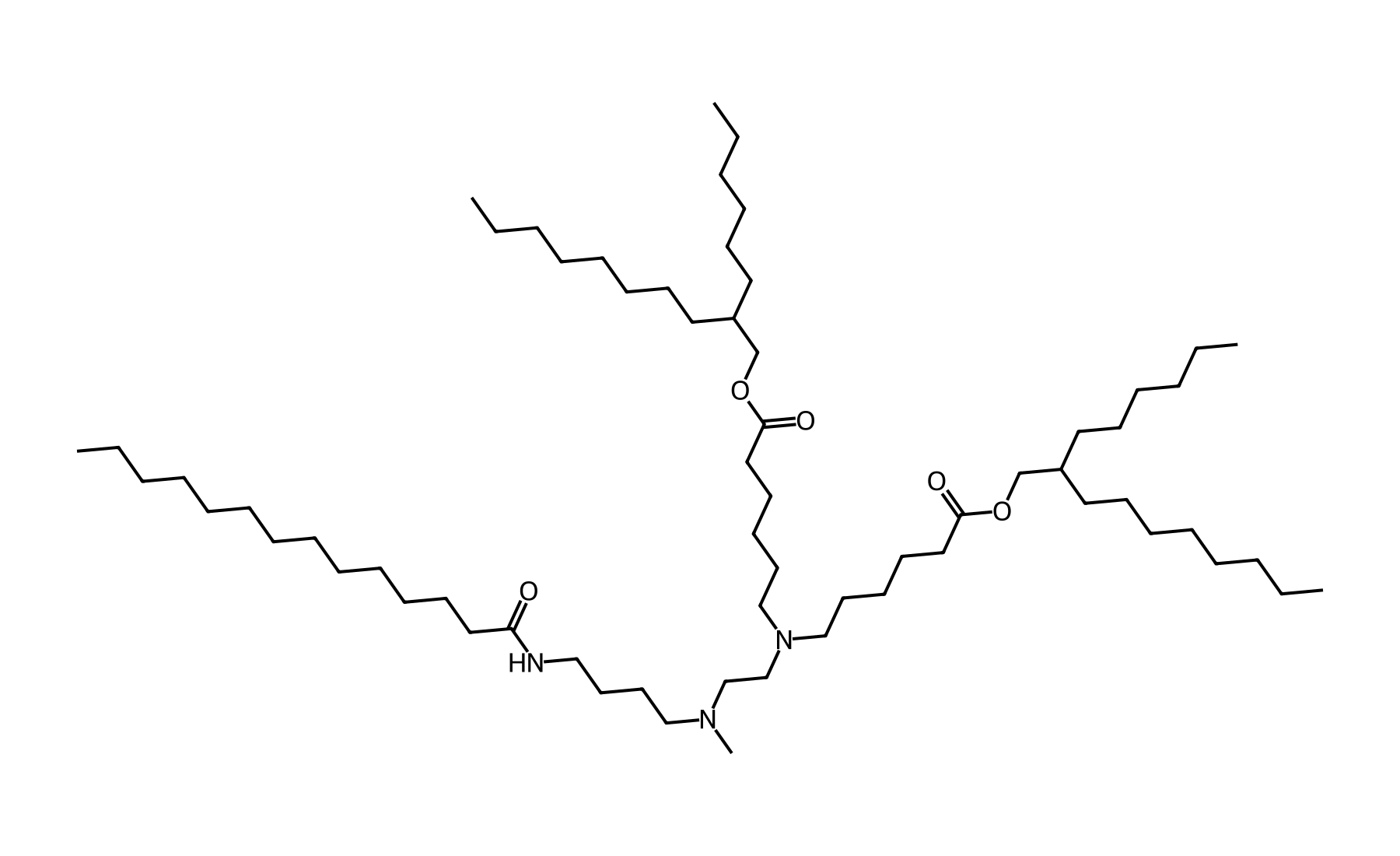
Acuitas Lipid I-15 is an ionizable lipid for mRNA delivery and intramuscular vaccine research. It combines a myristamide-bearing diamine headgroup with two branched 2-hexyldecyl ester tails. I-15-containing lipid nanoparticles elicit influenza HA-specific antibody responses in mice, with a mean HAI titer of 1,784 in a 0.2 µg HA mRNA prime–boost screen. Intravenous luciferase mRNA studies additionally report functional expression in mouse liver and spleen. These applications support research on ionizable-lipid formulations and RNA delivery.
| CAS No. | Not available |
| Chemical Name | Acuitas Lipid I-15 |
| Synonyms | I-15; Acuitas I-15; Lipid I-15; Compound I-15; WO2025231114A1 I-15 |
| SMILES | CCCCCCCCCCCCCC(=O)NCCCCN(C)CCN(CCCCCC(=O)OCC(CCCCCC)CCCCCCCC)CCCCCC(=O)OCC(CCCCCC)CCCCCCCC |
| Formula | C65H129N3O5 |
| M.Wt | 1032.76 |
| Purity | >95% by ELSD-HPLC |
| Storage | Follow the product label and batch documentation. Pure form: −20 °C, protected from light and moisture. |
| Availability | Price and lead time on request |
| Publication | WO2025231114A1, Table 1; I-15 |
Acuitas Therapeutics · WO2025231114A1 (2025) · Patent record
Representative Example 1 recipe: ionizable lipid / DSPC / cholesterol / PEGylated lipid = 47.5 : 10 : 40.7 : 1.8 mol%. The source introduces these percentages as an example, not the uniquely identified optimized recipe for every HA-screen compound. Example 1, printed p.63 / PDF p.64
| Component | DC Chemicals product | MW (g/mol) | Mol% | Mass at 1 µmol total lipid (mg) |
|---|---|---|---|---|
| Acuitas Lipid I-15 | DCL0042 | 1032.76 | 47.5 | 0.490561 |
| DSPC | DC57005 | 790.145 | 10 | 0.079015 |
| Cholesterol | DCD-041 | 386.65 | 40.7 | 0.157367 |
| PEGylated lipid (identity not specified) | Identity and exact form unassigned | Not specified | 1.8 | Not assigned |
The PEG lipid anchor and grade are not specified. No DMG-PEG2000 identity or PEG molecular weight is assumed. Complete mass percentages require the actual PEG lipid MW. Molecular weights for the new neutral lipids are calculated from the verified structures.
Calculated preparation amounts for this representative recipe. Edited inputs create a research scenario; the source table remains unchanged. This tool does not calculate N/P or RNA dose.
| Component | Editable MW (g/mol) | Editable mol% | Calculated mass (mg) | Calculated mass % |
|---|---|---|---|---|
| Acuitas Lipid I-15 | — | — | ||
| DSPC | — | — | ||
| Cholesterol | — | — | ||
| PEGylated lipid (identity not specified) | — | — |
Example 1 total lipid:mRNA is approximately 10:1–30:1 by mass. Example 8 uses 10:1–40:1 by mass. These values are not N/P ratios.
Table 1 reports the numeric pKa, but its measurement type and exact entry-specific formulation/buffer are not uniquely identified.
General fluorescence sigmoid fitting; excitation 321 nm, emission 445 nm; pKa is the pH at half-maximal fluorescence. Room temperature; SLM Aminco Series 2 luminescence spectrophotometer. Table 1 does not uniquely assign the buffer or sample formulation. Measurement type and formulation association are unassigned.
Reported LogP: 19.4; the table does not state its measurement/calculation method. N/P: not reported. Lipid:RNA mass ratio has not been converted to N/P.
No direct cell-transfection results or lipid cell-transfection protocol is reported in the examined examples. HEp-2 and VERO-TMPRSS2 cells are used in serum neutralization assays, not as demonstrations of LNP transfection.
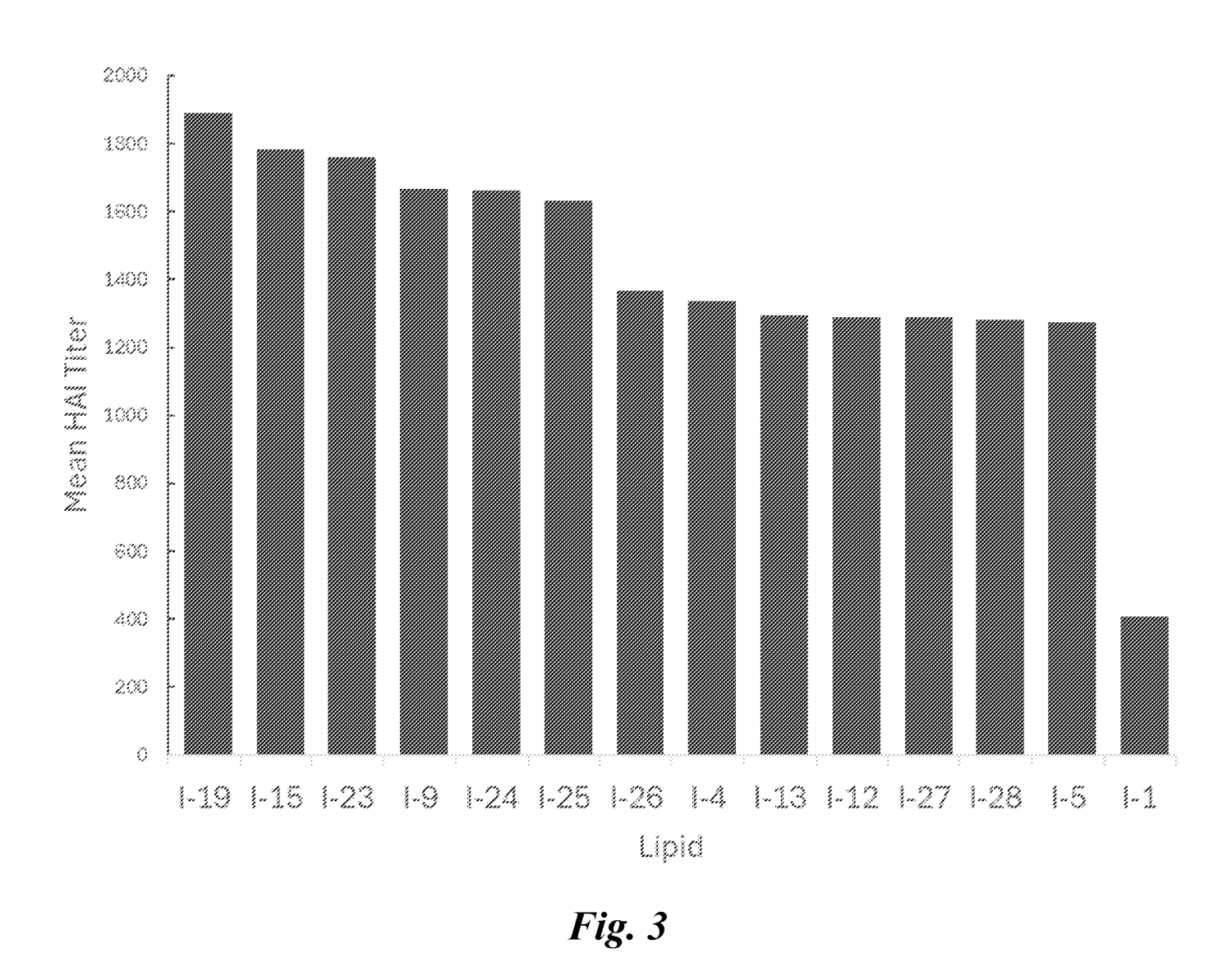
Each endpoint below belongs to its named cargo, dose, route and formulation context. The screening rank is descriptive and is not a statistical claim of superiority. The HA-screen composition is not uniquely assigned to the representative Example 1 recipe.
1784
BALB/c mice, n=10/group; Influenza A/Puerto Rico/8/1934 HA mRNA; 0.2 µg mRNA/animal per injection, 30 µL; intramuscular quadriceps; Day 28, 14 days after the day-14 boost; I-1 LNP: mean HAI 408 in this same screen; Reported mean; variability and statistical tests are not provided for this table
Example 3 additional 0.2 µg HA screen, printed p.67 / PDF p.68; Fig.3
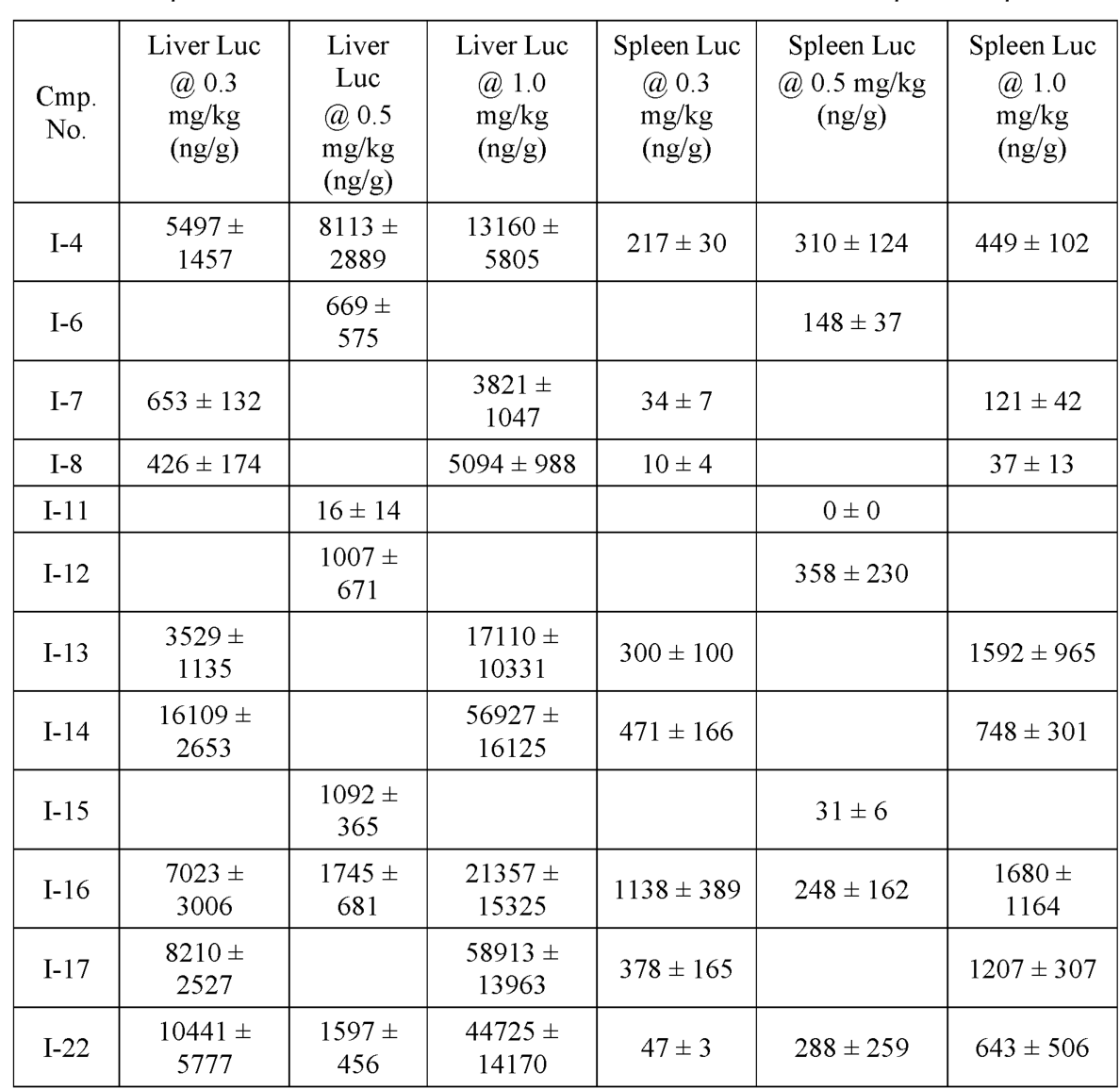
0.5 mg mRNA/kg: liver 1092 ± 365 ng/g, spleen 31 ± 6 ng/g
6–8-week female C57BL/6 or 8–10-week CD-1 mice; strain not assigned per table row; Luciferase mRNA; See each RNA mg/kg dose; intravenous tail vein; 4 h; I-1 or other compounds in Example 2; no cross-experiment fold comparison; Mean ± reported spread; n and definition of ± not stated for individual rows
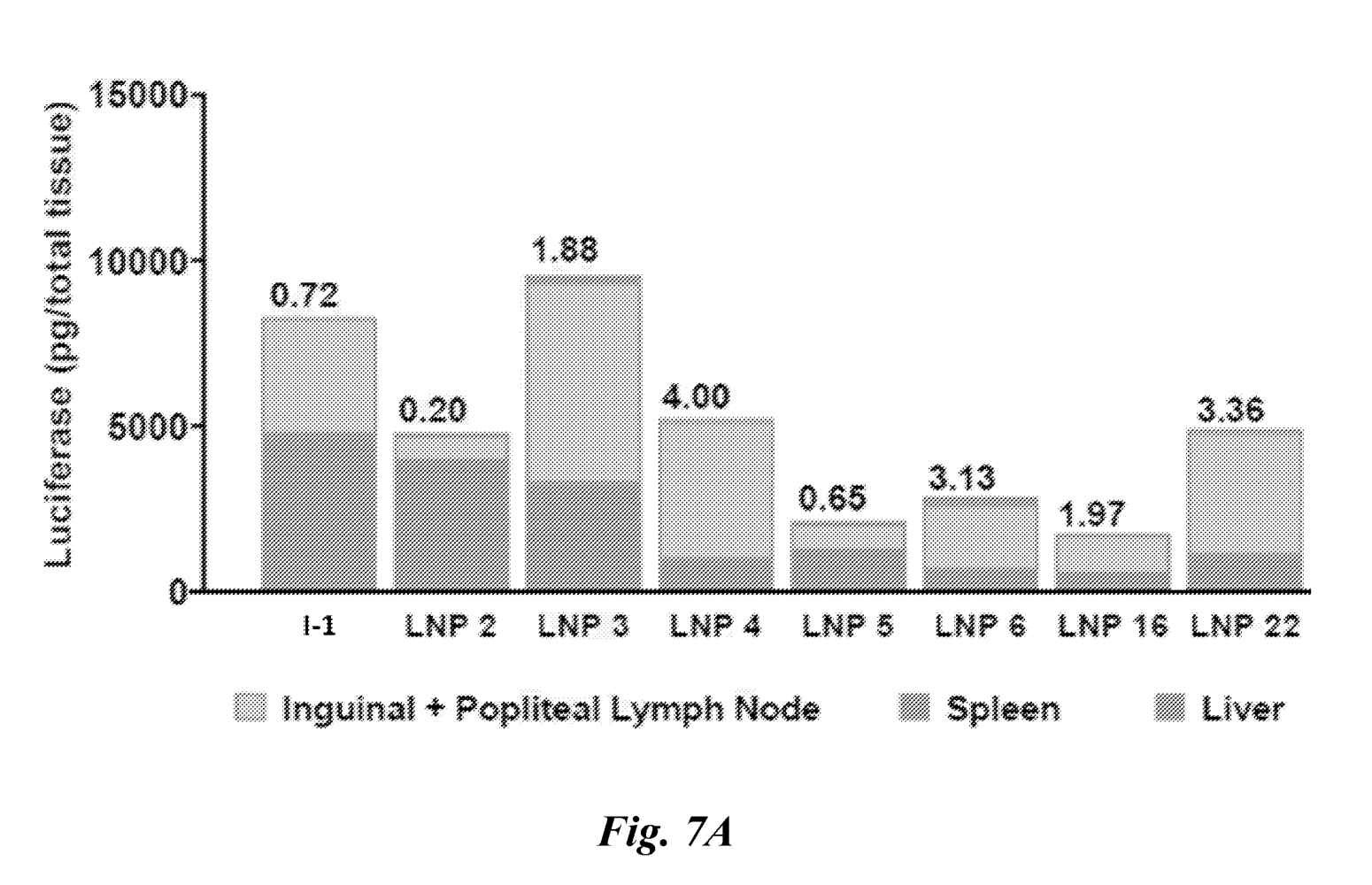
LNP 16: inguinal LN 28; popliteal LN 1114; combined LNs 1142; spleen 22; liver 592 pg luciferase/total tissue. (LNs + spleen)/liver ratio 1.97.
BALB/c mice, n=3/group; Firefly luciferase mRNA; 0.2 µg mRNA/animal, 30 µL; intramuscular quadriceps; 4 h; I-1 LNP ratio 0.72; n=3/group; reported group values, no statistical test assigned
1.9
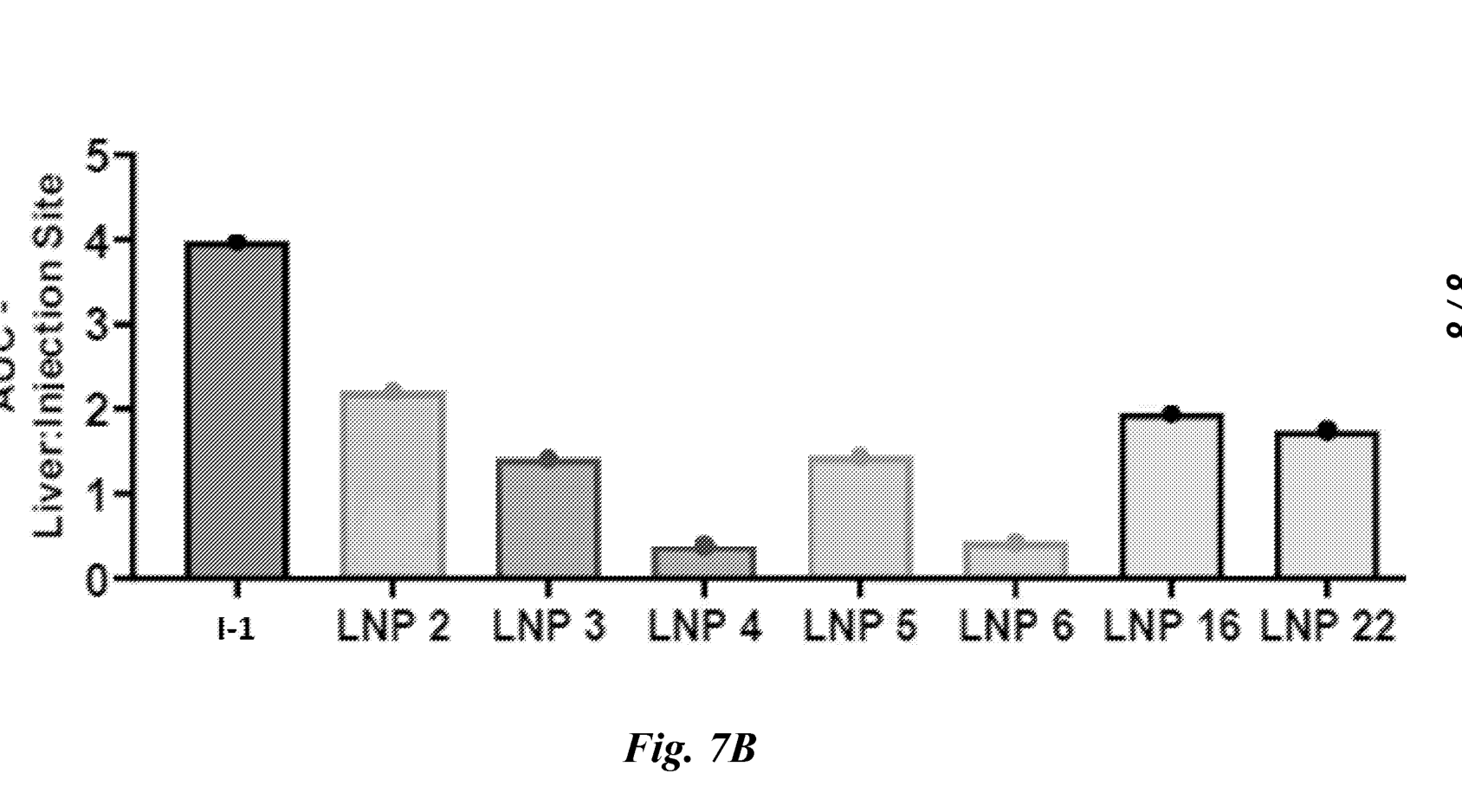
BALB/c mice, n=3/group; Firefly luciferase mRNA; 2 µg mRNA/animal (Fig.7B description); intramuscular; Imaging 4, 24 and 48 h; AUC 0–48 h; I-1 LNP ratio 4.0; n=3/group; ratio of liver to injection-site AUC
Fig.7B description printed p.5 / PDF p.6; Example 7 printed pp.70–71 / PDF pp.71–72; Fig.7B
Compound-specific particle diameter, PDI, encapsulation efficiency and zeta potential are not assigned in the examined characterization table. Values reported for I-4 have not been transferred to this lipid.
Dedicated compound-specific cytotoxicity, repeated-dose tolerability and chronic safety outcomes are not established by these examples. Serum IgG concentration does not identify the transfected organ or cell type.
Open each image for the full-size axes and controls. Only the indicated compound row/bar belongs to this product.
No direct cell-transfection results or lipid cell-transfection protocol is reported in the examined examples. HEp-2 and VERO-TMPRSS2 cells are used in serum neutralization assays, not as demonstrations of LNP transfection.
The source provides experimental procedures, but stock concentrations, exact selected mixing conditions and LNP storage are incomplete.
Lipids are dissolved in ethanol. Individual lipid-stock concentrations are not reported.
Reported input-phase RNA concentration, not final administration concentration.
Syringe pumps: ethanol:aqueous 1:5–1:3 (v/v), total flow >15 mL/min; PBS dialysis and 0.2 µm sterile filtration. Individual lipid concentrations and exact selected operating point are not specified.
The RNA dose is reported, but the final LNP/RNA concentration is not stated directly. No concentration has been inferred from the dose.
The study does not specify LNP storage temperature, storage lifetime or the interval from preparation to injection.
Source: Example 1 and Example 3, printed pp.63,65–67; PDF pp.64,66–68; Fig.3
Lipids are dissolved in ethanol. Individual lipid-stock concentrations are not reported.
Reported input-phase RNA concentration, not final administration concentration.
Syringe pumps: ethanol:aqueous 1:5–1:3 (v/v), total flow >15 mL/min; PBS dialysis and 0.2 µm sterile filtration. Individual lipid concentrations and exact selected operating point are not specified.
The RNA dose is reported, but the final LNP/RNA concentration is not stated directly. No concentration has been inferred from the dose.
The study does not specify LNP storage temperature, storage lifetime or the interval from preparation to injection.
Source: Example 7, printed pp.5,70–71 / PDF pp.6,71–72; Fig.7A
Acuitas Therapeutics. Method of Using Lipid Nanoparticles for Intramuscular Delivery. WO2025231114A1, 6 November 2025. Original supplied document · Patent record.
Values shown are literature-reported results for the cited formulation and study conditions. They do not guarantee performance of the supplied product in other formulations or experiments. DC Chemicals supplies the lipid only; RNA and prepared LNPs are not included.
Molecular weight is prefilled from the product record. Confirm solvent compatibility and solubility before preparation.
Solvent volumes update from the molecular weight above.
| Mass | 1 mM | 5 mM | 10 mM |
|---|---|---|---|
| 10 mg | 9.6828 mL | 1.9366 mL | 968.28 µL |
| 25 mg | 24.2070 mL | 4.8414 mL | 2.4207 mL |
| 50 mg | 48.4140 mL | 9.6828 mL | 4.8414 mL |
| 100 mg | 96.8279 mL | 19.3656 mL | 9.6828 mL |
| 250 mg | 242.0698 mL | 48.4140 mL | 24.2070 mL |
Contact our team with the catalog number and requested quantity.