iL-19
DCL0013
View specifications and product information.
View product →
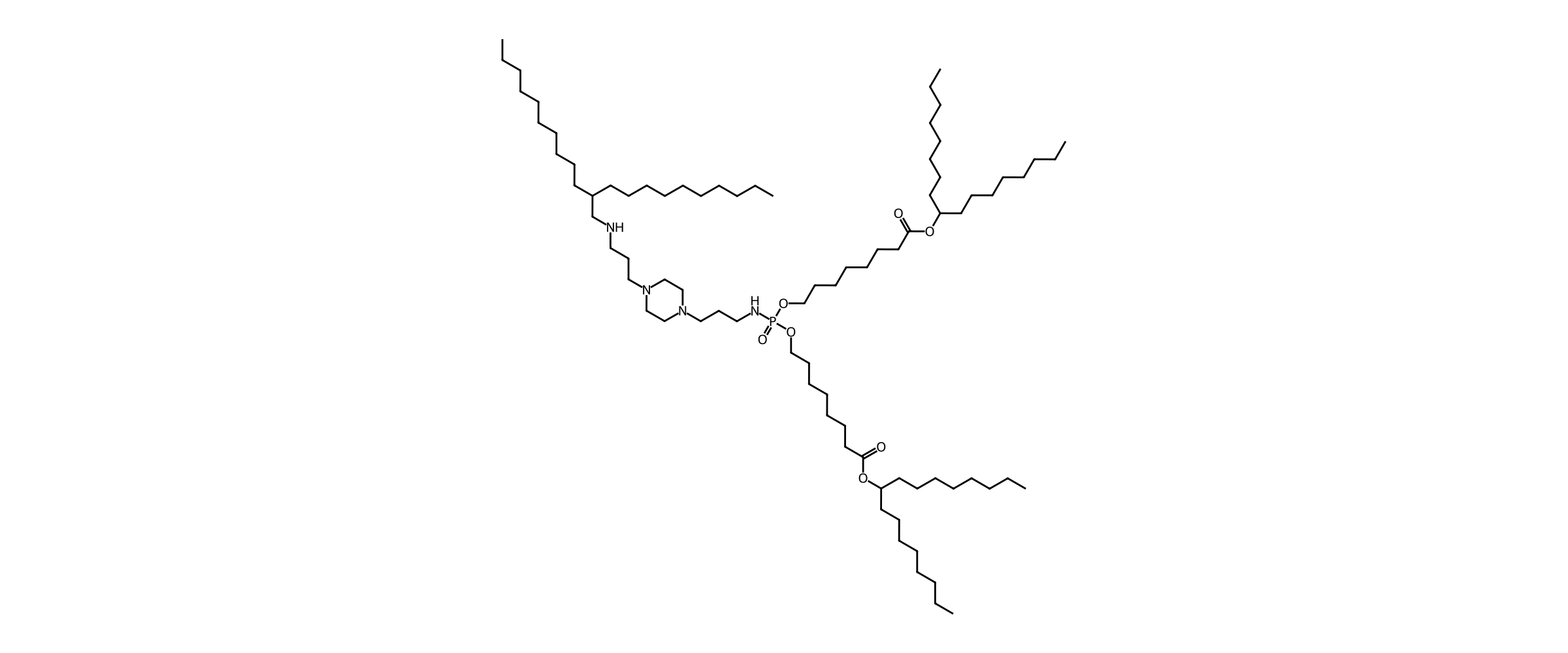
PL41 lipid for research. Confirm price, batch availability and lead time by quotation.
DSPG is additionally required for the cited PL41-PG formulation and is not included in this three-component set. RNA is not included. Component quantities are sales pack sizes, not a premixed formulation.
PL41 is a piperazine-containing phosphoramidate ionizable lipid studied for macrophage mRNA delivery and in situ CAR-M engineering. The optimized PL41-PG LNP contains DSPG and was investigated for TREM2-dependent delivery, receptor degradation and macrophage reprogramming in malignant ascites. Evidence comprises cell assays, mouse models and ex vivo patient-derived samples. Reported nanoparticle activity depends on the full formulation and RNA cargo; DC Chemicals supplies the PL41 lipid for research use.
| CAS No. | Not available |
| Chemical Name | PL41 |
| SMILES | CCCCCCCCCCC(CCCCCCCCCC)CNCCCN1CCN(CCCNP(=O)(OCCCCCCCC(=O)OC(CCCCCCCC)CCCCCCCC)OCCCCCCCC(=O)OC(CCCCCCCC)CCCCCCCC)CC1 |
| Formula | C82H165N4O7P |
| M.Wt | 1350.22 |
| Purity | To be confirmed; request batch COA |
| Storage | Follow the supplied batch storage instructions; request stability and handling information. |
| Shipping condition | Contact us for current shipping conditions |
| Synonyms | PL-41; PL 41; PL41 ionizable lipid |
| Stereochemistry / form | Neutral parent as drawn; no counterion or stereochemical designation. |
| Publication | Yijia Li, Ting Yang, Xiyue Zhang et al. In situ CAR engineering and nanoparticle-mediated TREM2 degradation for macrophage reprogramming in malignant ascites. Nature Materials (2026). DOI: 10.1038/s41563-026-02769-2. |
The reported PL41-PG formulation contains five lipid components. The amounts below refer to 1 µmol of total lipid, not 1 µmol of PL41.
| Component | DC Chemicals product | Molecular weight (g/mol) | Molar ratio (mol%) | Mass at 1 µmol total lipid (mg) |
|---|---|---|---|---|
| PL41 | DCL0029 | 1350.22 | 45 | 0.607599 |
| DSPC | DC57005 | 790.15 | 9 | 0.071114 |
| Cholesterol | DCD-041 | 386.65 | 34.65 | 0.133974 |
| DMG-PEG2000 | DC40169 | 2507 | 1.35 | 0.033845 |
| DSPG | Not uniquely mapped | Salt form not specified | 10 | Requires confirmed molecular weight |
Reported composition: PL41/DSPC/cholesterol/DMG-PEG2000/DSPG = 45:9:34.65:1.35:10 mol% (total 100 mol%). Source: Supplementary Table S1, PDF p. 30 / printed p. 29; main Methods, PDF p. 18. Primary paper and Supplementary Information
Masses are calculated planning values. DMG-PEG2000 uses a nominal average molecular weight of 2507 g/mol. The paper does not specify the DSPG counterion; confirm the supplied form before entering its molecular weight. N/P and RNA dose are not inferred.
Edit total lipid, molecular weights and molar percentages to calculate a research scenario. DSPG molecular weight is left blank until its supplied form is confirmed. Calculated results are not measured study data; editing inputs does not change the cited formulation above.
| Component | Molecular weight (g/mol) | Molar ratio (mol%) | Mass (mg) | Mass % |
|---|---|---|---|---|
| PL41 | ||||
| DSPC | ||||
| Cholesterol | ||||
| DMG-PEG2000 | ||||
| DSPG |
Enter the confirmed DSPG molecular weight and complete all inputs to calculate masses and mass percentages. Missing values are not assumed.
Mass (mg) = total lipid (µmol) × molar fraction × molecular weight (g/mol) ÷ 1000. Mass % = component mass ÷ total component mass × 100.
Microfluidic mixing of aqueous mRNA and ethanol lipid phases at 3:1 by volume. Final mRNA concentration: 0.1 mg/mL. Dialysis overnight at 4 °C against PBS using a 12–14 kDa MWCO membrane. Total mixing flow rate, assembly buffer/pH, N/P and lipid:mRNA mass ratio were not reported in the supplied method.
Source: Methods — Preparation and characterization of LNP formulation (main PDF p. 18).
PL41-PS and PL55-PS were advanced after the healthy-mouse reporter screen (5 µg mRNA per mouse, intraperitoneal, 6 h; n = 5 per group pooled from two experiments). PL41 then gave higher membrane-bound CAR expression than PL55 in mouse BMDM-TAMs and human THP-1-derived M2 macrophages (24 h; n = 3 independent tests).
Source: Main Fig. 2d–g; Supplementary Fig. S6c,d; Methods.
The tested PL41-PS, PL41-PI and PL41-PG formulations were approximately 150–200 nm and achieved approximately 90% mRNA encapsulation. These ranges describe the tested formulations and are not specifications for neat PL41.
Source: Main text; Supplementary Fig. S6g,h.
In the ligand comparison, the 10 mol% PG formulation gave approximately eightfold higher reporter expression in wild-type than Trem2-knockout macrophages. This comparison is WT versus knockout cells, not PL41 versus ALC-0315.
Source: Main Fig. 2i; main text.
PL41-PG LNPs delivered hCLDN18.2-targeting CAR mRNA and supported macrophage reprogramming in mouse malignant-ascites models. The study also examined patient-derived ascites ex vivo. Antitumour findings depend on the RNA-loaded formulation, administration schedule, tumour model and, for combination arms, anti-PD-1 treatment.
Source: Main Figs. 3–6; Extended Data; Methods.
The study evaluated cell viability and mouse tolerability under specified experimental conditions. These preclinical observations do not establish human safety or the safety of other doses, routes or formulations.
Source: Main text and Supplementary Information.
At M.Wt 1350.22 g/mol, 100 mg = 74.06 µmol and 250 mg = 185.16 µmol. These are amount conversions for planning, not a validated LNP scale-up protocol.
Values shown are literature-reported results for the cited formulation and study conditions. They do not guarantee performance of the supplied product in other formulations or experiments. Mouse and ex vivo patient-sample results do not establish clinical safety or efficacy. PL41 lipid is supplied separately from DSPG, helper lipids and RNA.
Yijia Li, Ting Yang, Xiyue Zhang et al. In situ CAR engineering and nanoparticle-mediated TREM2 degradation for macrophage reprogramming in malignant ascites. Nature Materials (2026). DOI: 10.1038/s41563-026-02769-2. Primary paper.
Structure: main Fig. 2h; Supplementary synthesis pp. 21–22 and Fig. S7. Formulation: Supplementary Table S1. Lead comparisons: Fig. 2 and Supplementary Fig. S6.
Molecular weight is prefilled from the product record. Confirm solvent compatibility and solubility before preparation.
Solvent volumes update from the molecular weight above.
| Mass | 1 mM | 5 mM | 10 mM |
|---|---|---|---|
| 10 mg | 7.4062 mL | 1.4812 mL | 0.7406 mL |
| 25 mg | 18.5155 mL | 3.7031 mL | 1.8516 mL |
| 50 mg | 37.0310 mL | 7.4062 mL | 3.7031 mL |
| 100 mg | 74.0620 mL | 14.8124 mL | 7.4062 mL |
| 250 mg | 185.1550 mL | 37.0310 mL | 18.5155 mL |
Contact our team with the catalog number and requested quantity.
Request batch-specific storage, stability and handling instructions. The paper does not establish a shelf life for the supplied neat lipid or its solutions.
DC Chemicals supplies the lipid only. Use laboratory controls appropriate for a research compound; request current safety and quality documentation before use.