
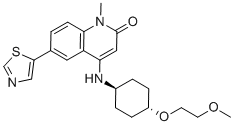
Biological Activity & Performance
| Endpoint | Model / source | Reported finding |
|---|---|---|
| Biochemical potency | Recombinant human CD38; ε-NAD+ hydrolase assay; Fig. 1A [1] | IC50 17.7 nM; n = 3 experiments. |
| Mechanism | Substrate-dependent kinetic analysis; Fig. 1B–C [1] | Reversible, uncompetitive inhibition; apparent Vmax and Km decreased. |
| Cellular target dependence | WT and CD38-knockout mouse embryonic fibroblasts; 0.2 µM, 24 h; Fig. 1E [1] | NAD+ elevation in WT cells supported a CD38-dependent effect; knockout cells provided the genetic comparator. |
| Animal activity | Naturally aged and progeroid mouse models [1] | Tissue NAD+ restoration accompanied improvements in glucose tolerance, muscle/exercise performance and cardiac function. |
| Mechanistic support | NAD+ synthesis inhibition [1] | Blocking NAD+ synthesis reversed physiological benefits, supporting an NAD+-dependent mechanism. |
How to interpret the evidence
Potency depends on assay format. These mouse findings do not establish human anti-aging efficacy.