HX1 is a hydroxyzine-derived ionizable lipid with acetal-containing tails, studied in lipid nanoparticles for brain mRNA delivery and CRISPR–Cas9 delivery. It was the lead in the reported in vivo brain-delivery screen; evidence is preclinical and formulation-dependent.
Reported formulation
Reported molar ratio: HX1 : DOPE : cholesterol : DMG-PEG 2000 = 20 : 30 : 40 : 0.75. These are ratio units, not mol%; their sum is 90.75. Reported ionizable lipid:mRNA mass ratio = 10:1; this is not N/P. The study used microfluidic mixing (INano L/L+, Micro&Nano), with lipids in ethanol and RNA in 10 mM citrate buffer at pH 3.0.
Source: Methods — Formulation of mRNA-loaded LNPs; Dosage of LNP formulations for in vivo evaluations.
Methods not specified
N/P, apparent pKa and mixing flow rates are not specified in the supplied formulation method. No numerical values are assigned here. Particle properties depend on the cargo; the approximately 80 nm diameter described for Cas9 mRNA/sgRNA LNPs is not a universal HX1 particle size.
Experimental evidence
Cellular reporter delivery
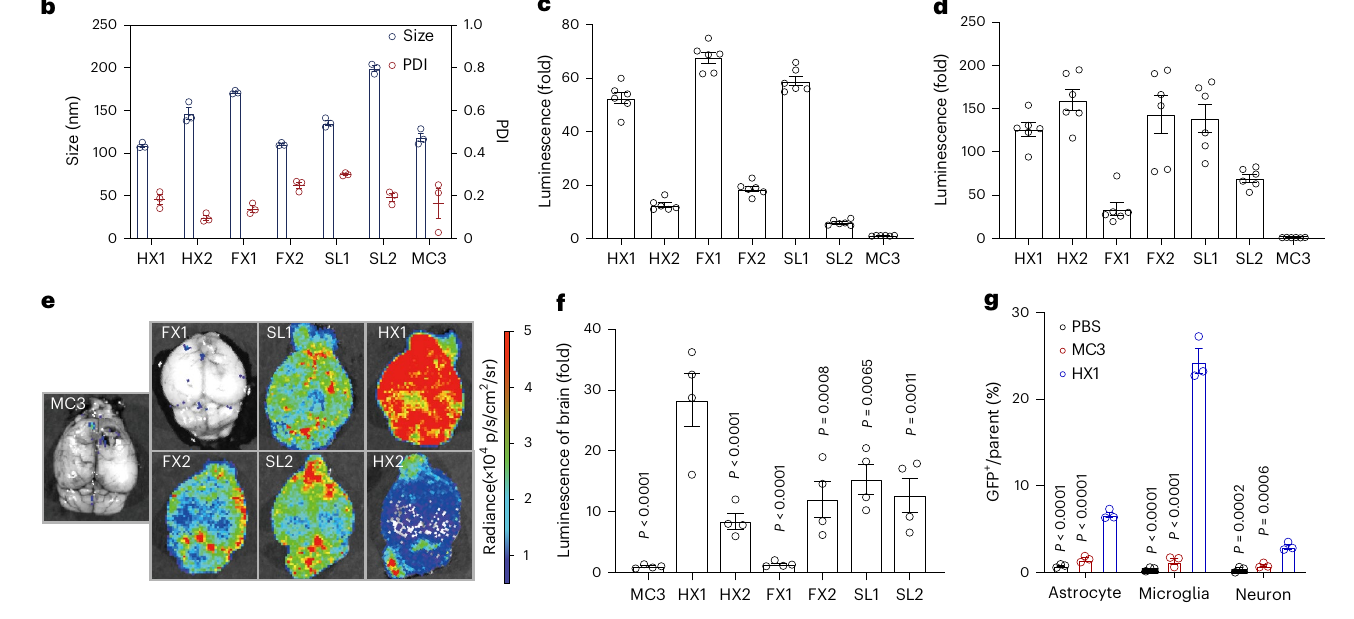
Neuro-2a and bEnd.3 cells; 50 ng Fluc mRNA per 100 µl medium; 20 h incubation. All six tested lipid formulations exceeded the MC3 comparator in these assays. The in vivo endpoint, rather than a universal cell-assay ranking, determined HX1 selection.
Source: Fig. 2c,d; Methods: Luciferase expression assay in cells
Mouse brain reporter delivery
Single intravenous dose of 0.5 mg/kg Fluc mRNA; brain analysis at 6 h; n = 4 biological replicates per group. HX1 LNPs produced the highest brain luminescence in the comparison, nearly 30-fold relative to the study's MC3 LNP formulation. This is a reporter-signal comparison, not a percentage of injected dose entering brain.
Source: Fig. 2e,f; main text p. 4
Brain CRISPR reporter activation
Ai14 mice received Cas9 mRNA:sgRNA at 1:1 by mass, 0.9 mg/kg total RNA per intravenous dose on days 0, 7 and 14; analysis on day 21. The authors reported approximately 14% tdTomato-positive neurons and 48% tdTomato-positive microglia after three doses. These are reporter-positive cell fractions, not direct sequencing-based indel percentages.
Source: Fig. 4; Supplementary Figs. 22–25; main text p. 7
Non-human-primate delivery
One male rhesus macaque received 0.25 mg/kg Fluc mRNA intravenously; tissues were examined at 6 h, with an untreated animal providing control samples. Luciferase expression was detected in brain regions and other organs. This single treated animal is exploratory evidence; spleen and liver signals were relatively high.
Source: Fig. 5; Supplementary Methods and Figs. 26–27
Preventive Il10 mRNA study
Mice received two intravenous injections of Il10 mRNA-loaded LNPs, each 0.5 mg/kg, 24 h and 12 h before 15 Gy whole-brain irradiation. HX1-Il10 LNPs reduced measured inflammatory and tissue-injury endpoints compared with the reported controls. This was prevention before irradiation, not treatment of established brain injury.
Mouse evaluations included 0.5 mg/kg mRNA after a single dose and weekly dosing for three weeks, with serum chemistry, histology and brain inflammatory assessments. The authors reported no apparent toxicity in the measured endpoints; the primate study had one treated animal. These observations do not establish human safety or long-term safety.
Calculated amounts for planning only: 100 mg = 105.84 µmol; 250 mg = 264.60 µmol. At the reported 10:1 ionizable lipid:RNA mass ratio, these correspond to 10 mg and 25 mg RNA respectively. This arithmetic is not a validated scale-up protocol or a pack-size offer.
Evidence limits
HX1 is not a brain-exclusive delivery material: liver and spleen distribution was also observed. Hydroxyzine's approval and safety history do not imply approval or clinical safety of HX1. DC Chemicals supplies the lipid only; literature LNP results depend on the complete formulation, RNA, preparation and experimental conditions and are not guaranteed product performance.
References
1. Meng Tian, Leiming Wang, Zhengwei Liu et al. Rational design of lipid nanoparticles for brain delivery of RNA therapeutics. Nature Nanotechnology (2026). DOI: 10.1038/s41565-026-02326-7.