Formulation components and molecular-weight conversion
Representative Example 1 recipe: ionizable lipid / DSPC / cholesterol / PEGylated lipid = 47.5 : 10 : 40.7 : 1.8 mol%. The source introduces these percentages as an example, not the uniquely identified optimized recipe for every HA-screen compound. Example 1, printed p.63 / PDF p.64
The PEG lipid anchor and grade are not specified. No DMG-PEG2000 identity or PEG molecular weight is assumed. Complete mass percentages require the actual PEG lipid MW. Molecular weights for the new neutral lipids are calculated from the verified structures.
Component mass calculator
Calculated preparation amounts for this representative recipe. Edited inputs create a research scenario; the source table remains unchanged. This tool does not calculate N/P or RNA dose.
Component
Editable MW (g/mol)
Editable mol%
Calculated mass (mg)
Calculated mass %
Acuitas Lipid I-26
—
—
DSPC
—
—
Cholesterol
—
—
PEGylated lipid (identity not specified)
—
—
Example 1 total lipid:mRNA is approximately 10:1–30:1 by mass. Example 8 uses 10:1–40:1 by mass. These values are not N/P ratios.
Reported pKa, LogP and N/P
Table 1 reports the numeric pKa, but its measurement type and exact entry-specific formulation/buffer are not uniquely identified.
Reported pKa: 6.44
General fluorescence sigmoid fitting; excitation 321 nm, emission 445 nm; pKa is the pH at half-maximal fluorescence. Room temperature; SLM Aminco Series 2 luminescence spectrophotometer. Table 1 does not uniquely assign the buffer or sample formulation. Measurement type and formulation association are unassigned.
Reported LogP: 12.4; the table does not state its measurement/calculation method. N/P: not reported. Lipid:RNA mass ratio has not been converted to N/P.
Cell performance
No direct cell-transfection results or lipid cell-transfection protocol is reported in the examined examples. HEp-2 and VERO-TMPRSS2 cells are used in serum neutralization assays, not as demonstrations of LNP transfection.
Each endpoint below belongs to its named cargo, dose, route and formulation context. The screening rank is descriptive and is not a statistical claim of superiority. The HA-screen composition is not uniquely assigned to the representative Example 1 recipe.
Influenza HA antibody response, mean HAI titer
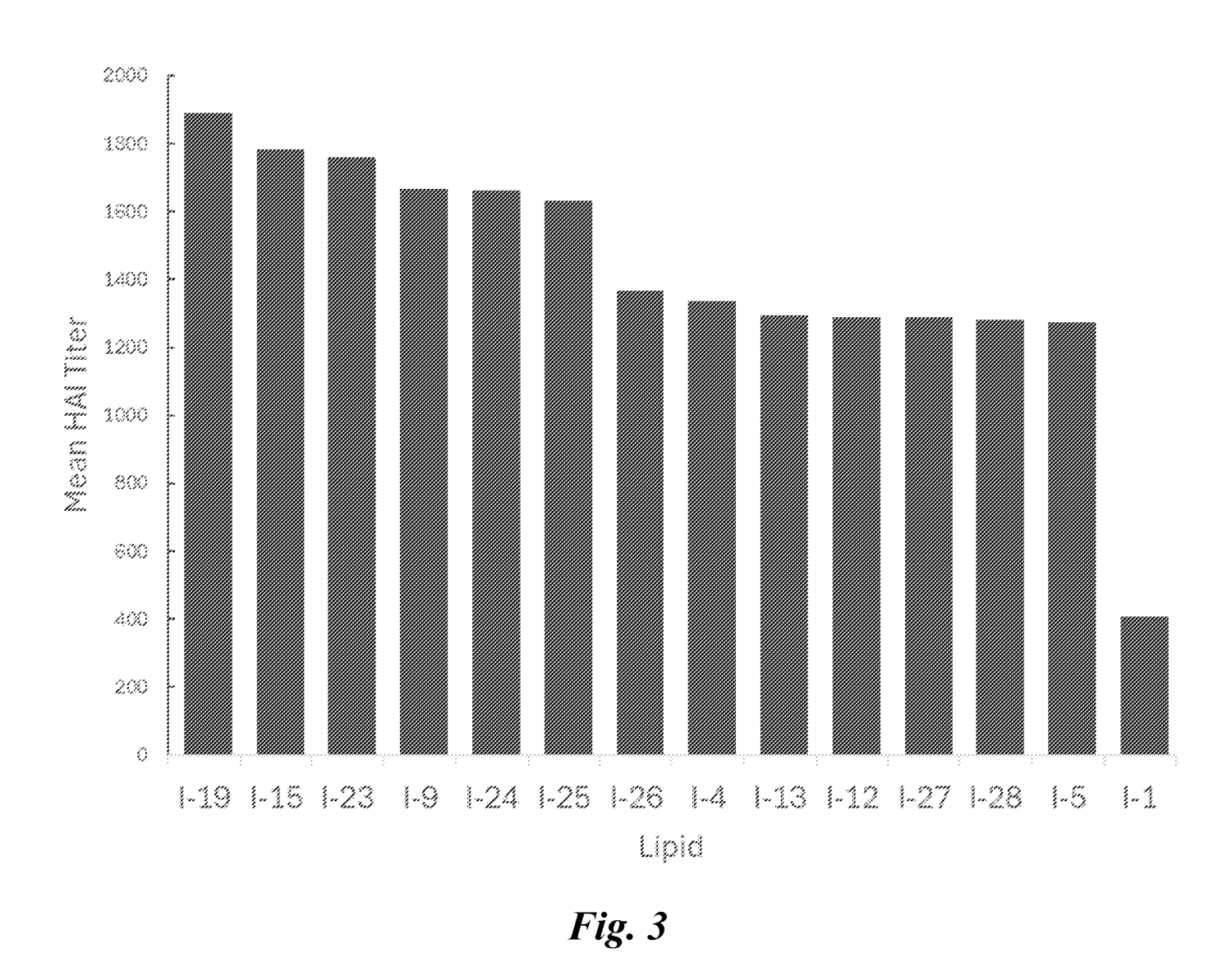
1368
BALB/c mice, n=10/group; Influenza A/Puerto Rico/8/1934 HA mRNA; 0.2 µg mRNA/animal per injection, 30 µL; intramuscular quadriceps; Day 28, 14 days after the day-14 boost; I-1 LNP: mean HAI 408 in this same screen; Reported mean; variability and statistical tests are not provided for this table
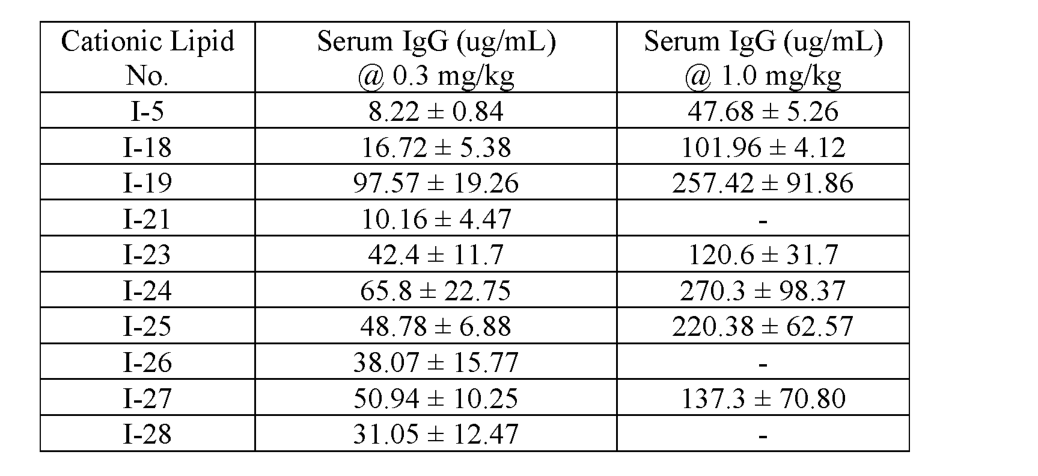
6–8-week CD-1/ICR mice; Human IgG mRNA; 0.3 or 1.0 mg mRNA/kg; see result; intravenous tail vein; 24 h; I-5 LNP in the same table: 8.22 ± 0.84 and 47.68 ± 5.26 µg/mL at 0.3 and 1.0 mg/kg; Mean ± reported spread; n and definition of ± not stated
Compound-specific particle diameter, PDI, encapsulation efficiency and zeta potential are not assigned in the examined characterization table. Values reported for I-4 have not been transferred to this lipid.
Dedicated compound-specific cytotoxicity, repeated-dose tolerability and chronic safety outcomes are not established by these examples. Serum IgG concentration does not identify the transfected organ or cell type.
Original performance figures and source tables
Open each image for the full-size axes and controls. Only the indicated compound row/bar belongs to this product.
Fig.3. Mean HAI titers in the additional 0.2 µg PR8 HA mRNA intramuscular screen; BALB/c n=10/group, 14 days after boost. Read the I-26 bar; I-1 control = 408. The table includes additional compounds not plotted in Fig.3. Source: Original patent figure/table, PDF p.94. Source: Acuitas Therapeutics, WO2025231114A1 (2025). Original patent data, not DC Chemicals measurements.Example 8 source table. Human IgG in mouse serum 24 h after intravenous delivery. Read the I-26 row; a dash is an unreported test point, not zero. Source: Original patent figure/table, PDF p.73. Source: Acuitas Therapeutics, WO2025231114A1 (2025). Original patent data, not DC Chemicals measurements.
Cell experiment protocol
No direct cell-transfection results or lipid cell-transfection protocol is reported in the examined examples. HEp-2 and VERO-TMPRSS2 cells are used in serum neutralization assays, not as demonstrations of LNP transfection.
Example 1 describes a representative LNP preparation with the ionizable lipid, DSPC, cholesterol and an unspecified PEGylated lipid. Its illustrative 47.5:10:40.7:1.8 mol% recipe is not uniquely assigned to every HA-screen sample.
Dilute RNA to 0.2 mg/mL in the stated citrate or acetate buffer. Mix ethanolic lipid with aqueous RNA by syringe pumps at ethanol:aqueous 1:5–1:3 and total flow >15 mL/min. Remove ethanol and exchange into PBS by dialysis; filter through 0.2 µm.
Inject 30 µL of PR8 HA mRNA LNP into the quadriceps at 0.2 µg mRNA per mouse on day 0 and day 14. The additional screening experiment uses 10 BALB/c mice per group; blood sampling in Example 3 is day −1, 13 and 28.
For HAI, treat serum with receptor-destroying enzyme II at 1:4 for 18 h at 37 °C, followed by 30 min at 56 °C. Dilute RDE-treated samples 1:10 in 0.85% NaCl. Check nonspecific agglutination with 1% turkey red blood cells.
Prepare duplicate twofold serum dilutions, 20–40960. Incubate with inactivated PR8 virus at 4 HA units (1:1) for 30 min at room temperature; add 1% turkey red blood cells (1:1) for another 30 min.
Record the highest serum dilution that completely inhibits hemagglutination. The selected screening table reports mean HAI titers 14 days after the boost; do not pool it with the separate earlier GMT experiment.
Lipid stock
Lipids are dissolved in ethanol. Individual lipid-stock concentrations are not reported.
Ionizable lipid, DSPC, cholesterol and PEGylated lipid; ethanol; Organic stock before mixing
RNA aqueous phase
Reported input-phase RNA concentration, not final administration concentration.
PR8 HA mRNA; 10–50 mM citrate, pH 4–6, OR 10–25 mM acetate, pH 4–6; 0.2 mg/mL; RNA aqueous phase before mixing
Mixing and processing
Syringe pumps: ethanol:aqueous 1:5–1:3 (v/v), total flow >15 mL/min; PBS dialysis and 0.2 µm sterile filtration. Individual lipid concentrations and exact selected operating point are not specified.
Ethanolic lipid and aqueous RNA input phases; Total lipid:RNA mass ratio 10:1–30:1; not N/P
Final administration
The RNA dose is reported, but the final LNP/RNA concentration is not stated directly. No concentration has been inferred from the dose.
PR8 HA mRNA LNP; PBS; 0.2 µg mRNA/animal, intramuscular; After dialysis; administration
Study LNP storage and use
The study does not specify LNP storage temperature, storage lifetime or the interval from preparation to injection.
Human IgG mRNA · 0.3 or 1.0 mg mRNA/kg; see result · 6–8-week CD-1/ICR mice
Example 8 specifies ionizable lipid:DSPC:cholesterol:PEGylated lipid 47.5:10:40.7:1.8 mol%. The PEG lipid identity is not specified. Prepare at a total lipid:RNA mass ratio of approximately 10:1–40:1.
Use 0.2 mg/mL RNA in the stated citrate or acetate buffer. Mix ethanol:aqueous 1:5–1:3 at >15 mL/min; dialyze into PBS and sterile-filter at 0.2 µm.
Administer IgG mRNA LNPs by tail vein to 6–8-week CD-1/ICR mice at 0.3 or 1.0 mg mRNA/kg. Collect whole blood 24 h later.
Separate serum at 2000g for 10 min at 4 °C and store at −80 °C until analysis. This is serum-sample storage, not LNP formulation storage.
Dilute serum 100–20000-fold in 1× diluent. Apply 100 µL in duplicate to anti-human IgG plates with standards; incubate at 150 rpm and 25 °C for 45 min.
Wash five times at 400 µL/well, then use HRP conjugate and TMB as described. Stop with 100 µL stop solution and read A450; interpolate against the human IgG standard curve.
Lipid stock
Lipids are dissolved in ethanol. Individual lipid-stock concentrations are not reported.
Ionizable lipid, DSPC, cholesterol and PEGylated lipid; ethanol; Organic stock before mixing
RNA aqueous phase
Reported input-phase RNA concentration, not final administration concentration.
Human IgG mRNA; 10–50 mM citrate, pH 4–6, OR 10–25 mM acetate, pH 4–6; 0.2 mg/mL; RNA aqueous phase before mixing
Mixing and processing
Syringe pumps: ethanol:aqueous 1:5–1:3 (v/v), total flow >15 mL/min; PBS dialysis and 0.2 µm sterile filtration. Individual lipid concentrations and exact selected operating point are not specified.
Ethanolic lipid and aqueous RNA input phases; Total lipid:RNA mass ratio 10:1–40:1; not N/P
Final administration
The RNA dose is reported, but the final LNP/RNA concentration is not stated directly. No concentration has been inferred from the dose.
Human IgG mRNA LNP; PBS; 0.3 or 1.0 mg mRNA/kg; see result; After dialysis; administration
Study LNP storage and use
The study does not specify LNP storage temperature, storage lifetime or the interval from preparation to injection.
Acuitas Therapeutics. Method of Using Lipid Nanoparticles for Intramuscular Delivery. WO2025231114A1, 6 November 2025. Original supplied document · Patent record.
Values shown are literature-reported results for the cited formulation and study conditions. They do not guarantee performance of the supplied product in other formulations or experiments. DC Chemicals supplies the lipid only; RNA and prepared LNPs are not included.