The pooled 65-LNP screen ranked PPZ-A10 among the highest-performing formulations for delivery to liver and splenic immune-cell populations; no lung delivery was observed in the screen.
· PDF pp. 2-5, Fig. 2.sales@dcchemicals.com
PPZ-A10
Formulation & Performance
Literature-reported formulation composition
| Component | mol% | Role |
|---|---|---|
| PPZ-A10 | 35 | Ionizable lipid |
| Cholesterol | 46.5 | Sterol |
| C18PEG2K | 2.5 | PEG lipid |
| DOPE | 16 | Helper phospholipid |
| Reported total | 100 | Source values retained |
Formulation calculator unavailable. The reported four-component composition is complete, but C18PEG2K identity and molecular weight are unresolved. Enter and verify the exact PEG-lipid material before any quantitative weighing. Obtain and verify the complete composition and component molecular weights before planning component quantities.
Literature-reported performance for the cited formulation
Literature-reportedApproximately 60% tdTomato-positive Kupffer cellsLNP-A10, 1 mg/kg IV, 3 days · Other liver and spleen cell populations in the same experimentPDF p. 5, Fig. 3c-d.
Literature-reportedApproximately 50% tdTomato-positive splenic macrophagesLNP-A10, 1 mg/kg IV, 3 days · Other liver and spleen cell populations in the same experimentPDF p. 5, Fig. 3c-d.
Literature-reportedApproximately 30% tdTomato-positive splenic dendritic cells; approximately 20% liver dendritic cellsLNP-A10, 1 mg/kg IV, 3 days · Other measured cell populationsPDF p. 5, Fig. 3c-d.
Literature-reportedDelivery remained measurable at 0.3 mg/kgLNP-A10 Cre mRNA, IV · 1 and 0.5 mg/kg groupsPDF p. 5, Fig. 3e.
Literature-reportedApproximately 25% reduction in GFP protein signal in Kupffer cellsLNP-A10 siGFP versus siLuc, 1 mg/kg · siLuc controlPDF p. 6, Fig. 3f.
Additional reported findings
Literature Data DisclaimerAll formulation parameters and performance values shown in this section are derived from the cited publication and are provided for reference only. These results were obtained using the specific materials, formulation process, cargo, dose, analytical method, model and administration route described in that study. Unless otherwise stated, the data were not generated or independently verified by DC Chemicals. DC Chemicals supplies the lipid compound only and does not guarantee that customers will reproduce the reported LNP properties or biological performance.
The administration route shown above was used in the cited study and is not a clinical-use instruction or recommendation by DC Chemicals.
The administration route shown above was used in the cited study and is not a clinical-use instruction or recommendation by DC Chemicals.
Cited literature for this formulation and performance datasetNi H, Hatit MZC, Zhao K, et al. Piperazine-derived lipid nanoparticles deliver mRNA to immune cells in vivo. Nature Communications. 2022;13:4766. DOI: 10.1038/s41467-022-32281-5
All quantitative claims apply to the cited PPZ-A10 LNP formulations and mouse models, not to the neat lipid alone.
All quantitative claims apply to the cited PPZ-A10 LNP formulations and mouse models, not to the neat lipid alone.
Published study figures
Original publication figures illustrating the cited formulation and biological results. Select an image to view it at full size.
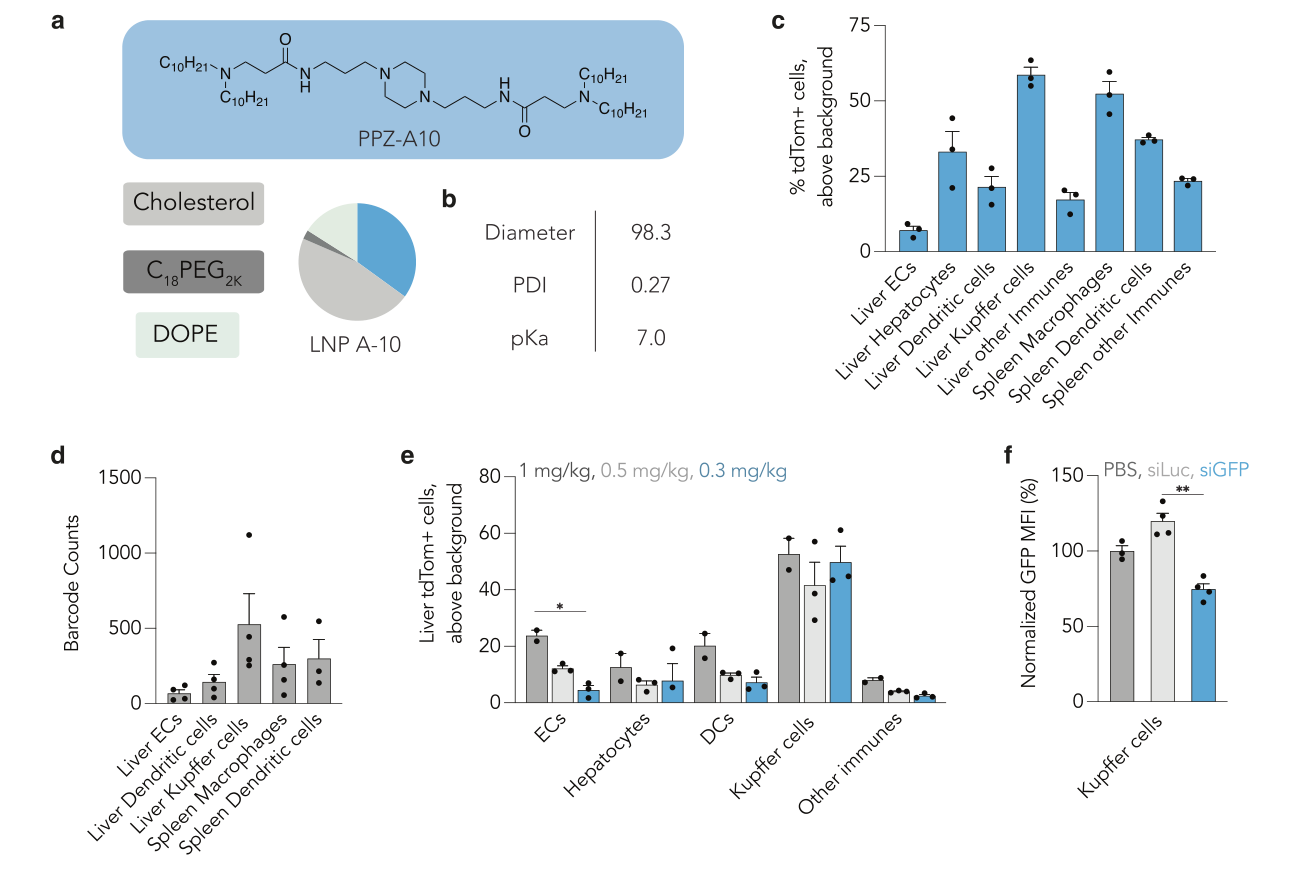
Figure 3a-f — LNP-A10 composition and functional delivery to liver and spleen immune cells
LNP-A10 composition and functional delivery to liver and spleen immune cells. Ai14 mice; Cre mRNA; intravenous administration; 3-day reporter readout; dose-response groups 1, 0.5 and 0.3 mg/kg.
Ni H, Hatit MZC, Zhao K, et al. (2022). Piperazine-derived lipid nanoparticles deliver mRNA to immune cells in vivo. Original article / figure · CC BY 4.0. Complete Figure 3 extracted from page 5 of the author-hosted publisher PDF; surrounding prose/caption omitted. Molecular identity illustration retained; no synthesis or chemical analytical panel is present.