8.82, measured for the complete Lipid 1 LNP using TNS. 10 µM total lipid; 6 µM TNS; pH 3.5–11 in 10 mM HEPES / 10 mM MES / 10 mM ammonium acetate / 130 mM NaCl; excitation 323 nm, emission 435 nm. The value 10.46 belongs to the separate 3,7-diethyl-9-oxabispidine headgroup model; the intrinsic pKa of the full lipid was not experimentally determined because of solubility limitations. Table 1 · TNS method
Oxabispidine Lipid 1 · DCL0052
Formulation & Performance
Oxabispidine Lipid 1 · DCL0052
Oxabispidine-based local pulmonary mRNA delivery
Formulation parameters
| Parameter | Study record |
|---|---|
| Composition | Lipid 1 / cholesterol / DSPC / DMPE-PEG2000 = 50 / 38.5 / 10 / 1.5 mol%. |
| N/P | 3, using the authors’ convention of one ionizable nitrogen per lipid. N/P=5 applies to lipid 2, not this product. |
| Stock solutions | Ionizable lipid: 40 mg/mL ethanol; DSPC/cholesterol/DMPE-PEG2000: 20 mg/mL ethanol. DSPC dissolution assisted at 48°C. |
| Mixing inputs | 12.5 mM total lipid in ethanol; 0.244 mg RNA/mL in 50 mM citrate, pH 3; aqueous:ethanol 3:1, total flow 12 mL/min. |
| Particle characterization | Lipid 1 LNP: number-average diameter 40 nm, Z-average diameter 59 nm, RNA encapsulation 99%, zeta potential +4.90 mV in PBS pH 7.4. PDI is not reported numerically. |
| Lipid:RNA mass ratio | Not reported as a mass ratio; no conversion from N/P is imposed. |
| Scope | Local intratracheal/inhaled delivery. No intravenous lung-targeting or clinical-safety claim is established. |
Main Fig. 1b and Table 1 · SI Methods pp. 3–6
Formulation components and molecular-weight conversion
| Component | DC Chemicals product | Molecular weight (g/mol) | Molar composition | Mass at 1 µmol total lipid (mg) |
|---|---|---|---|---|
| Oxabispidine Lipid 1 | DCL0052 | 777.273 | 50 mol% | 0.388637 |
| DSPC | DC57005 | 790.145 | 10 mol% | 0.079015 |
| Cholesterol | DCD-041 | 386.65 | 38.5 mol% | 0.148860 |
| DMPE-PEG2000 (SUNBRIGHT PM-020CN) | DC65770 · confirm grade/MW | Not established for study grade | 1.5 mol% | Not calculated |
The complete molar allocation is reported, so supported individual masses are calculated. DMPE-PEG2000 is the phospholipid conjugate, distinct from DMG-PEG2000. Its study-grade whole-conjugate average MW is not established; the PEG-segment label 2000 is not used as the full MW. Main formulation and SI Methods
Component mass calculator
Complete the unverified DMPE-PEG2000 MW only as an explicitly edited research scenario. Reset restores the unknown source value to blank; no default complete mass percentages are supplied.
| Component | MW (g/mol) | mol% | Mass (mg) | Mass % |
|---|---|---|---|---|
| Oxabispidine Lipid 1 | — | — | ||
| DSPC | — | — | ||
| Cholesterol | — | — | ||
| DMPE-PEG2000 (SUNBRIGHT PM-020CN) | — | — |
LNP apparent pKa
Cell performance
No cultured-cell transfection experiment or standalone cell protocol for compound 1 is reported in the examined main paper and SI. Lung IHC is an animal tissue endpoint.
Animal performance and tolerability
Instillation and inhalation use different protocols and exposure; their values are not pooled. BALF cell counts and short-term observations are limited tolerability endpoints, not comprehensive safety validation.
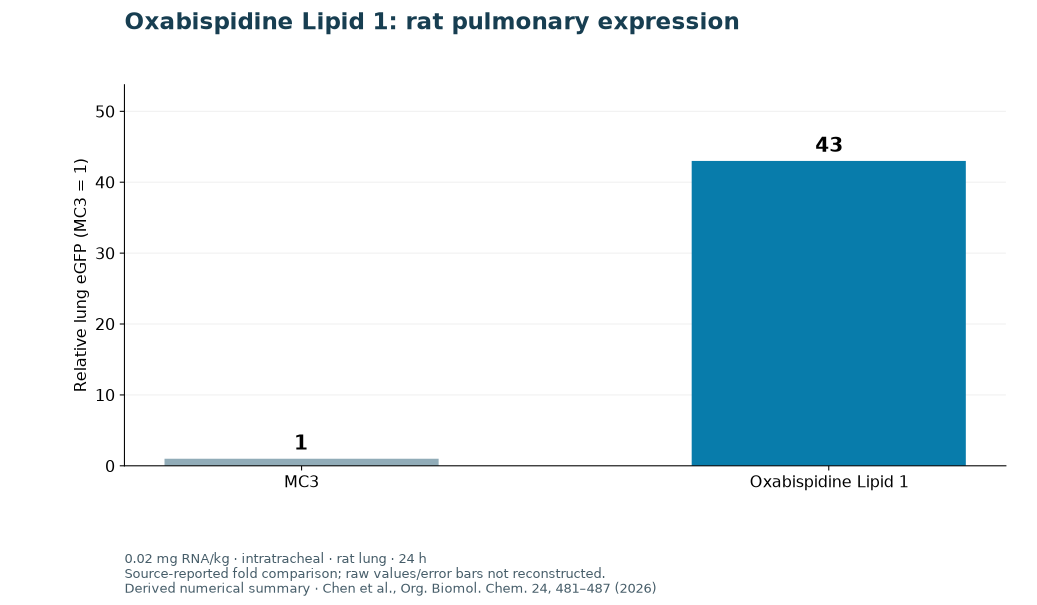
Lung eGFP protein expression · Lipid 1 LNP: 0.02 mg/kg intratracheal screen
43-fold higher than MC3 LNP.
Approximately 10-week-old male Wistar Han rats; 0.02 mg mRNA/kg, single dose; Intratracheal instillation; 24 h; comparator: MC3 LNP; Lipid 5 and lipids 2/3 are separate comparators. n=4 rats per formulation.
BALF inflammatory response · Lipid 1 LNP: 0.02 mg/kg intratracheal screen
Neutrophils increased above PBS and were lower than the MC3 response in the reported comparison; not an absence of inflammation.
Approximately 10-week-old male Wistar Han rats; 0.02 mg mRNA/kg; Intratracheal instillation; 24 h; comparator: PBS and the source LNP comparators. n=4 rats per formulation.
Lung tissue IHC · Lipid 1 LNP: 0.02 mg/kg intratracheal screen
eGFP staining was localized to morphologically identified macrophages and type 1 epithelial cells; not a cultured-cell or definitive cell-tropism assay.
Approximately 10-week-old male Wistar Han rats; 0.02 mg mRNA/kg; Intratracheal instillation; 24 h; comparator: Source IHC comparison. n=4 rats per formulation.
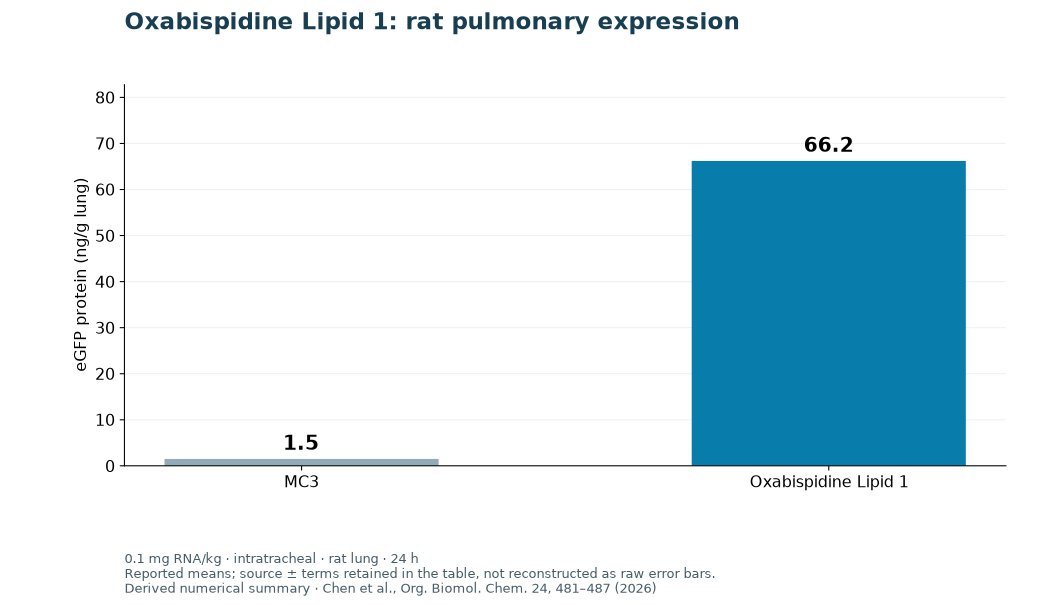
Lung eGFP at higher instillation dose · Lipid 1 LNP: 0.1 mg/kg intratracheal study
66.2 ± 4.9 ng/g lung; MC3 1.5 ± 0.2 ng/g lung.
Approximately 10-week-old male Wistar Han rats; 0.1 mg mRNA/kg; Intratracheal instillation; 24 h; comparator: MC3 and PBS. Group size not restated in Supplemental Table 1; preserve ± exactly as reported.
BALF neutrophils at higher instillation dose · Lipid 1 LNP: 0.1 mg/kg intratracheal study
Lipid 1: 400,000 ± 49,500; MC3: 566,300 ± 61,000; PBS: 287,500 ± 71,300.
Approximately 10-week-old male Wistar Han rats; 0.1 mg mRNA/kg; Intratracheal instillation; 24 h; comparator: MC3 and PBS. Uncertainty type/group size not specified in this table; values not repurposed as 0.02 mg/kg results.
Lung eGFP after nebulized inhalation · Lipid 1 LNP: 0.02 mg/kg reported lung dose by inhalation
0.377 ± 0.02 ng/g lung.
Approximately 10-week-old male Wistar Han rats; Reported lung dose 0.02 mg mRNA/kg; feed 0.5 mg RNA/mL for 60 min; Nebulized inhalation; 24 h; comparator: PBS; no MC3 inhalation value is given in Supplemental Table 1. n=4 rats per formulation.
BALF neutrophils after inhalation · Lipid 1 LNP: 0.02 mg/kg reported lung dose by inhalation
Lipid 1 and PBS each 126,250 ± 20,246 as tabulated; no increase relative to PBS in this experiment.
Approximately 10-week-old male Wistar Han rats; Reported lung dose 0.02 mg mRNA/kg; Nebulized inhalation; 24 h; comparator: PBS. n=4 rats per formulation.
Particle integrity during nebulization · Lipid 1 LNP: 0.02 mg/kg reported lung dose by inhalation
Number-average size was retained, while increased Z-average size and lower encapsulation indicated a minority of larger particles / partial physical instability.
Approximately 10-week-old male Wistar Han rats; 0.5 mg RNA/mL nebulizer feed; Vibrating-mesh nebulization; Before/after nebulization; comparator: Before versus after nebulization. Physical characterization; replicate count not specified in the caption.
Source-linked performance figures
New plots of verified reported numerical values are labelled as derived; original graphics, IHC and statistical annotations remain at the source links.
Cell experiment protocol
No cultured-cell transfection experiment or standalone cell protocol for compound 1 is reported in the examined main paper and SI. Lung IHC is an animal tissue endpoint.
Animal experiment protocols
Detailed source stock/mixing conditions are retained. Final instillation volume/concentration and the inconsistent early inhalation timepoint/nebulizer unit remain unresolved; no values are silently invented.
Lipid 1 LNP: 0.02 mg/kg intratracheal screen · Lipid 1 LNP: 0.02 mg/kg intratracheal screen
Approximately 10-week-old male Wistar Han rats. Cargo: CleanCap eGFP mRNA, 996 nt, 5-methoxyuridine modified. Dose: 0.02 mg mRNA/kg. Controls: PBS, MC3 and other LNP controls are assay-specific; no MC3 inhalation efficacy is provided.
Main comparisons n=4 rats/formulation; no per-test statistical method specified.
- Dissolve ionizable lipid stock in ethanol at 40 mg/mL; dissolve cholesterol, DSPC and DMPE-PEG2000 separately at 20 mg/mL. Assist DSPC dissolution at 48°C with vortexing and use clear solutions.
- Prepare the ICL/cholesterol/DSPC/DMPE-PEG2000 mixture at 50/38.5/10/1.5 mol% and 12.5 mM total lipid in ethanol.
- Thaw eGFP mRNA stock for 30 min at room temperature. Dilute with nuclease-free water and citrate to 50 mM citrate, pH 3, and 0.244 mg RNA/mL for N/P=3. The paper uses a one-ionizable-nitrogen-per-lipid convention; do not double the N/P because the head contains two amines.
- Mix aqueous RNA and ethanolic lipids at 3:1 volume ratio, total flow 12 mL/min, using the source microfluidic platform. Filter through 0.22 µm Supor membrane, dialyze against PBS pH 7.4 and concentrate by Amicon centrifugal filtration at 3000 rpm.
- Use approximately 10-week-old male Wistar Han rats, acclimatized at least five days.
- Under isoflurane anesthesia, position rats supine at a 30–40° angle and administer eGFP LNP intratracheally by the described modified cannula, at 0.02 mg mRNA/kg.
- Monitor clinical signs and body weight; collect lung tissue and BAL 24 h after dosing. Measure tissue eGFP by ELISA, BAL differential cell counts with the SYSMEX analyzer, and IHC on the left lung.
- For BAL, instill and recover 4 mL PBS twice, centrifuge cold lavage at 1200 rpm for 10 min at 4°C, resuspend the cell pellet in 0.5 mL PBS and process immediately for cell counting.
Lipid stock / organic phase
Individual source stocks, not final-treatment concentrations.
Oxabispidine Lipid 1; Ethanol; 40; mg/mL; ICL stock
Cholesterol; Ethanol; 20; mg/mL; Helper stock
DSPC; Ethanol; 20; mg/mL; Helper stock; 48°C water bath/vortex to assist dissolution; use clear solution only
DMPE-PEG2000; Ethanol; 20; mg/mL; PEG-lipid stock
RNA aqueous input
Use the source N/P=3 RNA input, not the N/P=5 value for lipid 2.
CleanCap EGFP mRNA (5moU); 50 mM citrate, pH 3; 0.244; mg/mL; RNA input phase for N/P=3; prepare immediately before mixing
Mixing and processing
Total flow and organic lipid molarity are reported; individual concentrations after mixing are not given.
Combined lipid mixture; Ethanol; 12.5; mM; Total lipid concentration in organic input
RNA aqueous input; 50 mM citrate, pH 3; 0.244; mg/mL; Aqueous:ethanol 3:1; total flow 12 mL/min
Final treatment / dose
The RNA mass/kg is reported; the instilled formulation volume and final RNA concentration are not reported.
eGFP mRNA LNP; PBS after dialysis; 0.02 mg mRNA/kg; Intratracheal bolus
Preparation, storage and use
Source-specific preparation/use conditions, not a supplied-pure-lipid shelf-life claim.
mRNA stock stored at −80°C; thaw at room temperature for 30 min. Use the citrate RNA dilution immediately after mixing. For 4°C LNP storage dialyze overnight in PBS; for −80°C storage dialyze for at least 4 h; concentrate by 3000 rpm centrifugal filtration as described.
SI Methods pp. 3–6; main pp. 2–5; Supplemental Table 1 for 0.1 mg/kg
Lipid 1 LNP: 0.1 mg/kg intratracheal study · Lipid 1 LNP: 0.1 mg/kg intratracheal study
Approximately 10-week-old male Wistar Han rats. Cargo: CleanCap eGFP mRNA, 996 nt, 5-methoxyuridine modified. Dose: 0.1 mg mRNA/kg. Controls: PBS, MC3 and other LNP controls are assay-specific; no MC3 inhalation efficacy is provided.
Main comparisons n=4 rats/formulation; no per-test statistical method specified.
- Dissolve ionizable lipid stock in ethanol at 40 mg/mL; dissolve cholesterol, DSPC and DMPE-PEG2000 separately at 20 mg/mL. Assist DSPC dissolution at 48°C with vortexing and use clear solutions.
- Prepare the ICL/cholesterol/DSPC/DMPE-PEG2000 mixture at 50/38.5/10/1.5 mol% and 12.5 mM total lipid in ethanol.
- Thaw eGFP mRNA stock for 30 min at room temperature. Dilute with nuclease-free water and citrate to 50 mM citrate, pH 3, and 0.244 mg RNA/mL for N/P=3. The paper uses a one-ionizable-nitrogen-per-lipid convention; do not double the N/P because the head contains two amines.
- Mix aqueous RNA and ethanolic lipids at 3:1 volume ratio, total flow 12 mL/min, using the source microfluidic platform. Filter through 0.22 µm Supor membrane, dialyze against PBS pH 7.4 and concentrate by Amicon centrifugal filtration at 3000 rpm.
- Use approximately 10-week-old male Wistar Han rats, acclimatized at least five days.
- Under isoflurane anesthesia, position rats supine at a 30–40° angle and administer eGFP LNP intratracheally by the described modified cannula, at 0.1 mg mRNA/kg.
- Monitor clinical signs and body weight; collect lung tissue and BAL 24 h after dosing. Measure tissue eGFP by ELISA, BAL differential cell counts with the SYSMEX analyzer, and IHC on the left lung.
- For BAL, instill and recover 4 mL PBS twice, centrifuge cold lavage at 1200 rpm for 10 min at 4°C, resuspend the cell pellet in 0.5 mL PBS and process immediately for cell counting.
Lipid stock / organic phase
Individual source stocks, not final-treatment concentrations.
Oxabispidine Lipid 1; Ethanol; 40; mg/mL; ICL stock
Cholesterol; Ethanol; 20; mg/mL; Helper stock
DSPC; Ethanol; 20; mg/mL; Helper stock; 48°C water bath/vortex to assist dissolution; use clear solution only
DMPE-PEG2000; Ethanol; 20; mg/mL; PEG-lipid stock
RNA aqueous input
Use the source N/P=3 RNA input, not the N/P=5 value for lipid 2.
CleanCap EGFP mRNA (5moU); 50 mM citrate, pH 3; 0.244; mg/mL; RNA input phase for N/P=3; prepare immediately before mixing
Mixing and processing
Total flow and organic lipid molarity are reported; individual concentrations after mixing are not given.
Combined lipid mixture; Ethanol; 12.5; mM; Total lipid concentration in organic input
RNA aqueous input; 50 mM citrate, pH 3; 0.244; mg/mL; Aqueous:ethanol 3:1; total flow 12 mL/min
Final treatment / dose
The RNA mass/kg is reported; the instilled formulation volume and final RNA concentration are not reported.
eGFP mRNA LNP; PBS after dialysis; 0.1 mg mRNA/kg; Intratracheal bolus
Preparation, storage and use
Source-specific preparation/use conditions, not a supplied-pure-lipid shelf-life claim.
mRNA stock stored at −80°C; thaw at room temperature for 30 min. Use the citrate RNA dilution immediately after mixing. For 4°C LNP storage dialyze overnight in PBS; for −80°C storage dialyze for at least 4 h; concentrate by 3000 rpm centrifugal filtration as described.
SI Methods pp. 3–6; main pp. 2–5; Supplemental Table 1 for 0.1 mg/kg
Lipid 1 LNP: 0.02 mg/kg reported lung dose by inhalation · Lipid 1 LNP: 0.02 mg/kg reported lung dose by inhalation
Approximately 10-week-old male Wistar Han rats. Cargo: CleanCap eGFP mRNA, 996 nt, 5-methoxyuridine modified. Dose: 0.02 mg mRNA/kg reported lung dose. Controls: PBS, MC3 and other LNP controls are assay-specific; no MC3 inhalation efficacy is provided.
Main comparisons n=4 rats/formulation; no per-test statistical method specified.
- Dissolve ionizable lipid stock in ethanol at 40 mg/mL; dissolve cholesterol, DSPC and DMPE-PEG2000 separately at 20 mg/mL. Assist DSPC dissolution at 48°C with vortexing and use clear solutions.
- Prepare the ICL/cholesterol/DSPC/DMPE-PEG2000 mixture at 50/38.5/10/1.5 mol% and 12.5 mM total lipid in ethanol.
- Thaw eGFP mRNA stock for 30 min at room temperature. Dilute with nuclease-free water and citrate to 50 mM citrate, pH 3, and 0.244 mg RNA/mL for N/P=3. The paper uses a one-ionizable-nitrogen-per-lipid convention; do not double the N/P because the head contains two amines.
- Mix aqueous RNA and ethanolic lipids at 3:1 volume ratio, total flow 12 mL/min, using the source microfluidic platform. Filter through 0.22 µm Supor membrane, dialyze against PBS pH 7.4 and concentrate by Amicon centrifugal filtration at 3000 rpm.
- Use male Wistar Han rats, approximately 10 weeks old, acclimatized at least five days and conditioned for inhalation restraint for up to five days.
- Load 5.6 mL LNP/vehicle into the Aerogen Solo vibrating mesh nebulizer and use the source inhalation tower. Main text specifies 0.5 mg RNA/mL over 60 min and a reported lung dose of 0.02 mg RNA/kg. The printed SI flow-rate unit is unresolved and is not silently corrected.
- At 24 h collect lung tissue for eGFP ELISA and BAL for total/differential cell counts. The earlier endpoint is inconsistent between main text (6 h) and Fig. 2 caption (5 h); the consistent 24 h endpoint is used here.
- For BAL, instill and recover 4 mL PBS twice, centrifuge cold lavage at 1200 rpm for 10 min at 4°C, resuspend the cell pellet in 0.5 mL PBS and process immediately for cell counting.
Lipid stock / organic phase
Individual source stocks, not final-treatment concentrations.
Oxabispidine Lipid 1; Ethanol; 40; mg/mL; ICL stock
Cholesterol; Ethanol; 20; mg/mL; Helper stock
DSPC; Ethanol; 20; mg/mL; Helper stock; 48°C water bath/vortex to assist dissolution; use clear solution only
DMPE-PEG2000; Ethanol; 20; mg/mL; PEG-lipid stock
RNA aqueous input
Use the source N/P=3 RNA input, not the N/P=5 value for lipid 2.
CleanCap EGFP mRNA (5moU); 50 mM citrate, pH 3; 0.244; mg/mL; RNA input phase for N/P=3; prepare immediately before mixing
Mixing and processing
Total flow and organic lipid molarity are reported; individual concentrations after mixing are not given.
Combined lipid mixture; Ethanol; 12.5; mM; Total lipid concentration in organic input
RNA aqueous input; 50 mM citrate, pH 3; 0.244; mg/mL; Aqueous:ethanol 3:1; total flow 12 mL/min
Final treatment / dose
Inhalation feed concentration is reported; the 0.02 mg/kg lung dose is a study-reported estimate, not calculated from the stock table.
eGFP mRNA LNP; Study LNP after dialysis; 0.5; mg/mL; Reported lung dose 0.02 mg mRNA/kg; Nebulizer feed for 60 min
Preparation, storage and use
Source-specific preparation/use conditions, not a supplied-pure-lipid shelf-life claim.
mRNA stock stored at −80°C; thaw at room temperature for 30 min. Use the citrate RNA dilution immediately after mixing. For 4°C LNP storage dialyze overnight in PBS; for −80°C storage dialyze for at least 4 h; concentrate by 3000 rpm centrifugal filtration as described.
SI Methods pp. 3–6; main pp. 2–5; Supplemental Table 1 for 0.1 mg/kg
Reference and scope
Chen CH, Dane EL, Oag S, et al. Oxabispidine-derived ionizable lipids for effective mRNA delivery to the lungs using lipid nanoparticles. Organic & Biomolecular Chemistry 24, 481–487 (2026). DOI: 10.1039/D5OB01888A · Supplementary Information.
Values shown are literature-reported results for the cited formulation and study conditions. They do not guarantee performance of the supplied product in other formulations or experiments. DC Chemicals supplies the lipid only; RNA and prepared LNPs are not included.