EEE32 · DCL0035Formulation & Performance
Formulation & Performance
The study uses EEE and oligonucleotide cell treatments. No LNP assembly recipe, component molar ratios, N/P or lipid:RNA ratio applies to these assays. No study-prefilled lipid component calculator is provided.
| N/P | Not applicable: cell co-treatment |
| Lipid:RNA | Not applicable: cell co-treatment |
Cell experiment protocol
Stock preparation and final well volume are incompletely reported; this is a partial literature method.
SSO and cell-tolerance assays
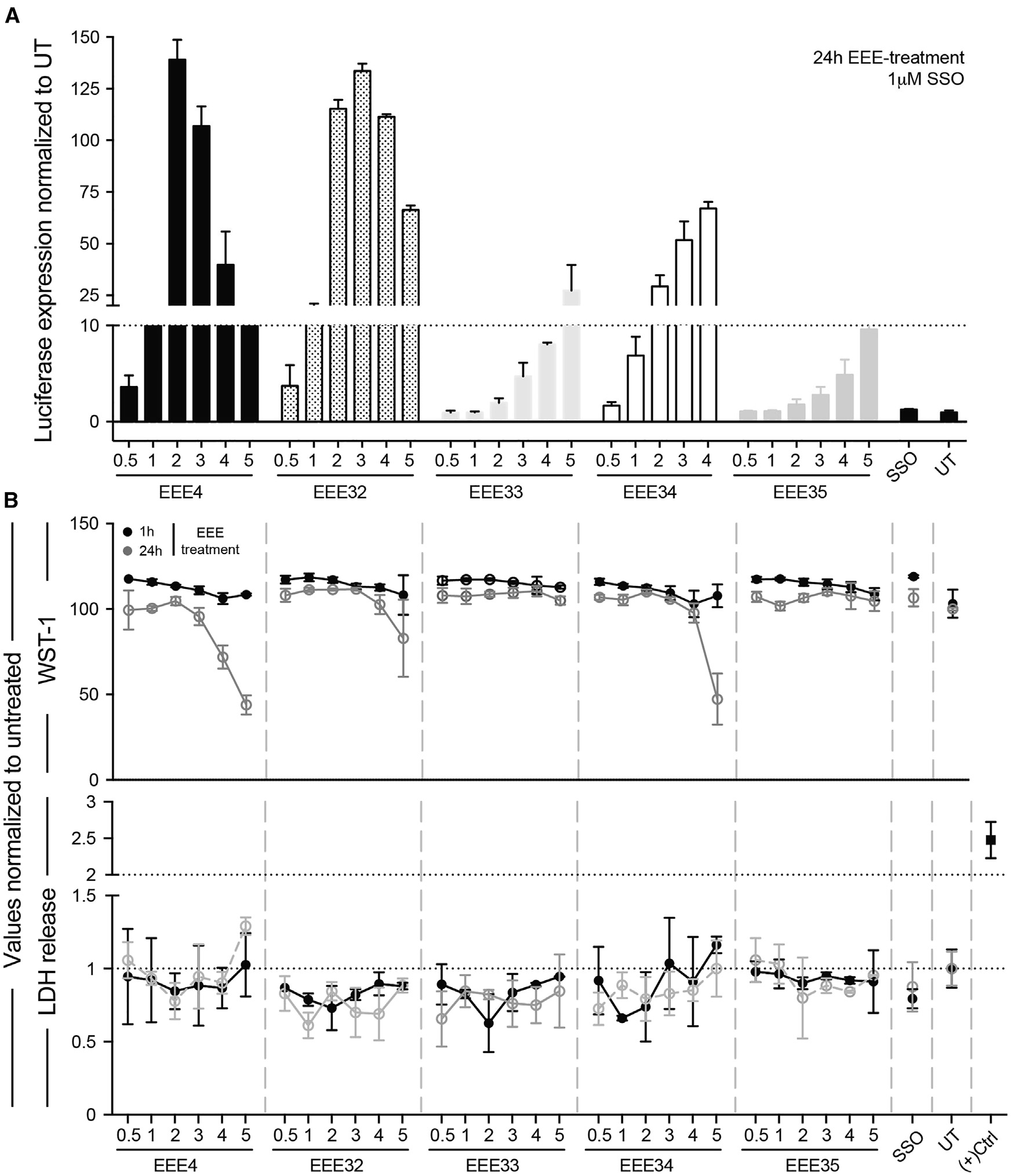
- Culture HeLa_Luc705 in DMEM + 10% FBS; seed 10000 cells/well in 96-well plates. The general method uses 24-h SSO pretreatment; Figure 3A uses 1 µM SSO.
- Apply EEE32 at the Figure 3 concentrations (0.5-5 µM). Figure 3A displays a 24-h EEE readout; toxicity was examined separately at 1 and 24 h.
- PBS rinse; lyse in 30 µL 0.1% Triton X-100. Add 30 µL luciferin substrate and read with GloMax: 10-s exposure, 2-s delay. SSO-only and untreated controls are retained; the general LF2000 positive control uses 100-200 nM SSO.
- Measure conditioned-medium LDH with a 0.1% Triton positive control, and WST-1 with the reported 4-h preincubation (420-480 nm). Normalize to untreated control.
EEE stockEEE stock solvent and concentration were not reported.
RNA aqueous phase705-SSO was supplied/stored in IDTE (10 mM Tris, 0.1 mM EDTA); stock oligonucleotide concentration was not reported.
Mixing and dilutionCell treatment; no LNP organic/aqueous mixing or assembly procedure.
Final treatment / administrationFinal concentrations are given in the protocol below. Final treatment volume per well was not reported.
EEE32: 0.5-5 µM · DMEM + 10% FBS Storage and useEEE stock storage temperature, shelf life and freeze-thaw conditions were not reported.
Materials and methods, Oligonucleotide therapeutics functional delivery assessment, Splice-switching oligonucleotide; Cell toxicity assays; Figure 3A-B · Estupiñán et al., 2025 · DOI: 10.1016/j.omtn.2025.102522
MALAT1 antisense assay
- Culture N2a in DMEM + 10% FBS; seed 20000 cells/well in 96-well plates.
- Cotreat the Figure 4C MALAT1 gapmer series with EEE32 2.5 µM for 24 h.
- Extract RNA (Maxwell RSC simplyRNA), quantify (Quant-iT), generate cDNA and perform TaqMan qPCR; use 36B4 as housekeeping control. Compare with gapmer alone.
EEE stockEEE stock solvent and concentration were not reported.
RNA aqueous phaseOligonucleotide stock solvent/buffer and stock concentration were not reported.
Mixing and dilutionCell treatment; no LNP organic/aqueous mixing or assembly procedure.
Final treatment / administrationFinal concentrations are given in the protocol below. Final treatment volume per well was not reported.
EEE32: 2.5 µM · DMEM + 10% FBS Storage and useEEE stock storage temperature, shelf life and freeze-thaw conditions were not reported.
Materials and methods, Antisense oligonucleotide; Results, EEE32 as a multimodal oligonucleotide therapeutics enhancer; Figure 4C · Estupiñán et al., 2025 · DOI: 10.1016/j.omtn.2025.102522
Primary hepatocyte siRNA assay
- Day 0: plate BioIVT QNT primary human hepatocytes on rat-tail collagen I-coated 96-well plates, using Williams E Medium and thawing/plating supplements.
- Maintain in Williams E Medium + CM4000 and 5C (DAPT, SB431542, forskolin, IWP2, LDN193189), at 37 °C/5% CO2. Seeding density and exact supplement concentrations were not specified.
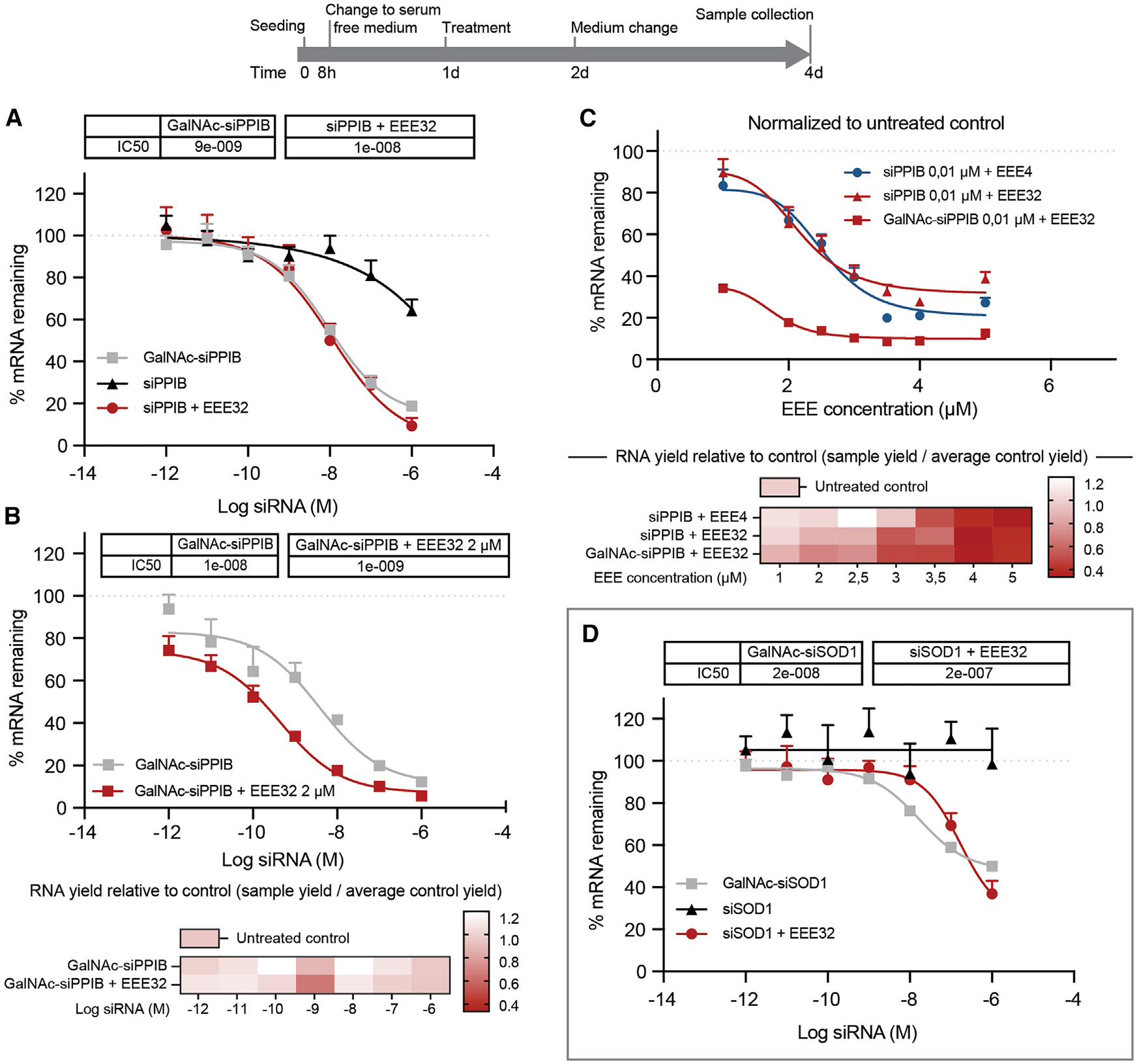
- Day 1: treat with the study-specific PPIB/SOD1 duplex or GalNAc-siRNA and 2 µM EEE. Figure 5C is a separate 10-nM siPPIB/EEE titration. EEE4 evidence is limited to that comparison.
- Change medium at 24 h. Methods specify day-4 harvest (72 h after treatment start); the Figure 5 caption states 48 h.
- Extract RNA (RNeasy Micro), generate cDNA, quantify PPIB/SOD1 by TaqMan qPCR with GAPDH control. Include siRNA-only, GalNAc-siRNA and untreated/PBS controls; monitor RNA yield.
EEE stockEEE stock solvent and concentration were not reported.
RNA aqueous phaseOligonucleotide stock solvent/buffer and stock concentration were not reported.
Mixing and dilutionCell treatment; no LNP organic/aqueous mixing or assembly procedure.
Final treatment / administrationFinal concentrations are given in the protocol below. Final treatment volume per well was not reported.
EEE32: 2 µM · Williams E + CM4000 + 5C Storage and useEEE stock storage temperature, shelf life and freeze-thaw conditions were not reported.
Materials and methods, siRNA; Results, EEE32 as a multimodal oligonucleotide therapeutics enhancer; Figure 5A-D · Estupiñán et al., 2025 · DOI: 10.1016/j.omtn.2025.102522